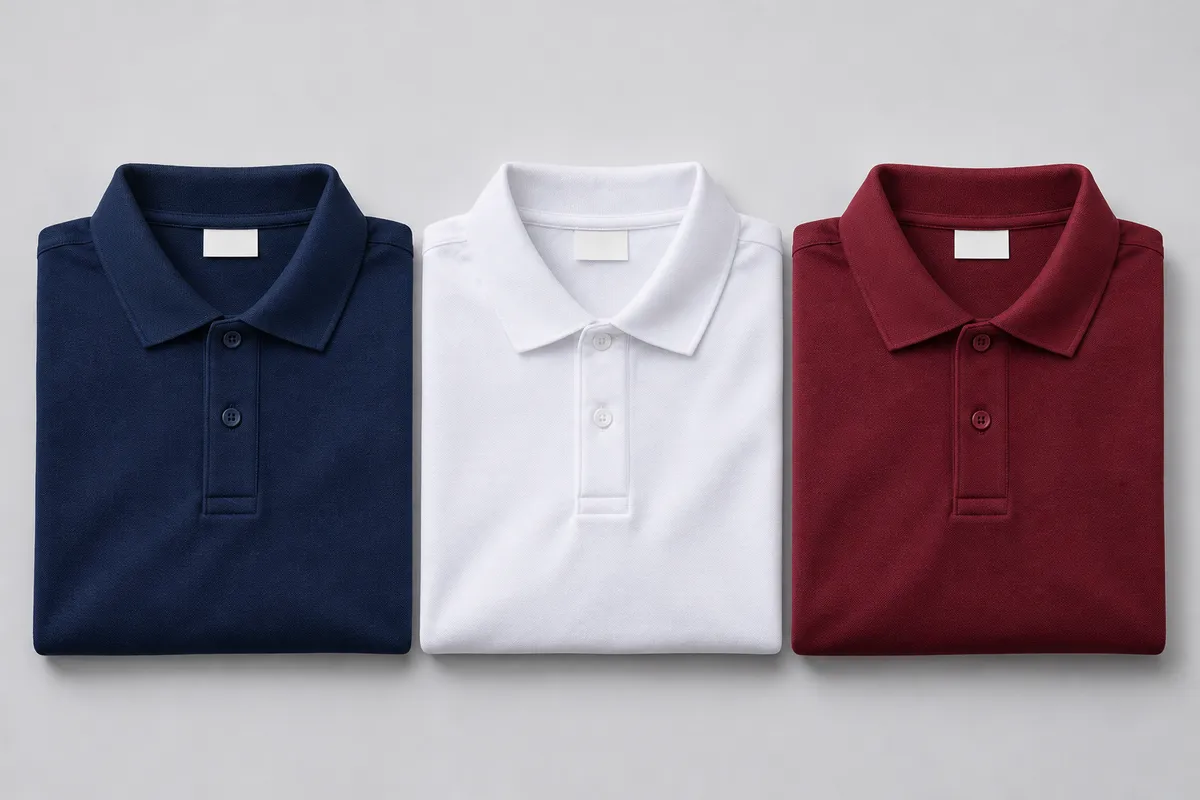
Polo collar curling happens when the knitted rib collar loses its flat shape and its points flip up or its edge waves. The causes are usually a collar knitted or sewn under tension, a yarn that relaxes unevenly when washed, or heat from tumble drying and ironing. Good collar construction and sensible care keep a school polo collar lying flat for longer.
Because the collar is the part of a polo seen above a sweatshirt all winter, a curling collar makes a polo look old long before the body wears out.
What makes a polo collar curl?
A flat-knit collar is a rib fabric with a natural tendency to roll at its edges. It stays flat because of how it is knitted, finished and sewn. When one of those steps is off, the collar starts to move.
| Cause | What you see | How it is reduced |
|---|---|---|
| Collar stretched while sewing | Wavy outer edge | Sewing the collar to the neck without pulling it |
| Collar too long for the neck | Ripples along the edge | Correct collar length for each size |
| Uneven yarn tension in knitting | One point curls more than the other | Consistent collar knitting, checked on the sample |
| High heat in drying | Points flip and stay curled | Line drying or low heat |
| Hot iron on the edge | Shiny, flattened or rippled rib | Cool iron, avoiding the collar edge |
| Collar folded flat in storage for long periods | Crease line along the fall | Folding along the natural roll line |
How does construction keep a collar flat?
Several details in making a polo affect its collar:
- Collar length. Each size needs a collar matched to its neck opening. A collar that is too long has to be eased in and waves; one that is too short pulls the neckline.
- Neck tape. Taping the back neck holds the seam stable, so the collar is not dragged out of shape when the polo is pulled on.
- Collar points. The points are finished so the edge does not open. A neat point is less likely to curl.
- Fabric relaxation. Knitted fabric that is relaxed before cutting moves less after washing, which keeps the collar and body in proportion.
We check collars on the sample and in our quality check, looking for an edge that lies flat and points that match.
What can families do to stop collars curling?
Shops can pass on simple care notes. They cost nothing and extend the look of the polo:
- Fasten the top button before washing so the collar keeps its shape
- Wash at a moderate temperature with similar colours
- Reshape the collar by hand while damp and lay the points flat
- Line dry on a hanger, or tumble dry on low heat only
- Iron the body if needed, keeping a hot iron off the collar edge
- Hang polos rather than folding the collar hard
A collar that has curled can often be eased back by laying it flat while slightly damp and pressing it under a cloth with a cool iron.
How should a buyer check collars before approving?
Look at the sample collar fresh, then again after a wash. Compare it with a polo you already sell. Check the smallest and largest sizes as well as a middle size, because collar length is graded and an error can appear only at the ends of the range.
Our page on fabrics and colour matching explains how fabric and colour are confirmed before production. You can see the polo styles we make on our school polo shirts page.
If collar shape has been a problem with your current polos, tell us when you enquire and send an example. We will look at it and include the collar details in your quotation.
Questions buyers ask
Does a contrast collar curl more than a self-colour one?
Not because of the colour. A contrast collar is the same flat-knit rib in a different shade. It may simply be more noticeable when it curls, because the edge stands out against the body and against a sweatshirt.
Is polyester rib less likely to curl than poly-cotton rib?
Each yarn behaves a little differently, and neither is free from curling if the collar is badly sewn or dried hot. Construction and care matter more than fibre. The collar for your order is matched to the body fabric you choose.
Can collar stays stop a polo collar curling?
Collar stays are used in some woven shirts but not normally in knitted polo collars. For polos, the answer lies in correct collar length, careful sewing and gentle drying rather than added stiffeners.