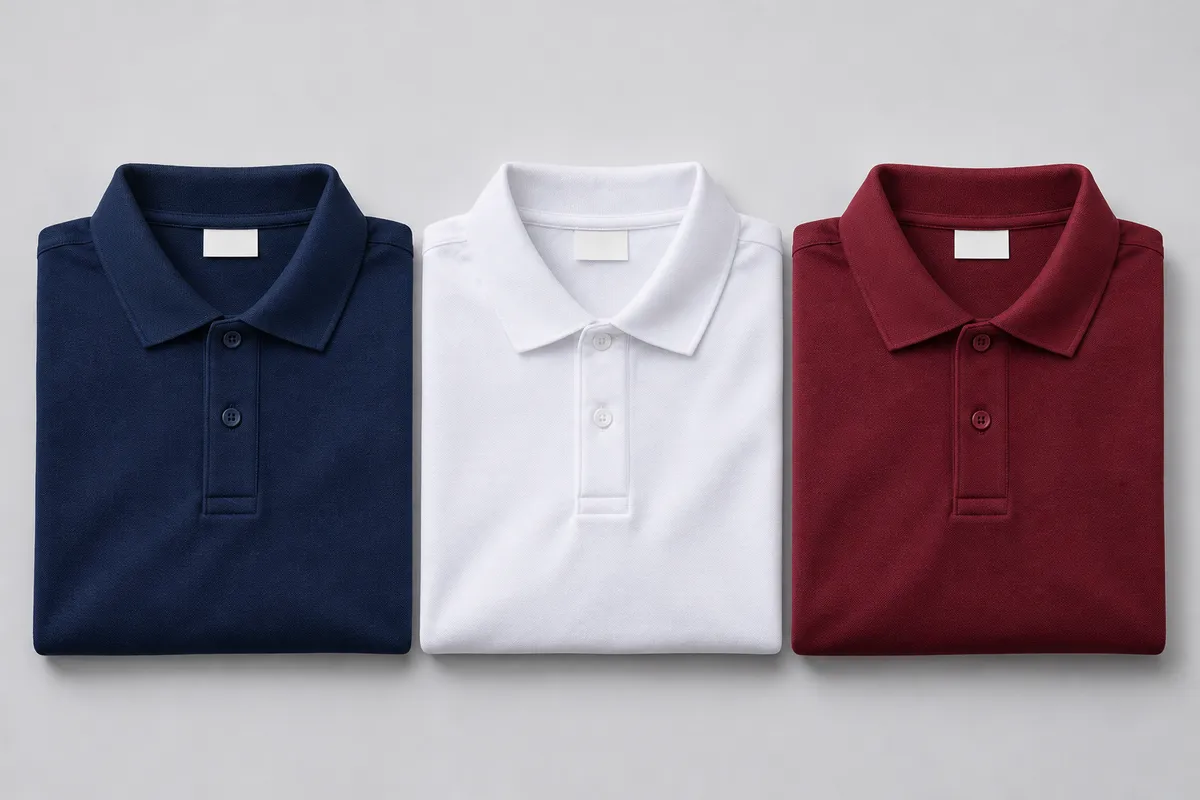
A polo shirt sample check is the step where you confirm the polo is right before bulk production begins. Work through it in a fixed order: colour, collar, placket, logo, seams and hems, then fit across sizes. Approving the sample sets the standard for the whole order and every reorder, so it is worth half an hour of careful looking.
This post gives a practical sequence and a checklist to use when the sample arrives.
Before you start
Have these to hand:
- Your colour reference, or the sweatshirt or jumper the polo is worn with
- A polo you currently sell, if you have one
- Your specification and logo artwork
- A tape measure
- Good daylight, and an indoor light for a second look
Lay the sample flat on a clean table and give yourself time. Rushing a sample check is how small problems reach a full order.
A step-by-step check
1. Colour. Compare the body and trims with your reference, in daylight and indoor light. On a contrast or tipped polo, check each colour.
2. Collar. Look at its height, how it lies, and whether the points match. Fasten the top button and see how it sits.
3. Placket. Check its length, the button count and colour, and the stitching at the base.
4. Logo. Check the method, size, position and thread or print colours against your artwork.
5. Seams and hems. Turn the polo inside out. Look at overlocked seams, the neck tape and the hem stitching.
6. Labels. Check the neck label, size label and care label wording.
7. Fit. Measure the chest and length, and compare with the size chart. If possible, try it on a student.
What to look for at each point
| Area | Looks right | Needs a comment |
|---|---|---|
| Body colour | Matches reference in both lights | Shifts under indoor light |
| Collar | Flat, even points, correct height | Wavy edge or one point curling |
| Placket | Straight, firm base, buttons secure | Puckering or a loose button |
| Logo | Flat, correct size and position | Puckering, lost detail, off-centre |
| Neck tape | Even, covers the seam | Twisted or puckered |
| Hems | Parallel rows, flat edge | Wavy or uneven |
| Labels | Correct wording and position | Missing details or wrong size |
| Measurements | Within the agreed chart | Outside the chart |
Washing the sample
If time allows, wash the sample once following the care label, then check it again. Washing reveals collar curl, hem ripple, shrinkage and colour change that a fresh sample cannot show. Note any differences.
Our page on fabrics and colour matching explains how colour and fabric are approved before production.
Sending clear feedback
Clear notes save a second round of samples. Write each point separately:
- What the issue is: “collar point curls on the left side”
- Where it is: “left chest logo, 1 cm too close to the placket”
- What you want: “move the logo 1 cm towards the armhole”
- What is approved: “body colour, buttons and labels approved”
- Photos with a ruler or tape in view, if useful
When everything is agreed, the approved sample becomes the reference for bulk production and for every future reorder. Keep it safe, labelled with the order details.
The polo styles we make are listed on our school polo shirts page. Once your sample is approved, we move to the advance payment and production, and lead time is confirmed in the quotation.
Questions buyers ask
Do I need samples in every size?
Usually not. A middle size shows colour, collar, logo and construction. If you are unsure about the smallest or largest sizes, ask for those too, because logo size, placket length and collar length are graded and errors can appear at the ends.
What if the sample is close but not perfect?
Note exactly what needs to change and whether the rest is approved. Small changes, such as moving the logo, can often be confirmed without a full new sample. Larger changes, such as colour, usually need another sample to check.
Should the approved sample be returned?
Keep one approved sample yourself as the reference. If we also keep a matching one, both sides can refer to the same standard on reorders. Labelling it with the date and order details makes it easy to find later.