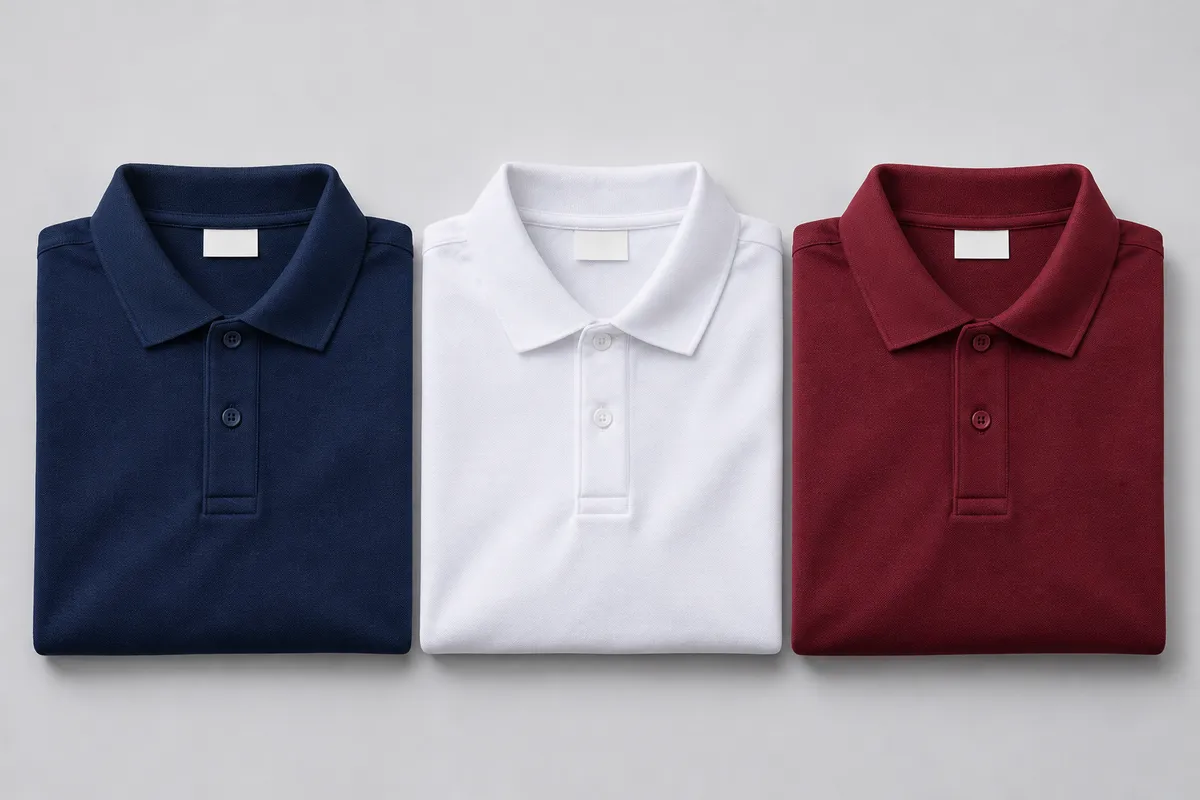
A school buying polo shirts direct from the manufacturer takes on the jobs a uniform shop would otherwise do: fixing the specification, collecting sizes, holding stock and handing polos to families. In return it controls the colour, logo and fit exactly, and orders in its own name. Before asking for a quotation, a school should settle four things: the polo specification, how sizes will be collected, where stock will be kept, and who will run reorders.
We make polos for schools ordering for their own students, as well as for shops and suppliers. The minimum is 100 pieces per style, with sizes mixed.
Why schools buy polos direct
Schools choose to order direct for different reasons. Some have no local uniform shop. Some run their own uniform counter or include uniform in fees. Others want to fix the exact shade of a school colour and keep it from year to year. Polos are often the first garment a school buys direct, since they are worn by every student and the specification is simple.
What the school needs to decide first
| Decision | Who usually decides | What to send us |
|---|---|---|
| Polo style: short, long or contrast collar | Head or uniform committee | The style name, or a polo you like |
| Body and trim colours | Head or governors | A colour reference or garment |
| Logo and its method | Office, with the artwork owner | Artwork file and colours |
| Size range | Office, from the roll | Ages and chest sizes needed |
| Labels | Office | Neck label wording, school name if wanted |
| Packing | Office or uniform counter | By size, by class or both |
Write these decisions down before the enquiry. Having them settled shortens the quotation and makes sure the sample is right first time.
Collecting sizes from families
A school does not need to measure every child. Most use one of three methods:
- Size from the roll, using a standard ratio by year group, then exchange sizes after delivery.
- Ask families to choose a size from a size guide on a form.
- Hold a fitting day with a set of sample polos in each size.
The fitting day gives the most accurate numbers; the roll method is quickest. Many schools use the roll for older year groups and a fitting day for the new intake.
Holding and handing out stock
Polos arrive packed by size, by class or both, with a size sticker on each pack. Plan where they will be kept, who will hand them out, and how exchanges will work. A small stock room with shelves by size is enough for most schools. Keep a simple record of what goes out, as it becomes the basis for the next order.
Our schools and school groups page covers how schools usually order from us, including school groups ordering for several sites.
Planning reorders
A school buying direct also owns the reorders. New students join during the year, children grow, and polos wear out. Set a date each year to review stock and order for the coming year, counting back from the start of term by the lead time in your quotation. Keep the approved sample and the size chart in the office so the next order matches.
- Approved sample kept in the office
- Signed size chart filed with the quotation
- Stock count by size at the end of each term
- A date in the calendar for next year’s order
Send us your polo style, colours, logo, size range and approximate numbers. We quote per style, by fabric, quantity and branding, and make a sample for the school to approve. Our polo styles and fabrics are on the school polo shirts page.
Questions buyers ask
Can a school order polos and sell them to families itself?
Yes. Many schools hold the stock and sell or issue polos to families through the office or a uniform counter. How you sell them is your decision; we supply the bulk order to the school.
Can a group of schools order polos together?
Yes. A school group can send one enquiry covering several schools. Each school’s polo with its own logo is quoted as its own style, while a shared polo used by all the schools can be one style.
Do we need a uniform shop as well as ordering direct?
Not necessarily. Some schools order direct for everything; others order polos direct and leave the rest to a shop. Choose what suits your families and the staff time you have.