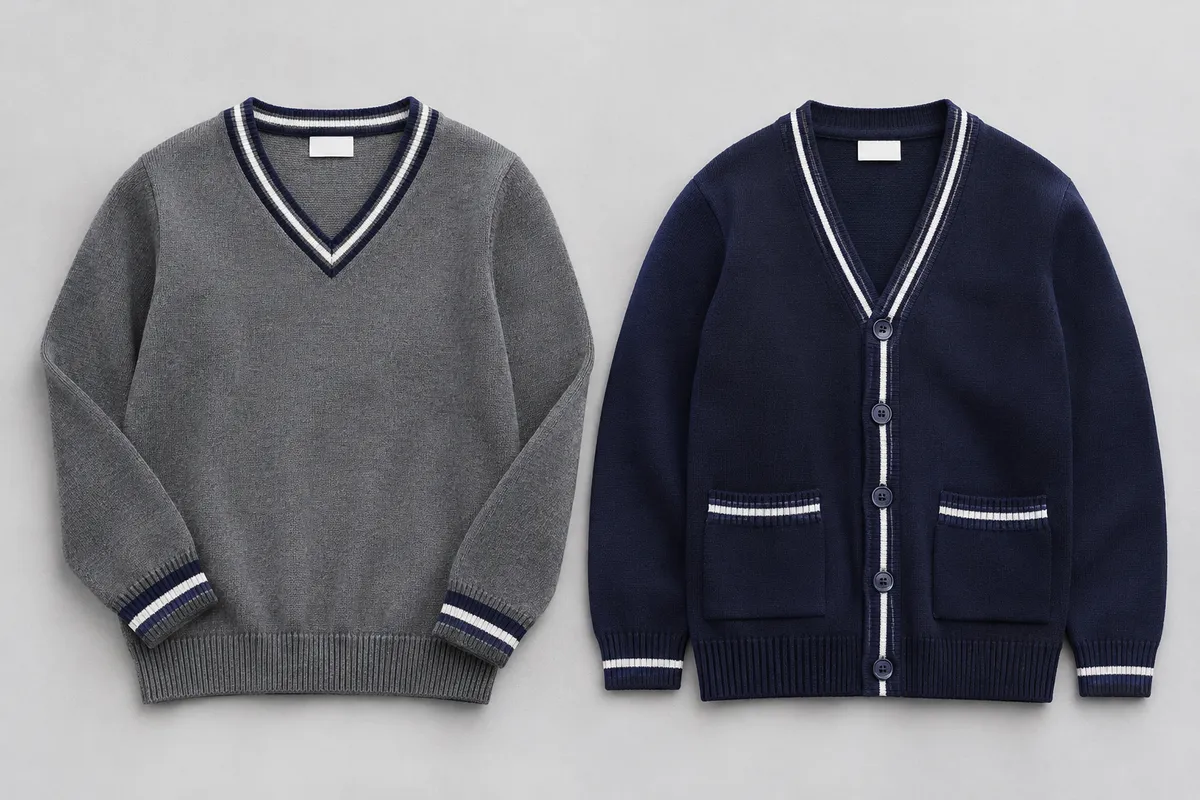
The school jumper wear points that show age first are the elbows, the cuffs, the hem band and the underarms, followed by the area around the badge. These are the places pupils lean on, pull at and rub every day. Knowing them lets a buyer look at the right spots on a sample and on returns, rather than judging the jumper as a whole.
Below is a map of the usual wear points, why each one wears, and the choices at specification stage that affect it.
A map of wear on a school jumper
| Wear point | What happens | Why | What affects it |
|---|---|---|---|
| Elbows | Thinning, bagging, a shiny patch | Leaning on desks, constant bending | Yarn, knit density, gauge |
| Cuffs | Stretching, fraying edge, bobbles | Pushed up, pulled over hands, chewed or picked | Rib type, rib tension, yarn |
| Hem band | Flaring, curling, bobbles at the front | Tugged down, rubbed by bags and desk edges | Rib depth and firmness |
| Underarms | Bobbling, thinning | Arm rubbing against the body | Yarn and knit surface |
| Front below the badge | Bobbling, slight wear | Bag straps and seat belts across the chest | Yarn, badge backing |
| Shoulders | Seam stretching | Hanging on pegs, carrying bags | Shoulder tape, seam type |
Why elbows go first
Elbows take two kinds of strain at once. They bend all day, which stretches the knit, and they press on hard desk surfaces, which rubs the surface fibres. On a finer knit, the yarn can thin at that spot over a long period. On any knit, the loops can stay slightly stretched and leave a bulge. Some school uniforms in the past added elbow patches; most modern school jumpers do not, and we do not list patches among our styles.
What a buyer can do is choose a knit with enough density for daily wear, and check the elbow area after wearing the sample for a day.
Cuffs and hems
The rib edges carry the most pulling. A cuff that is too loose from the start will look tired quickly; one that is firm but comfortable lasts longer. The hem band is often tugged down by pupils who want a longer jumper and rubbed by the top of a school bag. A deeper, firmer hem rib copes better with this than a narrow one. Rib choices are stated in the specification and shown on the sample.
What to check on a sample, area by area
Wear the sample for a school day if you can, or simulate it:
- Elbow: bend the arm repeatedly, then lay flat and look for a bulge
- Cuff: stretch over a fist several times and check it recovers
- Hem: pull down gently and release; the band should return flat
- Underarm: rub the sleeve against the side and look for early fluff
- Badge area: check the embroidery backing is smooth and not pulling the knit
- Shoulder: hang the jumper on a peg overnight and measure the shoulder
A sample cannot show a full year’s wear, but it shows where weaknesses begin. Our fabrics and colour matching page explains how the yarn is confirmed, which drives most of these results.
Using returns and feedback
Shops often see worn jumpers when families come back for a new one. Looking at those old jumpers is useful evidence. If most come back worn through at the elbows, say so when you enquire; if the cuffs stretch first, mention that. These notes help set the knit and rib on the next sample.
We manufacture in India, and each repeat order follows the approved sample. If you change the specification to address wear, that becomes a new sample to approve before the next production run.
Send us a worn jumper along with a new one if you can, and we will quote your knitted jumpers and cardigans per style, by fabric, quantity and branding.
Questions buyers ask
Do cardigans wear in the same places as jumpers?
Mostly, yes: elbows, cuffs and hem. Cardigans also wear along the front band near the buttons, because the band is handled every time the cardigan is fastened or opened.
Can families do anything to slow elbow wear?
Washing as labelled, drying flat and removing bobbles gently all help. Wear from desks is hard to avoid, but a jumper kept in good shape looks newer for longer.
Is a heavier knit always more hard-wearing?
Not always. A heavier knit has more yarn to wear through, but a loose heavy knit can snag and bag. A firm, well-knitted medium or fine knit can wear just as well in a classroom.