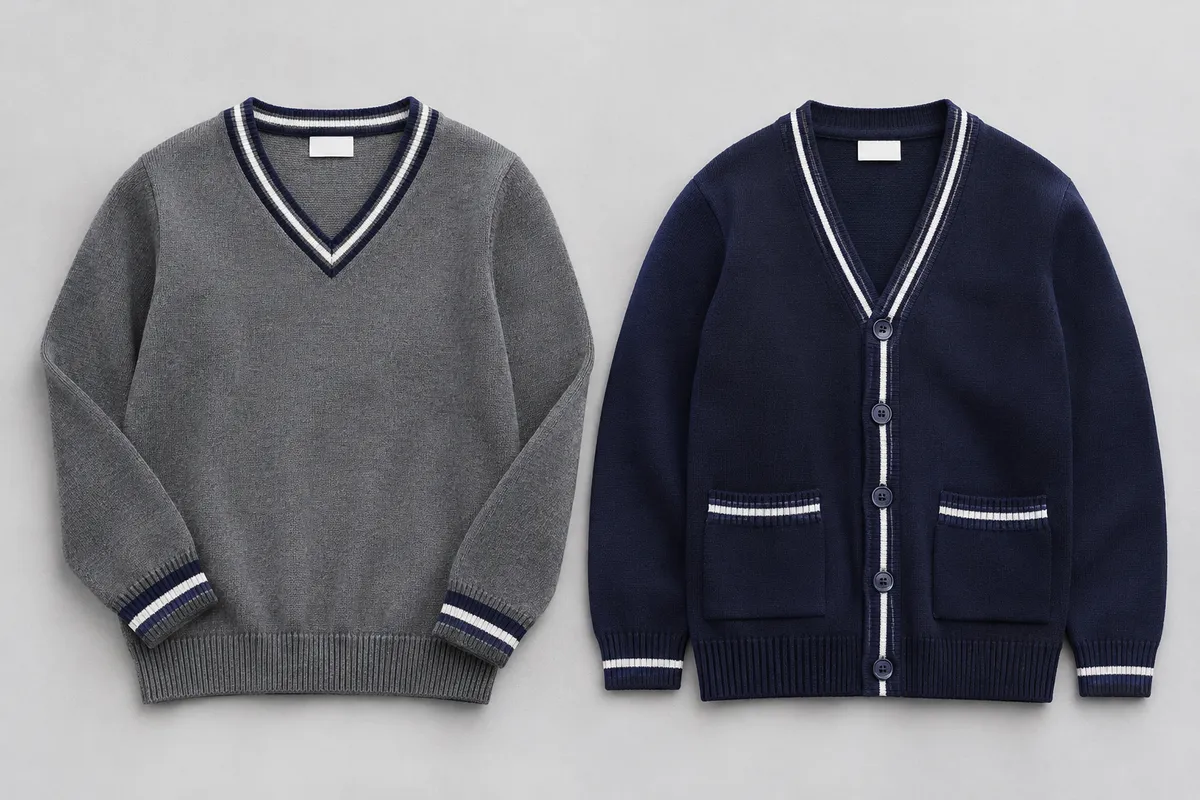
School jumper stripe placement usually follows one of three patterns: stripes at the neck only, at the neck and cuffs, or at the neck, cuffs and hem. The neck carries the most weight because it is seen above a desk and under a blazer; cuffs and hem add identity but also add places where stripes must line up.
Placement is a separate decision from stripe colours. Once you know the colours, decide which edges carry them on each style, and write it down per style so the jumper, cardigan and slipover look like one family.
The common placements and how they read
| Placement | How it looks | Practical notes |
|---|---|---|
| Neck only | Restrained; the stripe frames the tie | Fewest stripe joins; quick to recognise under a blazer |
| Neck and cuffs | Balanced; visible from any angle in class | Cuff stripes are seen when hands are on the desk |
| Neck, cuffs and hem | Strong school identity | The hem stripe is often hidden under a blazer or tucked |
| Cuffs and hem only | Unusual; quieter at the face | Leaves the V plain, which some schools prefer with a striped tie |
There is no rule that a school must stripe every edge. Some schools prefer a single stripe at the neck because a bold tie already carries the colours. Others stripe everything so a pupil can be identified from across a playground.
Placement on cardigans and slipovers
Each knitwear style has its own edges, so the same “neck and cuffs” choice needs translating.
Cardigans
A cardigan’s neck edge is part of its front band. You can run the stripe along the whole band, which is striking, or keep the band plain and stripe only the cuffs and hem. A plain band with striped cuffs is a common compromise: the cardigan still matches the jumper at the wrists without a long stripe down the front.
Slipovers
A slipover has armholes instead of cuffs. If the jumper is striped at the neck and cuffs, the slipover equivalent is usually neck and armholes. Under a blazer only the neck shows, so some schools stripe the neck alone on the slipover.
How many stripes, and how far from the edge?
Within each position, you also decide how many stripes there are and where they start. Two narrow stripes is a familiar look; one wider stripe is bolder; three narrow stripes need a deeper rib to fit. The first stripe usually starts a short distance in from the edge of the rib, with a band of body colour between stripes.
Keep these consistent across positions. If the neck has two stripes and the cuffs have one, the jumper looks unfinished. Where a position is narrower, such as a small child’s cuff, the stripes can be scaled slightly, but the count should stay the same.
Writing it into the specification
For each style, list the positions and the stripe detail. A short table like this, sent with your enquiry, removes guesswork:
- Jumper: positions (neck, cuffs, hem), stripe count, colours in order from the edge
- Cardigan: front band striped or plain; cuffs and hem
- Slipover: neck, armholes, hem
- Gap of body colour between stripes
- Whether stripes scale on the smallest sizes
- A photo or garment showing the current look, if one exists
Uniform shops supplying one school’s full knitwear range will find the same table useful when the school asks why a slipover looks different. Our page for uniform shops and retailers covers how shops run several knitwear styles for one school.
We manufacture in India. Stripes are knitted in, so their placement is set on the sample and cannot be added afterwards. Once approved, every reorder carries the same stripes in the same places.
When you have decided where the stripes go, send the details and we will quote your knitted jumpers and cardigans per style, by fabric, quantity and branding.
Questions buyers ask
Do stripes on the hem show under a blazer?
Usually not, because a blazer covers the jumper hem. Schools that require blazers sometimes leave the hem plain for that reason. If students often take the blazer off in class, a hem stripe adds identity.
Should primary and secondary jumpers use the same placement?
They can, and it helps where siblings share a school. Some schools simplify the primary jumper to neck-only stripes, which is easier to keep looking neat on very small sizes.
Can the cuff stripe be wider than the neck stripe?
It can, but most schools keep widths equal so the jumper looks consistent. If you want a difference, show it on a drawing and check the result on the sample.