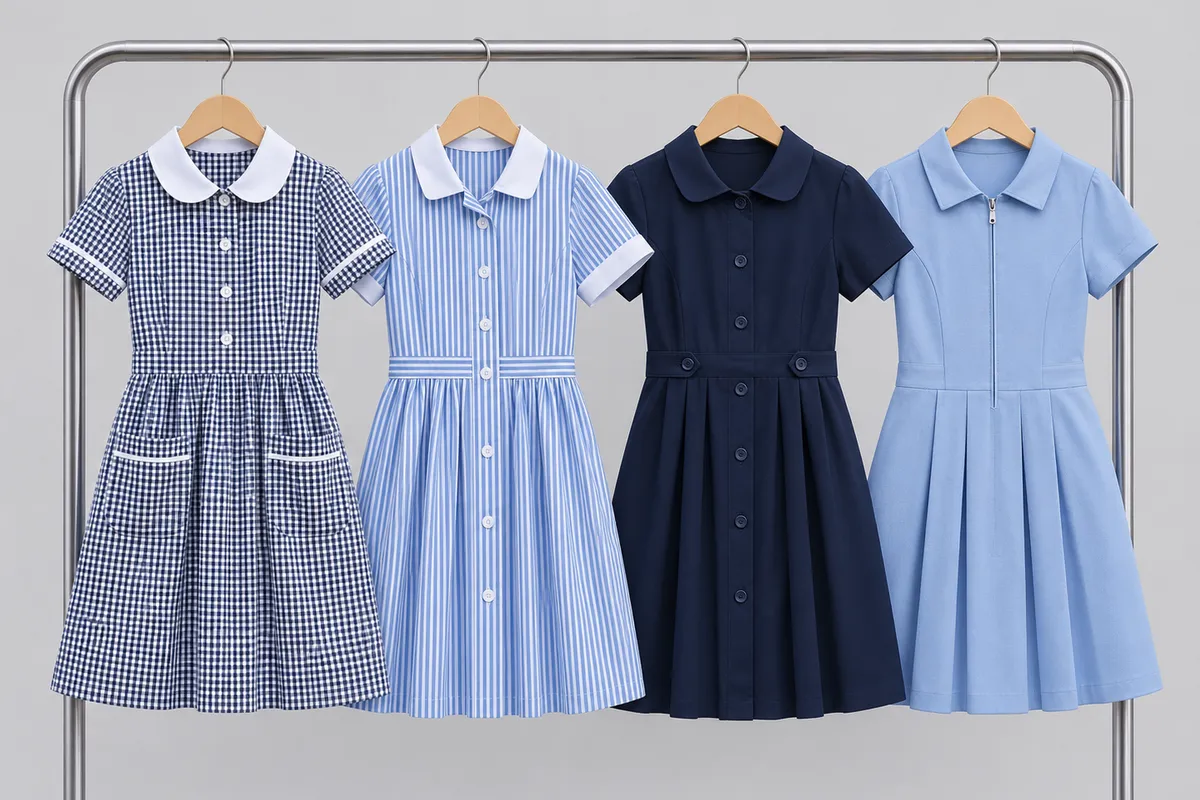
The main types of school uniform for girls are built around one lower garment or dress: a pinafore, a tunic, a skirt or a skort, worn with a shirt or blouse and a knitted or fleece layer on top. A summer dress often replaces these in the warm term, and girls’ trousers sit on many lists as an equal option. Which types a school chooses depends mostly on age, climate and how formal the uniform is meant to look.
This guide names each type, explains what it is, and shows how uniform shops, suppliers and schools usually combine them. It is written for buyers putting together a uniform list or a stock range, not for families buying a single outfit.
What is each girls’ uniform garment called?
Girls’ uniform names vary by country, which causes more mix-ups on purchase orders than any other detail. The definitions below are the ones we use in quotations.
- Pinafore. A sleeveless dress worn over a shirt or blouse. It may have a bib front with straps, a fitted bodice with a pleated skirt, or a front zip. In the USA the same garment is called a jumper.
- Tunic. A longer sleeveless dress, usually pleated from the shoulder or yoke, worn over a shirt. Tunics often run into older age bands than pinafores.
- Skirt. A separate garment from the waist down: pleated, A-line, or in a yarn-dyed check.
- Skort. A skirt with shorts built in underneath, so it looks like a skirt from the front and moves like shorts.
- Summer dress. A short-sleeved dress in gingham or stripe, worn without a blouse in the warmer months.
- Blouse. A girls’ shirt, often with a revere (open, flat) collar that sits outside a jumper.
How do the types compare?
| Garment | Worn with | Typical age use | Strength | Watch for |
|---|---|---|---|---|
| Bib or zip-front pinafore | Blouse or shirt | Nursery to early primary | Easy to put on; covers the blouse front | Strap length and fastening position |
| Pleated pinafore | Blouse or shirt | Primary years | Smart, traditional look | Pleat count affects fabric use |
| Tunic | Shirt | Primary into early secondary | Longer fit lasts through growth | Finished length per age band |
| Pleated or A-line skirt | Shirt or blouse, jumper | All ages | One waist size fits many heights | Waist adjusters for younger girls |
| Skort | Polo or blouse | Primary, active schools | Comfortable for play | Inner short length and leg finish |
| Summer dress | Worn alone, cardigan on top | All ages, warm term | One garment, cool to wear | Fastening type for young children |
The table is a guide to common practice. Plenty of schools keep a pinafore into the upper primary years, and some secondary schools list a skort.
Choosing the mix for a school or a shop
Most girls’ uniform lists name two or three of these types, not all of them. A typical primary list might offer a pinafore for the youngest classes, a skirt from the middle years, and a summer dress for the warm term. A secondary list usually moves to a skirt or trousers with a blazer or jumper.
A school writing its list can decide by asking three questions. How young are the youngest girls, and can they dress themselves after PE? How hot does the summer term get? And does the school want a uniform that looks the same from age five to sixteen, or one that changes as students move up?
A uniform shop stocking several schools tends to carry the types that cross most lists: a grey and a navy pleated skirt, a plain pinafore, and a gingham dress in the commonest colours. These can sit on many lists under the shop’s own label. A schoolwear supplier may run one pinafore and one skirt pattern in each school’s colour, with the badge changed per school.
Which of these types do we make?
We manufacture in India and make every garment named in this guide: pinafores and tunics, skirts and skorts, summer dresses, blouses, and girls’ trousers. Each is made in bulk to the buyer’s colours, logo and size range. Our school skirts and skorts page lists the skirt styles and fabrics, and our pinafores and tunics page covers the dress styles.
Before asking for a quotation, write down:
- Which types appear on the list, and for which age bands
- The colour of each, or a garment to match
- Pleat style for skirts, pinafores and tunics
- Logo position, or plain
- Size range per type
- Quantity per style
Each type is a separate style on the quotation. Woven garments such as these start at 50 pieces per style, and sizes can be mixed within a style. Schools ordering direct can read more on our page for schools and school groups.
Send us your list of girls’ garments, with colours and a rough size mix, and we will quote each style by fabric, quantity and branding.
Questions buyers ask
Is a pinafore the same as a tunic?
Not quite. Both are sleeveless dresses worn over a shirt, but a tunic is usually longer and pleated from the shoulder or yoke, while a pinafore may have a bib, a fitted bodice or a zip front. Tunics also tend to stay on lists for older girls.
Can girls’ trousers sit on the same list as skirts?
Yes. Many lists now give girls a choice of skirt or trousers, and a girls’ trouser is cut with a different waist and hip shape from a regular trouser. Each is its own style on an order, so a shop can stock both in the same colour.
Should younger girls wear a skirt or a pinafore?
A pinafore is often easier for young children, because it has no waistband to slip and covers the blouse front from spills. A skirt with an adjustable waist also works well. The choice usually comes down to how the school wants its youngest classes to look.