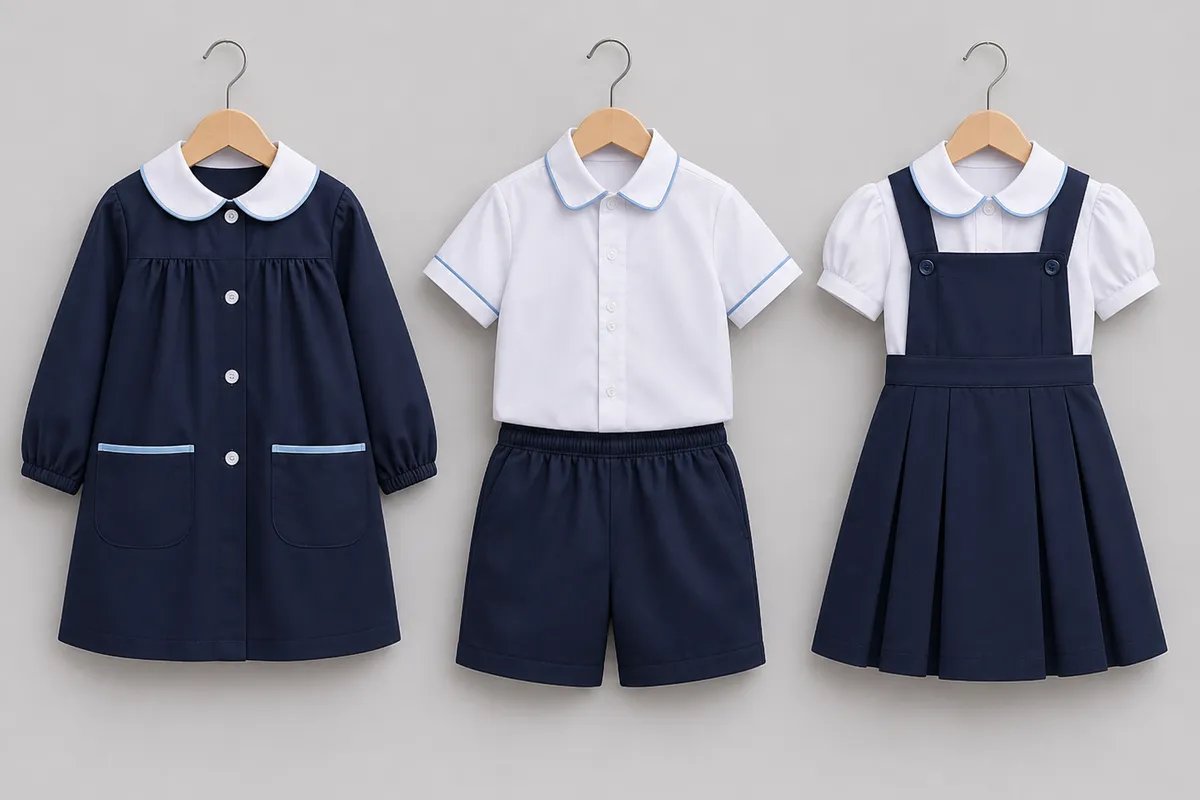
A kindergarten school dress is usually one of three garment types: a smock worn over everyday clothes, a pinafore set (a pinafore with a matching blouse), or a shirt-and-shorts set with an elastic waist. Each is designed for children aged roughly two to six, who need clothes they can move in, that survive paint and sand, and that open easily for toilet visits. Many kindergartens choose one type for every child; others offer the pinafore set and the shorts set side by side.
The terms LKG and UKG uniform (lower and upper kindergarten, used in India) refer to the same age group and the same garment types.
The three types, one at a time
Smock
A smock is a loose overgarment, long enough to cover the clothes underneath, with short or long sleeves. It fastens with buttons or press studs, as specified, at the front, back or shoulder. Because it goes over whatever the child is already wearing, families need fewer garments, and the smock takes the dirt from messy play.
Suits: play-based nurseries, art-heavy settings, and schools that want a uniform look without asking families to buy a full outfit.
Pinafore set
A pinafore set pairs a small pinafore, in a bib or zip-front style, with a short- or long-sleeved blouse. It looks like a younger version of a primary school uniform, so children moving up see little change.
Suits: kindergartens attached to a primary school that uses pinafores, and settings where a smart look matters to parents.
Shirt-and-shorts set
A short-sleeved shirt with elastic-waist shorts in a matching or contrast colour. The shorts pull on and off without buttons or zips.
Suits: warm climates, active settings, and kindergartens that want one practical outfit for all children, sometimes with a skirt or skort alternative.
Comparing the three
| Point | Smock | Pinafore set | Shirt-and-shorts set |
|---|---|---|---|
| Garments per outfit | One | Two | Two |
| Worn over own clothes? | Yes | No | No |
| Fastening | Buttons or press studs, as specified | Straps or zip on pinafore; buttons on blouse | Buttons on shirt; elastic waist shorts |
| Toilet independence | Good | Pinafore must be lifted or unfastened | Good; shorts pull down |
| Messy play | Designed for it | Needs care | Moderate |
| Look | Simple, practical | Smart, school-like | Neat, casual |
| Sizes with us | Age 2–3 to 5–6 | Age 2–3 to 6–7 | Age 2–3 to 6–7 |
Pairing with PE kit and warm layers
Kindergarten children often have movement sessions rather than formal PE, but many schools still list a simple T-shirt and shorts for sports days. A sweatshirt or sweatshirt cardigan is the usual warm layer, as it is soft and easy to pull on.
A practical rule for this age: every fastening a child meets should be one they can manage, or one an adult can do in seconds. That means elastic waists, front zips, press studs and wide necklines.
Planning a kindergarten order
Kindergarten classes are often small, and children grow fast. Points to settle:
- Which type, or which combination, the kindergarten will use
- Fabric: poly-cotton or cotton
- Colours, and whether they match the primary school uniform
- Fastening type for each garment
- Logo: a small embroidered version, or plain
- Sizes from age 2–3 upwards, with a heavier spread in the middle bands
Nursery uniforms are woven garments with a minimum of 50 pieces per style, and sizes can be mixed. A kindergarten attached to a larger school can often reach that number by ordering for several classes at once.
We manufacture smocks, pinafore sets and shirt-and-shorts sets in India in bulk, to the school’s colours. See all three on our nursery and kindergarten uniforms page. Charities equipping several kindergartens can read our page for charities and uniform programmes.
Tell us how many children you need to dress, and which type you prefer, and we will quote each style.
Questions buyers ask
What is the difference between LKG and UKG uniform?
There usually is none in garment type. LKG and UKG are the two kindergarten years in many Indian schools, for children around three to five. Both commonly use the same pinafore set or shirt-and-shorts set, simply in a size up for UKG.
Is cotton or poly-cotton better for kindergarten uniform?
Each has a place. Cotton feels soft and breathes well in heat. Poly-cotton dries faster, creases less and holds its colour through frequent washing. Many kindergartens choose poly-cotton for daily wear because it copes well with repeated laundering.
Should a kindergarten uniform match the primary uniform?
It helps if the kindergarten feeds into the primary school, because children see continuity and families can sometimes hand garments down. Matching the main colour while keeping simpler kindergarten garments is a common approach.