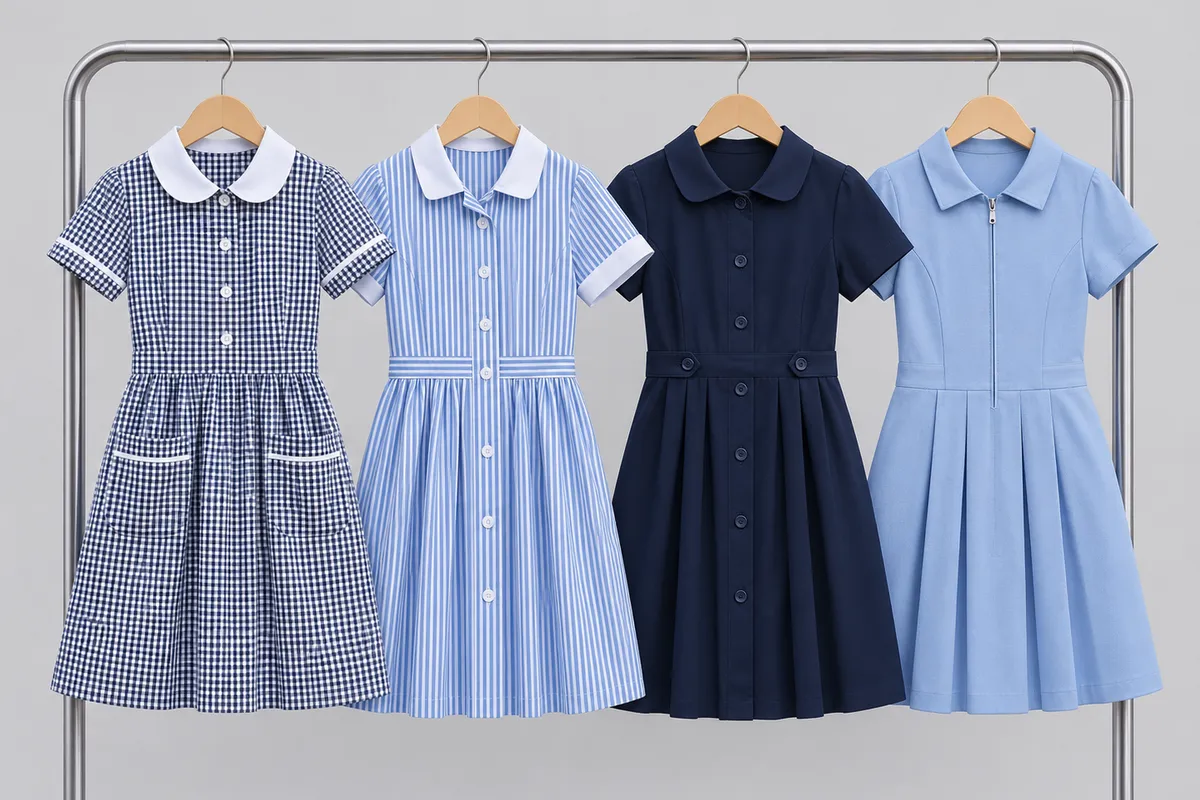
School summer dresses in South Africa are worn in the warm first and fourth terms, with a tunic or skirt for the winter terms in between. The school year starts in January, so uniform shops need their summer dresses in stock by early December, ready for families who buy before the holidays and in the busy first weeks of the new year.
This post is for South African school uniform shops, schoolwear suppliers and schools buying summer dresses in bulk from overseas.
How South African dress sales are shaped
South Africa’s school calendar runs from January to December in four terms. Summer uniform is worn in Terms 1 and 4, winter uniform in Terms 2 and 3. Unlike some countries where the dress is optional, many South African primary schools list a summer dress as the standard warm-weather uniform for girls.
| Selling window | What drives it |
|---|---|
| Late November to mid-January | Back-to-school: new Grade R and Grade 1 learners and returning learners |
| First weeks of Term 1 | Exchanges and late buyers |
| Before Term 4 | Learners who outgrew last summer’s dress |
| Terms 2 and 3 | Little demand |
Many families buy before the December holidays rather than in January, which pulls the stock deadline earlier than the term date suggests.
School-specific dresses across many accounts
South African uniform shops often hold contracts for several schools, each with its own summer dress. Dresses differ by gingham or stripe colour, collar trim, and sometimes an embroidered logo on the chest or pocket. That gives shops many small styles rather than a few large ones.
Planning tips for that pattern:
- Group schools by colour. Where two schools share a colour and accept a plain dress, one style can serve both.
- Check each style against the minimum. Each needs 50 pieces, with sizes mixed within it.
- Keep a specification sheet per school, recording colour, check size, logo and size range.
- Pack by school, so each school’s delivery can be put away without sorting.
Sizes from Grade R upwards
The youngest learners start in Grade R, the reception year, followed by Grade 1. Summer dress sizes therefore start at the smallest age bands and run through the primary grades. High schools that keep a summer dress use chest sizes for older learners.
Primary schools carry most of the dress demand. If you serve mainly high schools, expect lower volumes and plan the senior chest sizes with care. Our size charts are agreed for each order, so you can follow the sizes your learners already wear.
Ordering timeline for a January start
To have summer dresses on the shelf by early December:
- Mid-year: count stock left from the previous summer and send your enquiry.
- Winter months: quotation, swatch and sample approval for any new school or colour.
- Late winter to spring: advance payment and production. Lead time is confirmed in the quotation.
- Spring: dispatch, with time for shipping and customs clearance.
- Early December: stock checked, packed by school and ready.
A smaller order timed for Term 4 can top up sizes that ran short. Our shipping and documents page explains how shipping and documents are confirmed.
Getting a quotation
We manufacture school summer dresses in India and take enquiries from buyers in any country, including South Africa. The dress styles are on our school summer dresses page. Send us the schools you supply, each school’s colour and logo, and your size totals, and we will quote per style.
Questions buyers ask
Can a South African shop order summer dresses for ten schools in one shipment?
Yes, provided each school’s dress reaches the minimum for its style. All styles can be produced and shipped together, packed by school. Each new colour needs its own swatch approval, so allow time for that in a large first order.
Do South African summer dresses need a logo?
Some schools require one, others accept a plain dress in the school colour. A plain dress is easier to stock across schools, while a logo dress is limited to one school. Confirm each school’s rule before ordering.
Should Term 4 dresses come from the same order as Term 1?
They can. Many shops keep back part of the January stock for Term 4. Others order a small top-up after seeing Term 1 sales. Either works, as long as the top-up is timed to arrive before the fourth term begins.