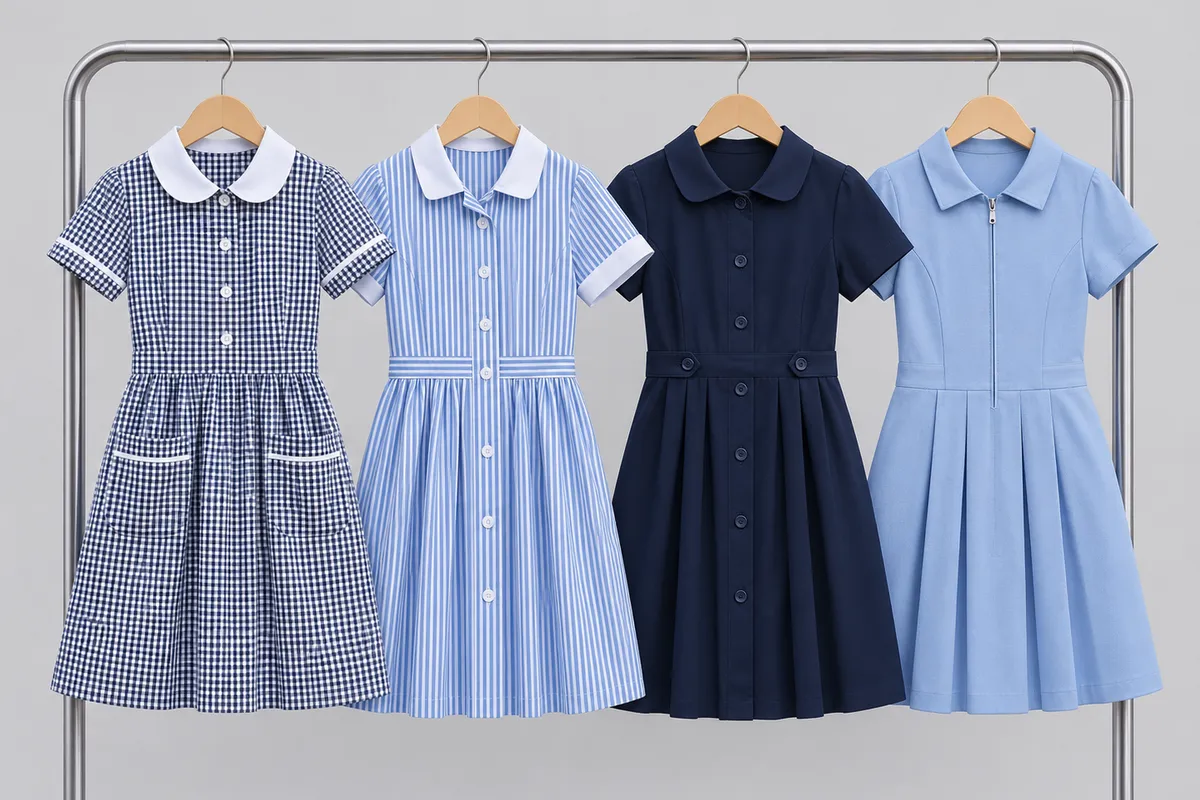
The girls’ school dress name used on a uniform list varies by country and school: “summer dress”, “gingham dress”, “check dress”, “school frock” and “candy-stripe dress” can all describe the same garment, a lightweight woven dress worn in warm weather. Agreeing what each name means before ordering stops a shop or school from receiving a different dress from the one it pictured.
This post is a short vocabulary for buyers, explaining the common names for school summer dresses and the details each one usually implies.
Common names for a school summer dress
| Name | Where it is often heard | What it usually means |
|---|---|---|
| Summer dress | UK, Ireland, Australia, New Zealand, South Africa | A lightweight dress for the warm term, often gingham or stripe |
| Gingham dress | Widely used | A summer dress in a small woven check of one colour and white |
| Check dress | Widely used | Same as gingham, or a larger check of two or more colours |
| Candy-stripe dress | UK, Australia | A summer dress in thin vertical stripes of one colour and white |
| School frock | India, South Asia, parts of Africa | A girls’ school dress; can mean a summer dress or a pinafore |
| Uniform dress | USA, Gulf | A girls’ school dress, sometimes a pinafore, sometimes a one-piece dress |
| Tunic | UK, South Africa, India | Usually a sleeveless pleated dress worn over a shirt; not a summer dress |
| Pinafore | Widely used | A sleeveless dress worn over a blouse; not a summer dress |
The last two cause the most confusion. A tunic and a pinafore are worn over a shirt or blouse; a summer dress is a complete garment worn on its own.
Words that describe parts of the dress
Uniform lists often add detail words. Knowing them helps a buyer read a specification correctly:
- Button-front: opens down the front with buttons, like a shirt.
- Zip-front: opens down the front with a zip.
- Peter Pan collar: a flat collar with rounded ends.
- Revere collar: a collar with lapel-like points, often seen on senior dresses.
- Tie belt or half belt: a belt at the back or sides to adjust the waist.
- Shirt-dress: a dress cut like a long shirt, usually button-front.
- Drop waist: a waist seam set below the natural waist.
The details of each dress follow your specification, and are fixed on the approved sample.
Why do names matter when ordering?
Names carry assumptions. A buyer in India asking for a “school frock” may mean a sleeveless dress worn over a blouse, while a buyer in the UK asking for a “summer dress” means a single sleeved dress. If both send only the name, each may receive something they did not expect.
A short description beside the name removes the doubt. For example: “Summer dress: blue gingham, short sleeves, Peter Pan collar, zip-front, worn on its own.” Our page for uniform shops and retailers explains what information helps a shop’s enquiry.
Using the right name with families
The name on a shop’s rail or a school’s uniform list should be the one families already use. If your local word is “frock”, use it on the price ticket and the uniform list, even if the specification sheet says “summer dress”. Consistency between the list, the label and the rail reduces questions at the counter.
We manufacture school summer dresses in India in gingham and stripe, with button-front or zip-front openings. The styles are on our school summer dresses page. Whatever your local name for the garment, send a description or a photo with your enquiry, and we will confirm the details before quoting.
Questions buyers ask
Is a gingham dress the same as a check dress?
Often, yes. Gingham is a specific even check of one colour and white, while “check” can also mean larger or multi-colour checks. If your list says “check”, send a fabric piece or photo so the pattern is matched correctly.
What do Americans call a school summer dress?
US uniform lists usually say “uniform dress” or simply “dress”, and “jumper” means a sleeveless pinafore worn over a blouse. Gingham summer dresses appear less often on US lists than on lists in the UK or Australia.
Is a school tunic a type of summer dress?
Not usually. A tunic is generally a sleeveless, often pleated dress worn over a shirt or blouse, and it is more often part of a winter or year-round uniform. A summer dress is worn on its own in warm weather.