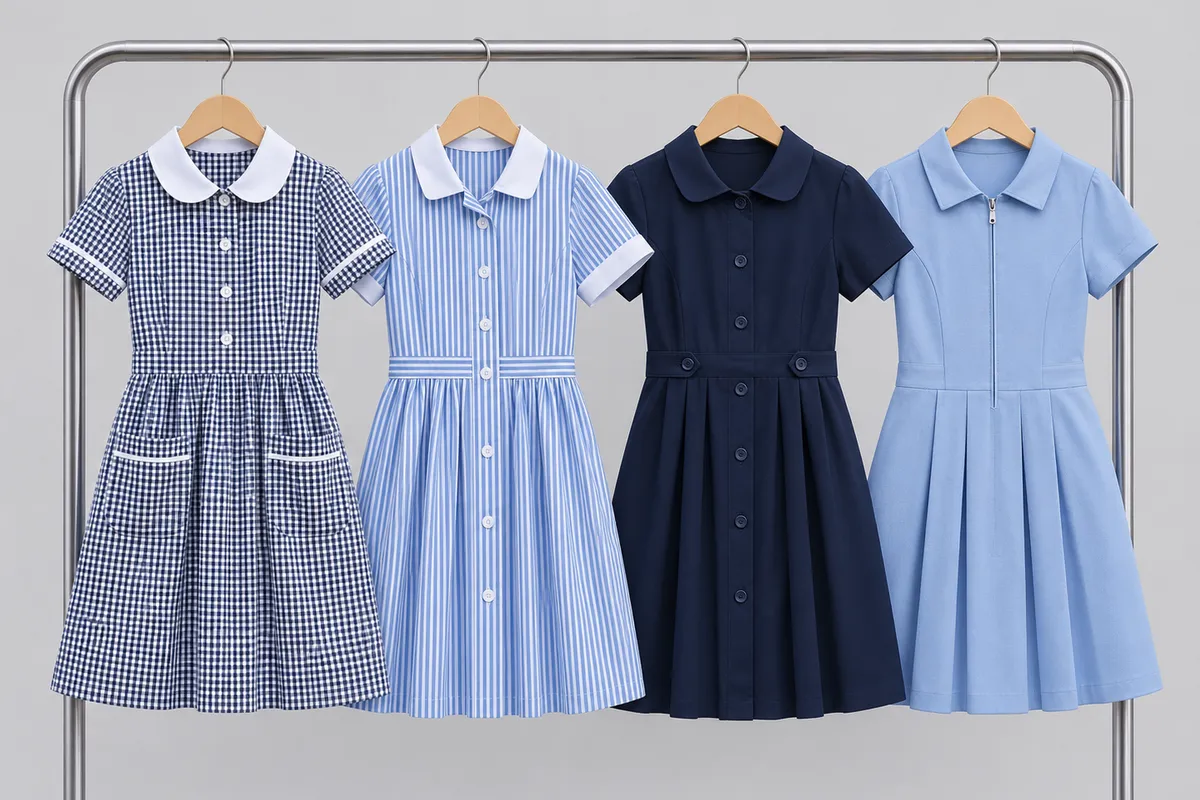
Summer dress sizes by age are labels such as 5–6 or 9–10 that stand for a set of garment measurements, not for the child’s birthday. An age band tells a shop roughly who the dress should fit, while the chest, waist and length agreed on the size chart decide who it actually fits.
This post explains how to read age bands on a school summer dress, where they mislead, and what a uniform shop, supplier or school should check before relying on them for a bulk order.
What does an age band on a summer dress mean?
An age band is shorthand for a typical child of that age. A dress labelled 7–8 is cut for a child of average build at seven or eight. In practice, a tall six-year-old may need it, and a slight nine-year-old may still fit it.
Two-year bands, written 7–8, are common on school dresses because a summer dress is fairly forgiving. It hangs from the shoulders, so a small difference in waist is not felt as much as it would be on trousers or a skirt. That is why one band can cover a spread of children without a separate half size.
On our summer dresses, the age bands typically run from 3–4 up to 13–14, and senior students who still wear a dress are then sized by chest. Your own range can be shorter. A primary school that drops the dress after the final primary year has no need for the upper bands.
Which measurements sit behind each age label?
Every band needs numbers behind it. Without them, two makers can both print “8–9” and produce dresses that fit differently. The measurements we agree on the chart for each order are listed below.
| Measurement | Where it is taken on the dress | Why it matters for age bands |
|---|---|---|
| Chest | Across the dress, just below the armholes | Decides whether a child can do the dress up comfortably |
| Waist | At the waist seam, or where a waist would be | Matters most on a sewn waist; less on elastic or a tie belt |
| Length | From the shoulder point to the hem | Changes fastest between bands as children grow taller |
| Shoulder | Seam to seam across the back | Keeps the dress sitting straight on narrow or broad frames |
| Sleeve | From shoulder seam to sleeve hem | Small differences between bands, but noticed on short sleeves |
Length usually changes the most from one band to the next. A dress that fits across the chest can still look short if the child is tall for her age, so the length column deserves the closest look.
Where age sizing goes wrong
Age bands are an estimate, so they fail in predictable places. Knowing them helps a shop plan stock and helps a school write a size guide for families.
- Tall children in the younger bands. They need the next band for length before they need it for chest. The dress then looks loose across the body.
- Children between bands. A girl at the top of 7–8 may be better in 8–9 for a dress meant to last the whole summer.
- Different makers, same label. If a shop changes supplier, a 9–10 from the new maker can be cut longer or shorter than the old one. Compare the measurements, not the labels.
- Changing the dress style. Moving from a sewn waist to a tie belt changes how a band fits, even with the same chest figure.
For this reason, our size charts page explains that the chart is agreed for each order. If you already sell a summer dress, the simplest route is to send one in each band so we can follow its measurements.
How to use age bands when planning stock
An age band is also a planning tool. A school knows how many girls it has in each year group, and each year group maps roughly to one or two bands. A shop can start from that mapping, then adjust using its own sales history.
A few points make the mapping more useful:
- Map each year group to the band its youngest and oldest children are likely to need, not only the band that matches their age.
- Expect the most demand in the bands covering the middle primary years, and less at the smallest and largest ends.
- Keep a note of which bands sold out early and which were left over. That record is more reliable than any age-to-size rule.
- Check the length column again whenever the dress style changes.
We manufacture school summer dresses in India to your measurements and your size range, with sizes mixed within each style. Our school summer dresses page lists the gingham and striped styles by age band. When you ask for a quotation, include the age bands you sell, any measurements you already use and an approximate split by size, and we will build the chart around them.
Questions buyers ask
Should a summer dress use one-year or two-year age bands?
Two-year bands such as 7–8 are common because a summer dress fits loosely through the body. One-year bands give a closer fit but double the number of sizes a shop must hold, which makes each size slower to sell and harder to keep in stock.
Is an age 8 summer dress the same as an age 8 skirt?
Not necessarily. The age label describes the child, but the measurements behind it differ by garment. A dress is checked mainly on chest and length, a skirt on waist and length, so a child can need different bands for each item on the uniform list.
What size do children usually start at for school summer dresses?
That depends on the school’s starting age. Schools that admit children at three or four need the smallest bands, while schools starting at five can begin from 4–5 or 5–6. The size range is set by your uniform list, not by a fixed rule.