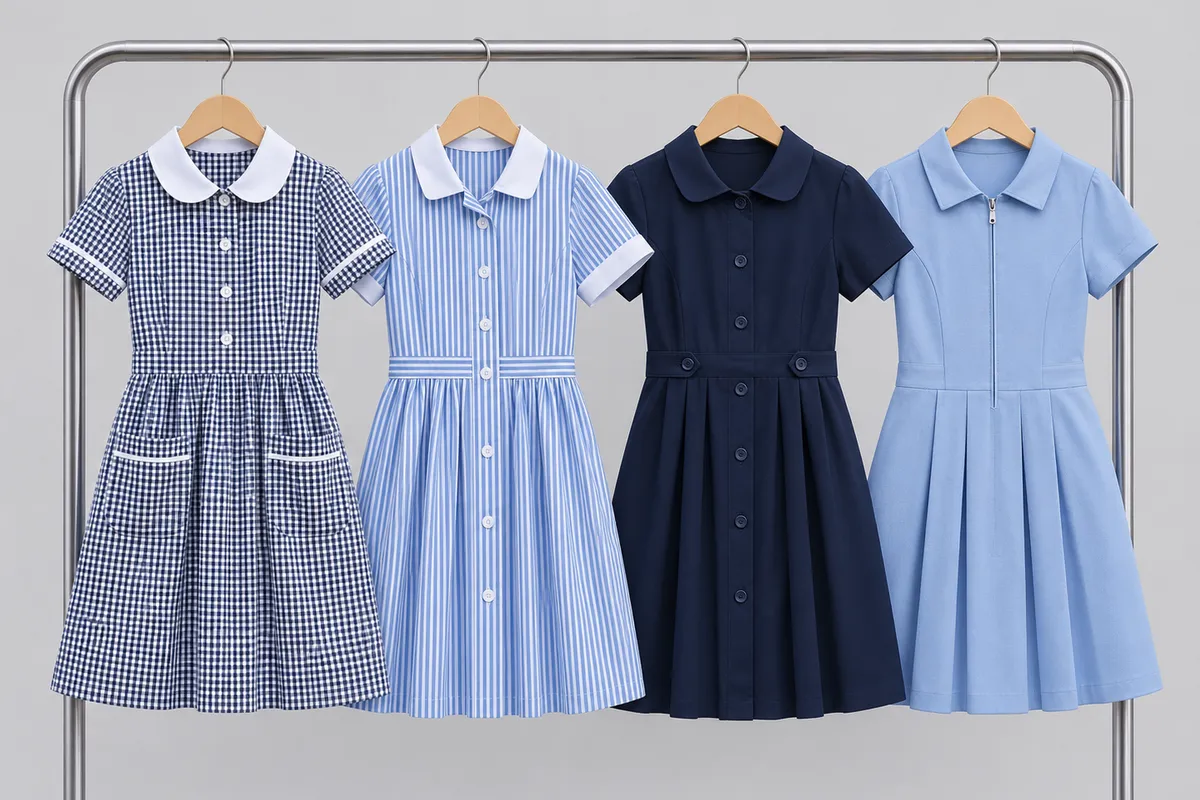
School dress seams on a summer dress are usually plain seams with overlocked edges, sometimes upgraded to French or bound seams where the inside shows or rubs. What makes a seam last is the stitch length, the thread and the reinforcement at stress points: underarms, the waist, pocket corners and the base of the opening. Turning a sample inside out is the quickest way to judge how a dress has been made.
This post walks through the inside of a summer dress, seam by seam, for buyers who want to know what to look for.
What seam types are used on summer dresses?
| Seam type | How it is made | Look inside | Where it suits |
|---|---|---|---|
| Plain seam, overlocked | Stitched, then the raw edges finished with an overlock stitch | Neat thread edge | Side seams, shoulders; the everyday choice |
| French seam | Stitched twice so the raw edge is enclosed | Clean, no raw edge | Light fabrics; unlined bodices |
| Bound seam | Raw edges wrapped in a binding strip | Very neat | Armholes and necklines on unlined dresses |
| Flat-felled seam | Edges folded and stitched flat | Strong, flat | Shirt-dress styles; less common on dresses |
| Topstitched seam | A visible row of stitching beside the seam | Holds the seam flat | Plackets, yokes, pocket edges |
An overlocked plain seam is strong and quick, and it suits most of the dress. French or bound seams are worth specifying where the inside can be seen or where a seam sits against the skin, such as an unlined armhole.
Where do summer dresses fail first?
Over a busy term, the same points tend to give way:
- Underarm seams. Children raise their arms constantly, so the junction of sleeve and side seam takes strain.
- Waist seam. Gathered skirts put weight on the waist seam, especially when a child is pulled by the skirt in play.
- Base of the opening. The bottom of a placket or zip is a stress point when the dress is pulled on and off.
- Pocket corners. Hands pushing into pockets tear the top corners.
- Belt loops and sash joins. Tugged often, these can pull out of the seam.
Reinforcing these points with a bar tack, a backstitched end or a small triangle of stitching adds little to the making and noticeably extends wear.
Stitch length and thread
Stitch length affects both strength and appearance. Very long stitches can pull open; very short ones on light fabric can cause puckering along the seam. A medium stitch suited to light poly-cotton is normal. The thread should be strong and in a colour that suits the fabric, usually matched to the check colour or to white, depending on which shows least. Our fabrics and colour matching page covers how fabric and thread colours are approved.
What to look for on the sample
Turn the sample inside out and check:
- Seam edges finished all the way, with no loose raw edges
- Stitching straight and even, with no skipped stitches
- No puckering along side seams or the waist seam
- Underarm junction neat, with seam allowances lying flat
- Reinforcement at the base of the opening and pocket corners
- Thread ends trimmed, not left hanging
- Seam allowances wide enough to hold, not trimmed too close
- Neckline and armholes finished cleanly, with facing or binding secure
Then turn it right side out and pull gently at a side seam and the waist seam. The seam should stay closed without gaps showing between stitches.
Seams on patterned fabric
On gingham and stripe, seams also carry the pattern matching. A seam stitched too far from or too close to its line shifts the check. Consistent seam allowances are therefore part of matching, not just strength. When seams are pressed flat after sewing, the pattern lines up more cleanly too.
Inspection before dispatch
Before dispatch, our quality check looks at seams, stitching and finishing against the approved sample. Keeping your own sample dress means you can compare a delivered dress inside and out in the same way.
Each summer dress style starts at 50 pieces, with sizes mixed. See the gingham and stripe styles on our school summer dresses page. If you have seam preferences, such as French seams on an unlined bodice, include them in your enquiry, and we will quote per style, by fabric, quantity and branding.
Questions buyers ask
Are French seams worth specifying on a summer dress?
On an unlined dress, French seams enclose the raw edge, so the inside is smooth and neat. They suit light fabric well. Overlocked seams are also durable, so French seams are mainly chosen for comfort and appearance rather than strength.
Why does a seam pucker after washing?
Puckering after washing can come from thread and fabric shrinking at different rates, or from a stitch that was too tight. Checking a washed sample before bulk approval shows whether the seam stays flat through normal care.
What is a bar tack?
A bar tack is a short, dense block of zigzag stitches used to reinforce a point under strain, such as the top corners of a pocket or the base of a placket. It stops the seam or fabric tearing there first.