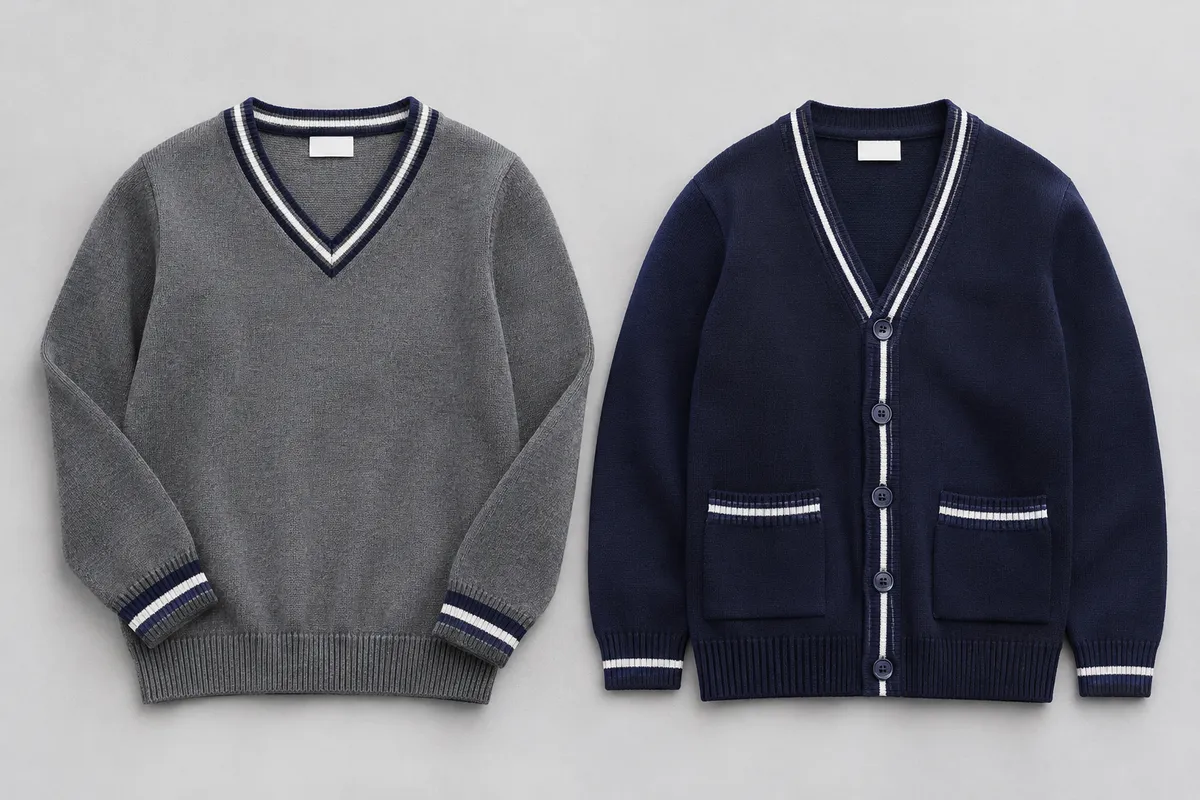
School jumpers are replaced mid-term more often than most uniform items, because they are taken off and lost, worn through at the elbows and cuffs, or damaged in the wash. A shop or school that plans only for the start of the year will find itself short of core sizes in the middle of the cold season, when families need a jumper the next day.
This post looks at the causes of mid-term replacement for knitwear, how to estimate the demand, and how to hold stock for it without overbuying.
Why do jumpers need replacing during term?
Each cause shows up in a different way at the counter.
| Cause | When it peaks | Sizes affected | What the buyer sees |
|---|---|---|---|
| Lost at school | Throughout the cold months | All, most in primary | Families buying the same size again |
| Outgrown | After the winter break | One band up from the start of year | Requests for the next size |
| Worn elbows or cuffs | Late in the season | Core sizes | Older jumpers replaced before spring |
| Shrunk or felted in a hot wash | Any time | All | A jumper that no longer fits after washing |
| Snags and pulled loops | Any time | All | Jumpers caught on bags or rough surfaces |
| New students joining | Start of each term | Spread across sizes | Single purchases outside the main rush |
Lost jumpers are the largest cause in many schools. A jumper taken off at break is easily left behind, and without a name in it, it often stays in lost property.
How can a buyer estimate mid-term demand?
Your own sales by week from last year are the most reliable guide. If you have them, look at sales between the first few weeks of term and the end of the cold season. That middle period is the replacement demand.
If you have no history, ask the school:
- How full is the lost-property box by the middle of winter?
- How many students join during the year?
- Has the school had complaints about jumpers wearing out or shrinking?
Then hold a reserve rather than guessing exact numbers.
Holding stock for mid-term replacements
A reserve works better than a large opening order. The opening order covers the start-of-year rush; the reserve and a top-up cover the months after.
- Keep a small reserve of each core size behind the counter
- Watch weekly sales by size from the first month of term
- Place a top-up early enough to arrive before the coldest weeks
- Hold a few pieces of the largest and smallest sizes, which are hard to replace quickly
- Tell the school when stock of a size is low, so they can warn families
Our knitwear minimum is 100 pieces per style, with sizes mixed, so a mid-term top-up can be built mainly from the core sizes that sell as replacements. Shops can find more on how orders are usually arranged on our page for uniform shops and retailers.
Reducing avoidable replacements
Some mid-term replacements can be reduced with simple advice. Fewer avoidable replacements mean fewer emergency orders and calmer weeks at the counter.
Names in jumpers. Encourage families to name every jumper. Many lost jumpers are found but cannot be returned.
Care advice. A short card with each jumper, repeating the care label, helps families avoid hot washes and tumble drying where the label advises against them.
Fit at purchase. A jumper bought far too large is pushed up at the sleeves and wears faster at the elbows. A good fit lasts longer.
A second-hand rail. Some schools collect unclaimed lost property at the end of term and offer it at the school. This takes some pressure off new stock, and shops can plan around it.
If mid-term replacement is a regular pattern at your schools, send us your weekly sales and we will quote a main order and a timed top-up of your school jumpers and cardigans per style, by fabric, quantity and branding.
Questions buyers ask
Is mid-term demand higher for jumpers or cardigans?
It follows whichever is worn more. Cardigans can be more likely to be taken off in warm classrooms and left behind, so where both are common, plan a reserve for each style.
Can a school order replacement stock directly?
Yes. A school that sells uniform from its own office can order knitwear in bulk and hold a reserve for replacements. The same minimum of 100 pieces per style applies.
Do replacement jumpers match the ones bought earlier in the year?
Repeat orders are knitted to the approved sample, so body colour, trim and fit stay consistent. Small shade differences between yarn lots are possible, which is rarely noticeable once jumpers are worn.