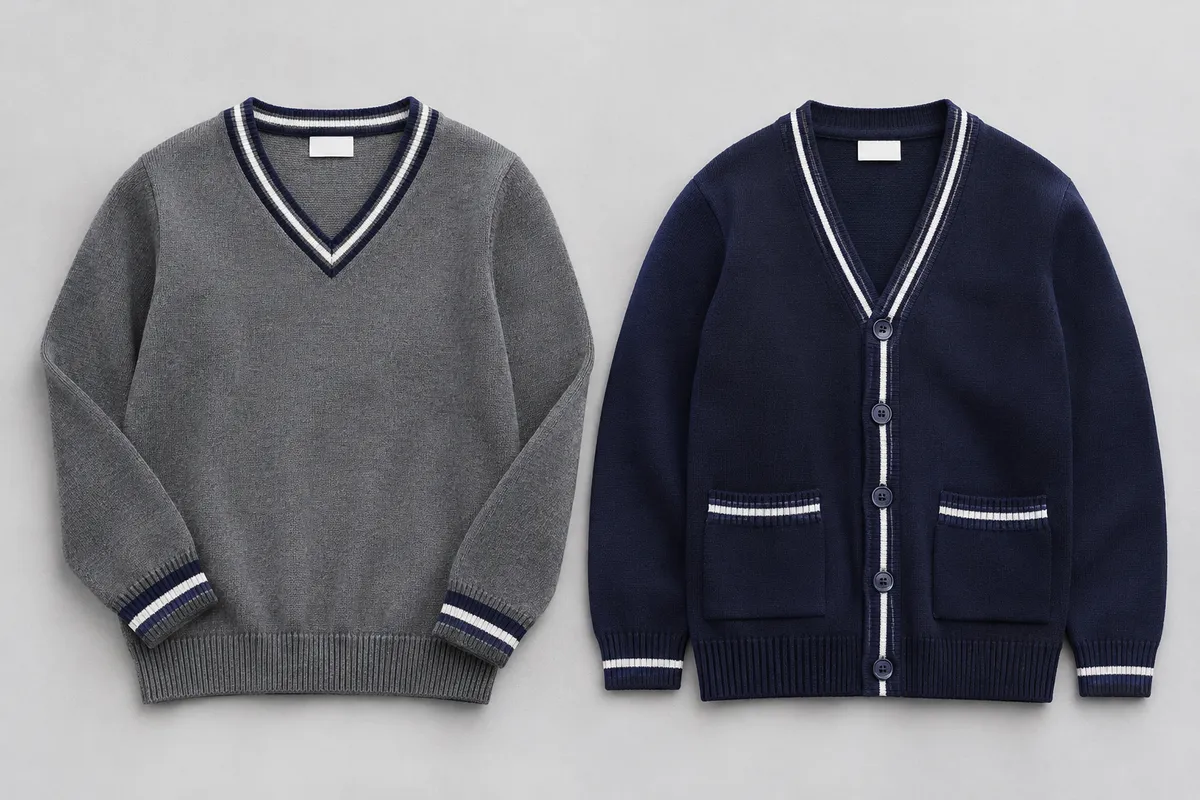
School jumper sizes by age are written as two-year bands, such as 7–8 or 11–12, and each band is a set of garment measurements rather than a promise about a child’s age. A shop or school reads the band as a label for a chest width, body length and sleeve length, and agrees those numbers with the maker before bulk knitting starts.
This post explains what an age band on a knitted jumper actually describes, how the bands step up, and where they hand over to chest sizes for older students.
What does an age band on a school jumper mean?
An age band is shorthand. The label says 9–10, but the knitting machine works to a chest width, a body length, a sleeve length and a neck depth. The age is a guide to which children that set of measurements usually fits.
Children of the same age vary a great deal in height and build. A tall eight-year-old may wear 9–10, and a slight eleven-year-old may still be comfortable in 9–10. That is why parents and staff should be told to choose by fit, and why a shop’s fitting room matters more for knitwear than the age printed on the label.
For buyers, the useful point is this: two makers can both label a jumper 9–10 and produce different garments. The band only means something once the measurements behind it are written down and agreed.
How the bands usually step up
A typical school knitwear range runs in even steps of two years. The table below is a planning example of the bands a range might use and the year groups each tends to serve. Your own range may start or stop at different points.
| Age band | Usually worn by | Planning note |
|---|---|---|
| 3–4 | Nursery and reception | Cardigans more common than V-necks here |
| 5–6 | Early primary | Short sleeves get rolled up; sleeve length matters |
| 7–8 | Middle primary | Slipovers often start from this band |
| 9–10 | Upper primary | A busy band for primary schools |
| 11–12 | Last year of primary, first of secondary | Two kinds of buyer share this band |
| 13–14 | Lower secondary | Often the core size for a secondary list |
| 15–16 | Upper secondary | Last age band before chest sizes |
The step between bands is usually larger in body length than in chest width, because children grow taller faster than they grow broader. Ask to see the measurement chart rather than assuming a fixed step.
Our styles list sizes from age 3–4 to 15–16, then chest sizes for senior students, with slipovers starting at around 7–8. The chart itself is agreed for each order.
Where do age sizes stop and chest sizes start?
Around the mid-teens, age stops being a sensible guide. Some students in the final years are adult height and build; others are not. A knitwear range therefore usually switches from age bands to chest sizes, written either in centimetres or inches, or as letters with a chest measurement beside them.
The handover point is a decision for the buyer. A secondary school with older students may want age bands to 13–14 and then chest sizes. A primary school may never need chest sizes at all. A shop serving both may run the full set.
If you already stock knitwear, the simplest route is to send one jumper in each size you sell. We measure them and match the measurements on the sample, so your new stock sits beside the old without a change in fit.
How to turn age bands into a size chart you can trust
Write down the measurements for each band before you ask for a quotation. A short chart with five points is enough for most knitwear:
- Chest width, measured flat one centimetre below the armhole
- Body length from the high shoulder point to the hem
- Sleeve length from the shoulder seam to the cuff edge
- Depth of the V from the shoulder line to the point of the V
- Width of the ribbed hem when relaxed
Add a tolerance for each point, because knitted fabric relaxes slightly after washing and pressing. Agree whether the chart describes the garment or the child’s body, and say so at the top of the chart. Our size charts page explains how a chart is set for each order.
Once the chart is agreed, every repeat order is knitted to it. That keeps a 9–10 bought in September the same as a 9–10 bought in February.
If you have a band list and a rough quantity for each, send them with your styles and colours, and we will quote your knitted school jumpers and cardigans per style, by fabric, quantity and branding.
Questions buyers ask
Why do some jumpers say 7–8 and others say 122 or 128?
Some ranges label sizes by height in centimetres instead of age. Both describe the same idea: a set of garment measurements. If your customers know one system, keep it, and print the other beside it on the label if that helps.
Can a primary range and a secondary range share one size chart?
Yes, where the bands overlap the measurements can be identical. A shop then holds one stock of 11–12 that serves both the top of primary and the start of secondary, provided both schools use the same jumper colour.
Do cardigans follow the same age bands as jumpers?
Usually yes, so the shop rail reads the same across both styles. The chest and length points match, while the front opening and button positions are set separately on the cardigan sample.