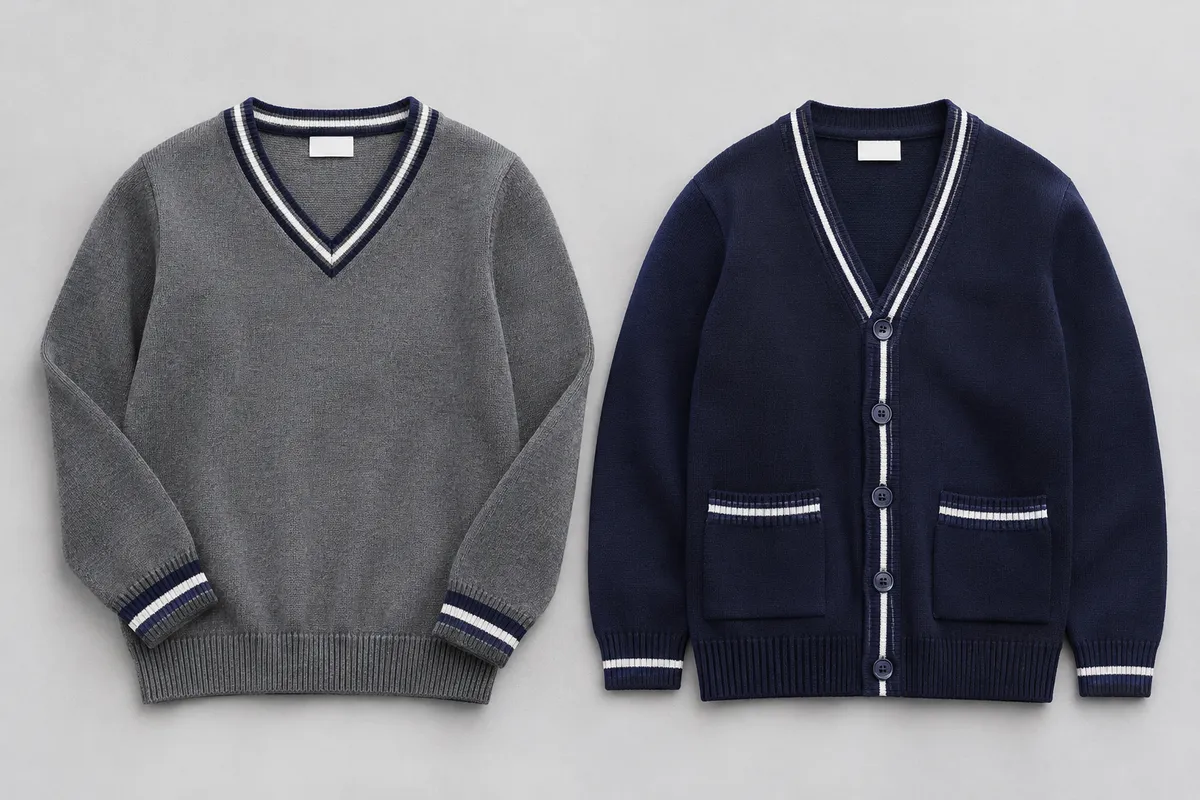
A school cardigan size chart needs the same core points as a jumper chart, chest, length and sleeve, plus a few that only an open-front garment has: the button band width, the number and spacing of buttons, and the chest measured with the cardigan fastened. Getting these extra points written down is what keeps a cardigan from gaping or hanging short once it reaches the shop.
Below is a practical list of the measuring points, a sample layout for the chart, and the checks we suggest when the first sample arrives.
Which points belong on a cardigan chart?
Start with the points that any knitted top needs, then add the front details. Measure the garment laid flat on a table, buttoned, with no stretching.
| Point | How it is measured | Why it matters on a cardigan |
|---|---|---|
| Chest width | Across the front, buttoned, just below the armholes | Measured buttoned so the overlap is included |
| Body length | High shoulder point to hem, at the front | Front and back can differ if the band pulls |
| Sleeve length | Shoulder seam to cuff edge | Same as a jumper |
| Button band width | Across the band, edge to edge | Sets the overlap and how the front lies |
| First button position | From the shoulder line down to the top button | Fixes the depth of the V |
| Button spacing | Centre to centre between buttons | Changes with each size |
| Hem width | Across the ribbed hem, relaxed | A tight hem rides up over a skirt or pinafore |
Write down whether each figure is a half measurement (flat width) or a full circumference. Mixing the two is one of the most common reasons a cardigan chart goes wrong.
Buttons and spacing change with the size
A cardigan for age 3–4 and one for a senior student cannot share the same button layout. The smaller body is shorter, so either the buttons sit closer together or there are fewer of them.
Buyers usually choose one of two approaches:
- Same number of buttons on every size. The spacing grows as the size grows. The front looks the same across the range, which suits shops that display several sizes side by side.
- Fewer buttons on small sizes. Small cardigans have, say, one button fewer. Spacing stays closer to even, and young children have fewer buttons to manage.
Whichever you choose, write the button count for each size into the chart. If the logo is embroidered on the left chest, the chart should also note how far the badge sits from the button band, so it does not disappear under the overlap.
Tolerances and a cardigan’s relaxed shape
Knitted fabric moves. A cardigan measured straight off the machine, after washing and after pressing can show small differences in length and width. A chart that gives a single figure with no tolerance invites argument at the quality check.
Set a tolerance for each point, a little wider on length than on chest, and agree it on the sample. Our quality check measures against the agreed chart and tolerance, not against a figure that was never written down. The size charts page sets out how charts are agreed for each order.
If you already sell a cardigan that customers like, send one in each size. We measure them point by point and use those figures as the starting chart.
Checking the first cardigan sample
When the sample arrives, test it the way a customer will.
- Button it and measure chest width flat; compare with the chart
- Check the front edges hang level, with no dip at the bottom button
- Count the buttons and measure spacing against the chart
- Try it over a shirt and over a pinafore or blouse, if both are worn
- Check the hem rib does not grip and ride up
- Confirm the size label and the size sticker match
Note any changes in writing against the chart, so the revised figures become the reference for bulk production and every repeat.
Once your chart is ready, even in draft, send it with your colours and quantities and we will quote your school cardigans and jumpers per style, by fabric, quantity and branding.
Questions buyers ask
Should a cardigan be measured buttoned or open?
Buttoned. Measuring with the front closed includes the overlap of the button band, which is how the cardigan will be worn. Write “measured buttoned” at the top of the chart so nobody measures it open.
Can a cardigan use the same chart as the matching V-neck jumper?
The chest, length and sleeve points can match, so the two styles look consistent on the rail. The cardigan then needs its own extra rows for the button band, button count and spacing.
Why does a cardigan sometimes measure longer at the front?
A firm button band can pull the front down slightly, or a loose one can let it drop. Measure front and back length separately on the sample, and if they differ, agree which one the chart controls.