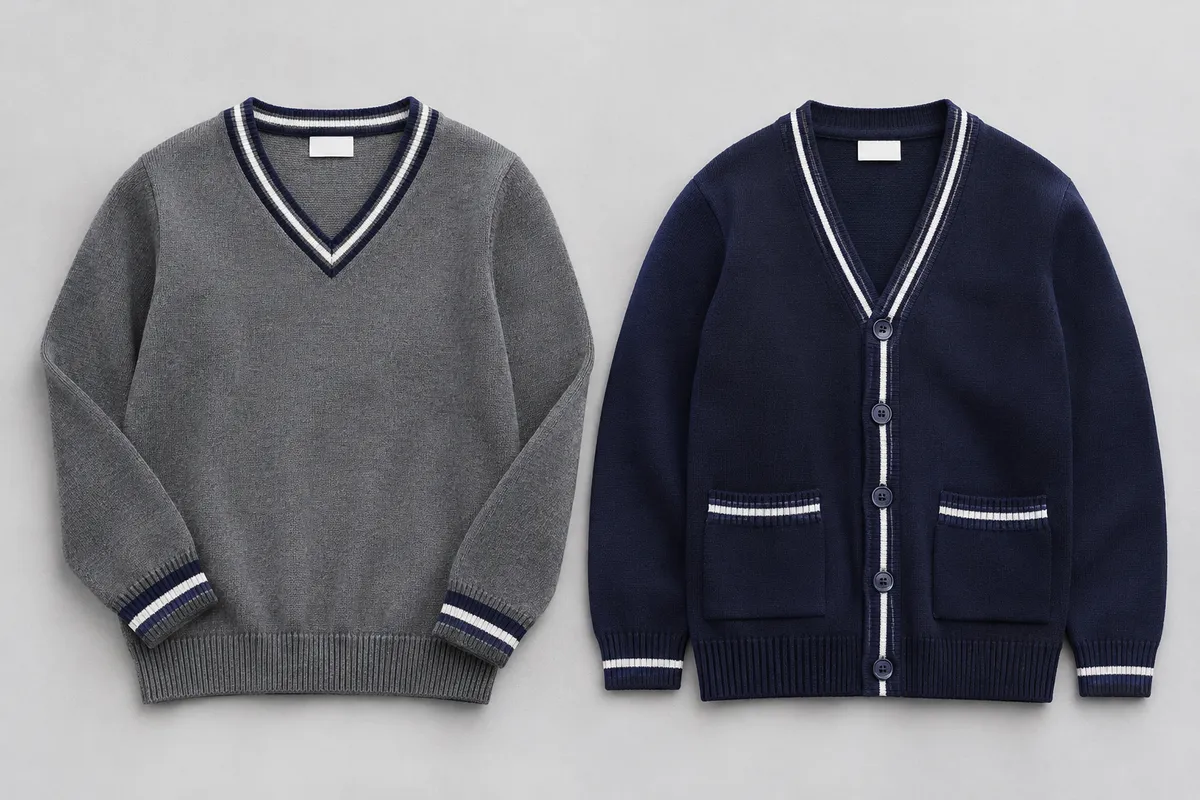
School jumpers for charity programmes are usually plain knitted V-necks or cardigans in a common school colour, ordered in a size mix by age band and packed by size so they can be handed out quickly. The key decisions are colour, size mix and timing, because a warm jumper is only useful if it reaches a child before the cold weather does.
This post is for charities, community groups and uniform programmes that provide knitwear to children who need it. It covers what to order, how to estimate sizes without fitting every child, and how to plan the timing.
Which jumpers suit a charity programme?
A programme often serves children from several schools. A school-specific jumper with a badge and stripes only works for one school, so most programmes choose plain knitwear.
| Choice | Works for | Watch for |
|---|---|---|
| Plain V-neck in a common colour | Several schools that share that colour | Schools with a different colour cannot use it |
| Plain cardigan | Younger children, and schools that allow cardigans | Fewer schools list cardigans for older students |
| One school’s own striped jumper | A programme run with a single school | Leftovers cannot go to other schools |
| Two or three plain colours | Programmes covering many schools | Each colour is a separate style with its own minimum |
Ask the schools you serve which jumper colours they accept, and whether a plain jumper without a badge is allowed. Many schools accept plain knitwear in the right colour.
Estimating a size mix without fitting every child
Charities rarely have the chance to measure each child before ordering. A size mix by age band, based on the ages of the children you expect to help, is the practical alternative.
Here is a starting example for a programme supporting primary and lower secondary children. Adjust it to the ages you serve and to any records from earlier years.
| Age band | Starting share | Note |
|---|---|---|
| 5–6 | Low to medium | Younger children may receive cardigans instead |
| 7–8 | Medium | |
| 9–10 | Medium to high | |
| 11–12 | High | Covers the move between primary and secondary |
| 13–14 | Medium | |
| 15–16 | Low | Fewer older children in many programmes |
When in doubt between two sizes, lean towards the larger one. A child can wear a slightly large jumper for longer; a small one is soon useless.
Timing the order for winter
A charity order is often tied to funding dates. Work out when the jumpers must be in children’s hands, then plan backwards from it through distribution, delivery, production and the sample. Lead time is confirmed in the quotation, so share your target date in the enquiry.
- Date children need the jumpers, before the cold weather
- Time needed to sort and hand out once delivered
- Date funding is confirmed and the advance payment can be made
- Time to approve a sample
- Buffer for delays
If funding arrives late in the year, a smaller first order of the busiest sizes can go ahead, with more following later.
Packing for distribution
Packing affects how quickly volunteers can hand jumpers out. Each jumper is folded with a size sticker, and cartons can be packed by size, so the sizes can be laid out without unpacking every box. If the programme supplies several schools, cartons can be packed by school instead, provided each school’s quantities are known in advance. Packing is confirmed in the quotation.
Our page for charities and uniform programmes explains how programmes usually work with us. The minimum for knitwear is 100 pieces per style, with sizes mixed, so a programme can reach it with one colour and a spread of sizes.
When your colours, ages and target date are clear, send them with any funding timetable, and we will quote your plain school jumpers and cardigans per style, by fabric, quantity and branding.
Questions buyers ask
Can a programme add its own label to donated jumpers?
Yes, a woven or printed label can be sewn in during making. Some programmes prefer a neutral label so the jumper looks like any other school jumper, which helps children feel comfortable wearing it.
Should a programme supply jumpers and cardigans together?
It depends on the schools. Where both are allowed, offering a cardigan for younger children can help. Each is a separate style, so check both can reach the minimum before including them.
What if the programme has leftover sizes after distribution?
Plain jumpers keep well if stored folded and dry, and can be used in the next year’s programme. Record what was left over so the next size mix can be adjusted.