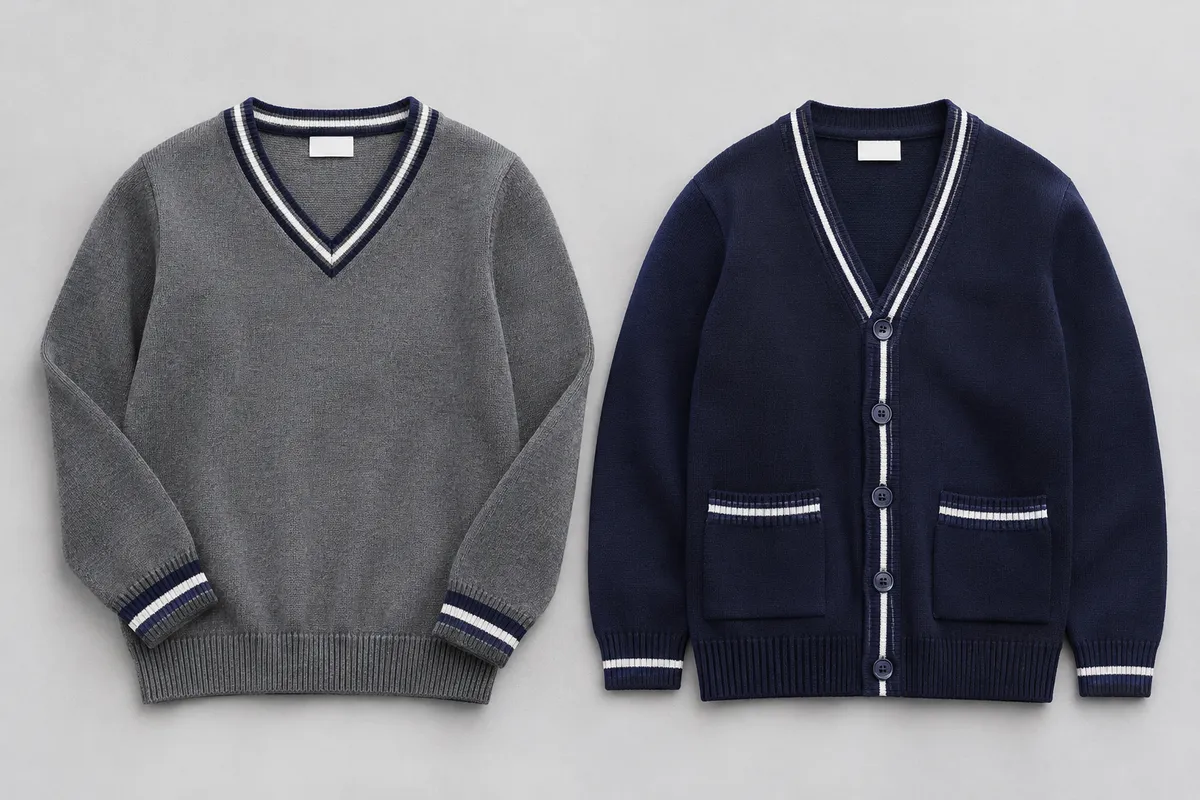
Knitted school jumpers in Australia sell mainly in Terms 2 and 3, when schools switch to winter uniform for the cooler months from around late April to September. Because the school year starts in late January or early February, in summer, an Australian buyer can order knitwear separately from the summer uniform and time it to arrive before Term 2.
This post explains how the Australian calendar shapes knitwear orders, how demand varies across the country, and how to tell suppliers whether “jumper” means knitted or fleece.
Why knitwear is a separate order in Australia
In the northern hemisphere, knitwear is bought with everything else before the school year. In Australia, the summer uniform is what families need first: polos, dresses, shorts and skorts for a January or February start. Jumpers and cardigans can wait.
That gives buyers two separate orders with two arrival dates:
| Order | Main garments | Arrival target |
|---|---|---|
| Summer and start of year | Polos, dresses, shorts, skorts, shirts | Before the January or February start |
| Winter | Knitted jumpers, cardigans, slipovers | Before Term 2 begins |
| Winter top-up | Core knitwear sizes | Early in Term 2, before the coldest weeks |
Splitting the order this way spreads cash flow and stockroom space across the year. It also means the knitwear order can use sales information from the previous winter, collected while the summer order is in production. Lead time is confirmed in the quotation for each order.
How demand differs across the country
Australia’s climate varies a great deal, and so does knitwear demand.
- Southern states and highland areas. Cold mornings in winter. Knitted jumpers and cardigans are worn daily through Terms 2 and 3, and some students wear them from late Term 1.
- Coastal temperate cities. Mild winters, with knitwear worn on cooler days. Demand is steady but shorter.
- Northern and tropical areas. Little need for warm layers. Knitwear may be optional or absent from the list, and demand is small.
A distributor serving schools in several states should plan each region separately, with its own quantities and possibly its own arrival date. Distributors can read more about how we work with them on the page for schoolwear suppliers and distributors.
Knitted or fleece? Saying which “jumper” you mean
In Australia, “jumper” covers both knitted pullovers and fleece sweatshirt tops. A school list may say “school jumper” and mean either. Before ordering, confirm which the school wants:
- Knitted jumper. Knitted from yarn, often V-neck, plain or with stripe trim. Usually seen on secondary and more formal uniforms.
- Fleece jumper. Sweatshirt fabric, often crew-neck or zip-front, common in primary schools.
We make the knitted versions in acrylic or cotton-acrylic knit: V-neck jumpers, cardigans and sleeveless slipovers. In your enquiry, write “knitted” beside every jumper, so the quotation cannot be read as fleece.
Checklist for an Australian winter knitwear order
- Confirm the school’s winter uniform start date for Term 2
- Set the arrival date with a buffer before that date
- Send a current jumper as the colour and trim reference
- List sizes, from the youngest year group wearing knitwear to senior chest sizes
- Note which campuses or regions each quantity is for
- Plan a top-up for the colder weeks of Term 2 and Term 3
- Count leftover knitwear at the end of Term 3 for next year’s order
Each knitted style starts at 100 pieces, sizes mixed. We manufacture in India and take enquiries from Australian shops, distributors and schools; shipping is agreed in the quotation.
When your winter dates and sizes are set, send them over and we will quote your knitted jumpers and cardigans per style, by fabric, quantity and branding.
Questions buyers ask
When do Australian schools usually change to winter uniform?
Many change around the start of Term 2, in late April or early May, and return to summer uniform in Term 4. Dates vary by state and by school, so confirm each school’s own policy.
Should an Australian order include slipovers?
Only where the school lists them. Slipovers are less common on Australian lists than jumpers and cardigans, but some secondary schools use them under a blazer in winter.
Can leftover winter knitwear be sold the following year?
Yes, if the uniform has not changed. Store it folded and dry over Terms 4 and 1, then count it before placing the next winter order.