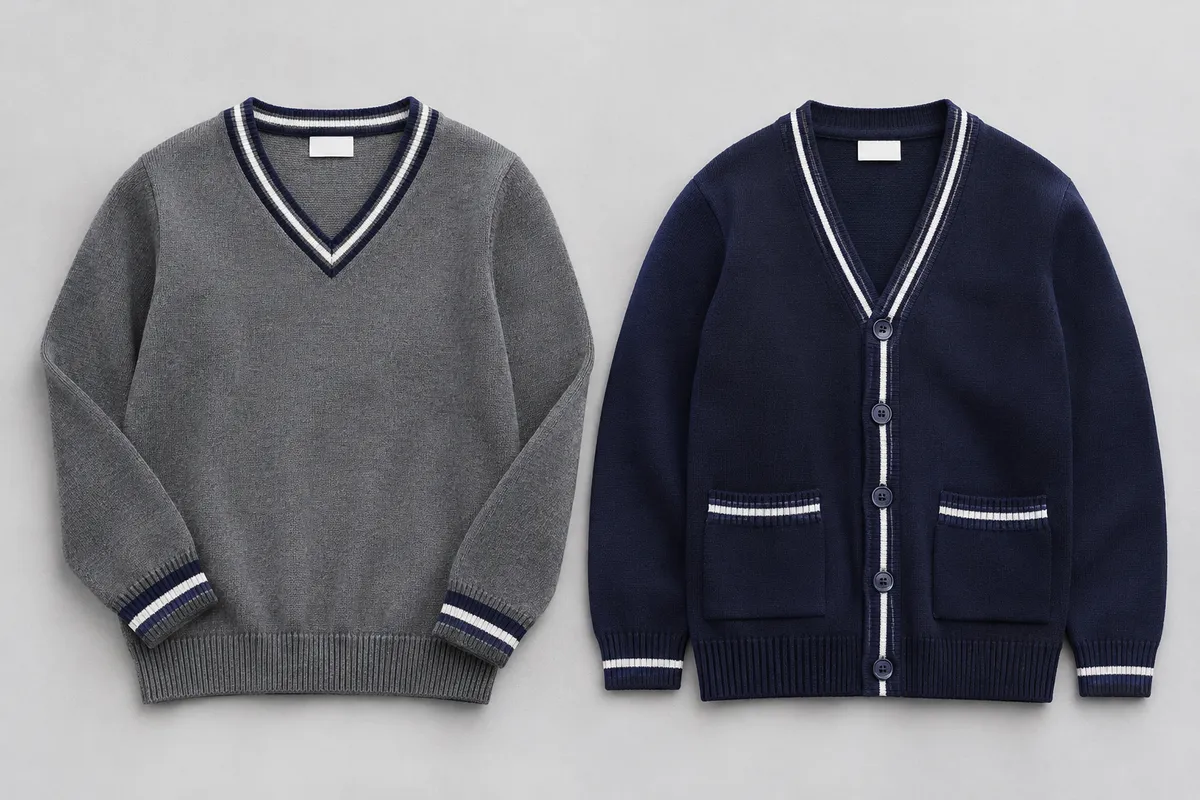
With knitwear gauge explained simply: gauge is how closely the needles are set on the knitting machine, usually counted as needles per inch, and it decides how fine or chunky the finished fabric looks. A higher gauge number means more, finer stitches; a lower number means fewer, larger stitches. School jumpers are generally knitted in a fine to medium gauge.
You do not need to specify a gauge number to order school knitwear. It helps, though, to understand the term when comparing samples or reading another supplier’s specification.
What the number means
On a flat knitting machine, needles sit in a row along a bed. The gauge is the count of needles in a set length, traditionally an inch. Each needle makes one column of stitches. More needles in the same width give more, smaller stitches; fewer needles give bigger stitches.
Gauge and yarn go together. A fine gauge needs a finer yarn, because thick yarn will not fit between closely spaced needles. A coarse gauge uses a thicker yarn. So when buyers say a jumper is “fine knit” or “chunky”, they are describing the gauge and yarn together.
Fine, medium and coarse compared
| Gauge band | What you see | How it feels | Where you meet it |
|---|---|---|---|
| Fine | Small, tight stitches; smooth surface | Light, close to the body, drapes | Many school V-necks and cardigans |
| Medium | Stitches visible but neat | A little more body and warmth | Some school jumpers, especially in colder climates |
| Coarse | Large, obvious stitches | Thick, heavy, casual | Fashion knitwear, rarely school uniform |
These bands are descriptive. The exact gauge of a school jumper depends on the yarn and the look the school wants, and is confirmed on the sample.
How gauge affects a school jumper
Look
A finer gauge looks smarter and sits neatly under a blazer. A heavier gauge looks more casual and can bulk up under a jacket.
Warmth
A heavier knit traps more air and feels warmer, but warmth also depends on yarn and on how densely the fabric is knitted. A fine, dense knit can be warm enough for a heated classroom.
Logo
Embroidery sits more cleanly on a fine gauge, because the surface is smoother. On a coarse knit, fine detail sinks between large stitches. Logo embroidery or printing is available, and method, size and position are confirmed with the sample.
Stripes
Narrow stripes are easier to knit cleanly in a fine gauge, because each stripe is made from more rows in the same width.
Comparing samples from different makers
If you are moving from one supplier to another, gauge is one of the first things to compare. Two jumpers in the same colour and yarn can look different simply because one is knitted finer. Lay them side by side:
- Count the stitch columns in a short width on each; a big difference means a different gauge
- Compare how each drapes when held up by the shoulders
- Compare the weight in your hand
- Look at how the logo embroidery sits on each surface
- Check the stripes are as narrow and crisp on both
Send us your current jumper and we match the gauge as closely as our knitting allows, showing it on the sample. Our page on fabrics and colour matching explains what else to send when copying an existing garment. We manufacture in India, and the gauge you approve is used for every repeat.
If you have a jumper you want matched, or a feel you are aiming for, describe it in your enquiry and we will quote your knitted jumpers and cardigans per style, by fabric, quantity and branding.
Questions buyers ask
Is a higher gauge always better quality?
No. A higher gauge is finer, not automatically better. A medium gauge suits a warmer, sturdier jumper, while a fine gauge suits a smart look under a blazer. Quality depends on yarn, knitting tension and making as much as gauge.
Does gauge affect how much a jumper stretches?
Partly. A finer knit made with thin yarn can feel more delicate, while a medium knit has more body. Stretch and recovery depend on yarn and tension too, so test them on the sample rather than relying on the gauge number.
Do jumpers and cardigans in one range use the same gauge?
Usually, yes, so they look and feel like a set on the shelf. If one is noticeably finer, families will see it. Approve both samples together to confirm they match.