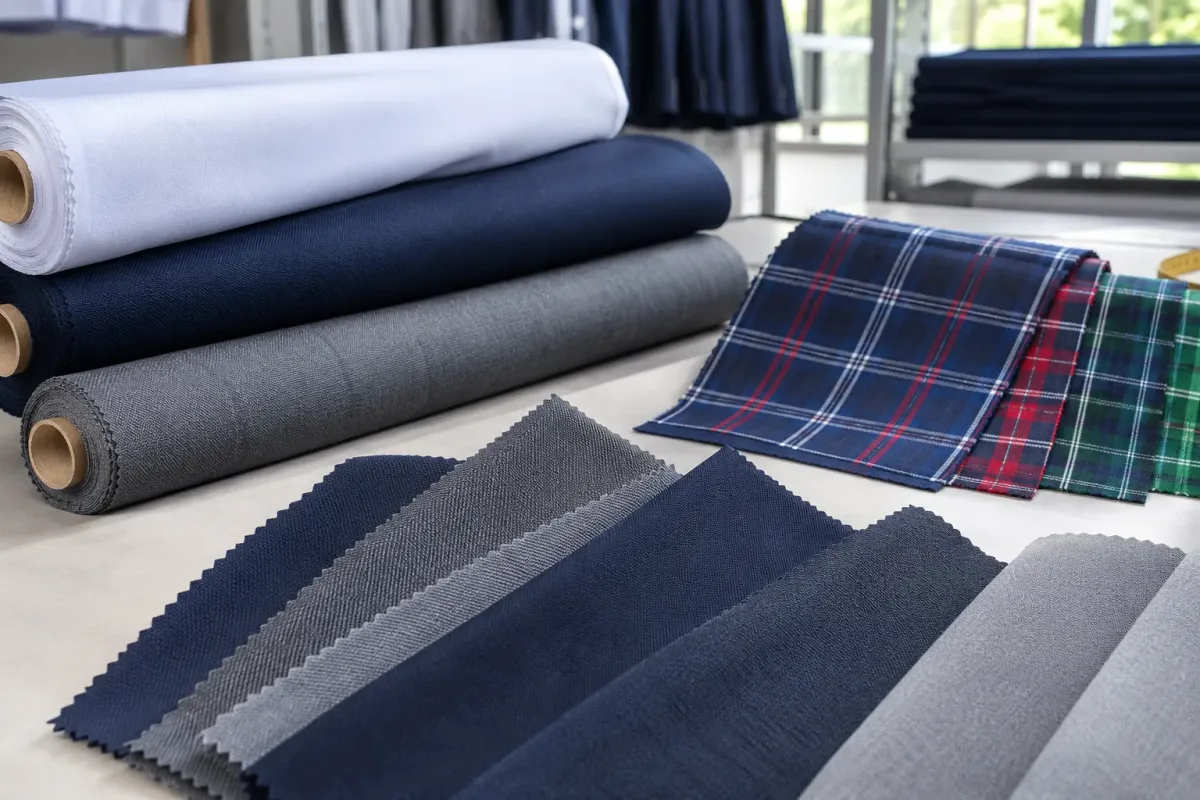
School group uniform colours work well as a shared framework rather than a single uniform: every school in the group uses the same garment styles and the same neutral colours for shirts and lower garments, while each school keeps its own main colour for knitwear or blazers, plus its own trim and badge. That keeps fit, ordering and stock simple while each school stays recognisable.
Groups of schools, whether a trust, a chain or a set of sister schools, often want a family look and the buying advantages that come with it. The colour palette is where that balance between shared and individual is set.
Three models for a group palette
| Model | What is shared | What differs | Suits |
|---|---|---|---|
| One uniform | Every garment and colour | Only the badge | Groups that want a single identity |
| Shared framework | Styles, neutrals, sometimes the accent | Main colour and badge | Groups wanting a family look with local identity |
| Shared styles only | Garment patterns and fabrics | All colours and badges | Groups focused on buying, not on a shared look |
The shared framework is the most common because it balances both aims. A group might give every school white shirts and grey trousers and skirts, but a navy jumper at one school, a bottle green jumper at another and a maroon jumper at a third.
Deciding what to share
Shared neutrals
Shirts, blouses, polos and lower garments carry the least identity and the most volume. Sharing their colours lets the group order them together, in one fabric and one shade.
Individual main colours
Knitwear, sweatshirts and blazers carry identity. Giving each school its own colour here keeps local pride.
Shared or individual accent
A shared accent, such as the same gold trim at every school, emphasises the group. An individual accent emphasises each school. Either can work; decide once and apply it to every school.
Planning the order across the group
A group palette makes the order easier to plan, because shared items combine into larger quantities and individual items are kept separate.
- List every garment on the group’s uniform framework.
- Mark each as shared or individual.
- Fix a colour reference for each shared colour and for each school’s main colour.
- Combine quantities of shared items across schools.
- Plan individual items per school, keeping in mind each style’s minimum: 50 pieces per style for woven garments and 100 for knitwear, with sizes mixed within each and the colour split confirmed at quotation.
- Agree packing: by school, so each delivery can go straight to its site, or by size for a central store.
- Shared items identified and quantities combined
- One colour reference per shared colour
- One colour reference per school’s main colour
- Trim and badge colours listed per school
- Packing method agreed
Groups can see how we handle multi-school orders on our page for schools and school groups.
Reviewing the framework
Revisit the shared framework every few years. Check whether the shared neutrals still suit every school’s main colour, whether any school wants to change, and whether combined quantities still justify the shared items. A short review keeps the palette working as the group grows.
Adding a new school to the group
When a school joins, the framework makes it simple: it takes the shared items as they are and chooses its own main colour, trim and badge. Choose a main colour clearly distinct from the existing schools, so stock and garments do not get confused. Match it to a reference and approve a sample before the first order.
Our knitted jumpers and cardigans suit this approach well: one base jumper, each school in its own colour and stripe. Send us the group’s framework and each school’s colours, and we will quote each style by fabric, quantity and branding.
Questions buyers ask
Should every school in a group have the same uniform?
It depends on the group’s aims. A single uniform is simple and strong, but schools may lose local identity. A shared framework with individual main colours keeps buying efficient while letting each school remain recognisable to its own families.
Can one jumper pattern be made in different colours for each school?
Yes. The jumper keeps one pattern and size chart, while each school’s colour and stripe trim are matched to its own reference. Each colour is approved on a sample, and repeat orders for every school follow that approval.
How do we stop schools in a group choosing similar colours?
Keep a simple register of every school’s main and accent colours with physical references. Before a new school chooses, compare its preferred shade against the register so it stands clearly apart from the others.