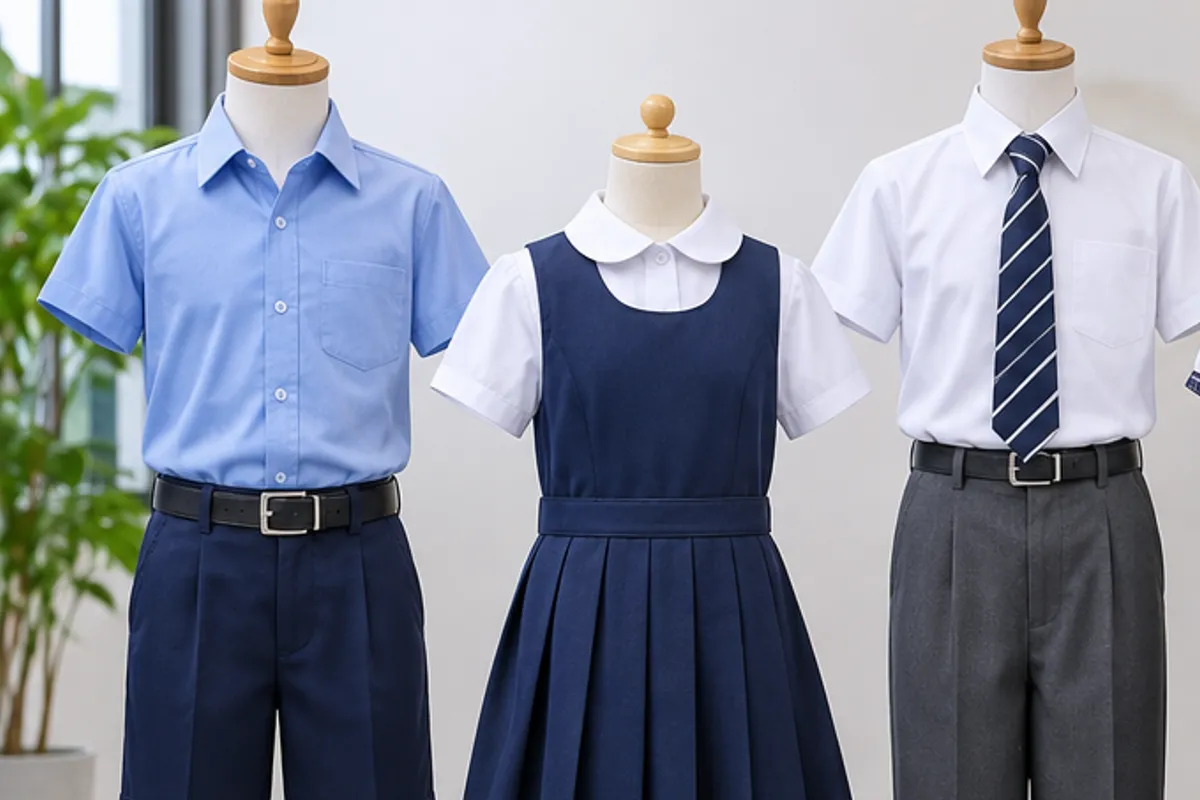
Reinforced knee school trousers have an extra layer of fabric sewn inside the front of each leg at the knee, so the area that rubs on floors and playgrounds has two layers instead of one. It is an option rather than a standard feature, and it suits younger, active children most. For older students and formal uniforms, a single layer in a hard-wearing cloth is usually enough.
Knees are where junior trousers wear through first. Children kneel on carpets, slide on playground surfaces and crawl under tables, and a hole at the knee can end a pair long before it is outgrown. Reinforcement is one way to slow that down.
How the reinforcement is built
There are two common ways to reinforce a trouser knee.
Inner knee patch. A panel of fabric is cut to cover the knee area and stitched to the inside of the front leg panel before the leg is closed. From the outside the trouser looks normal, apart from the rows of stitching that hold the patch, which can be hidden in the design or made neat and even.
Double-layer front. A larger inner layer runs from above the knee to below it, often caught into the side seams. It spreads the wear over a bigger area but adds more weight.
Both are made at the cutting and sewing stage, so the decision must be made before production. It cannot be added to finished stock.
Where reinforcement helps, and where it does not
| Situation | Is reinforcement worth considering? | Why |
|---|---|---|
| Nursery and infant trousers | Often yes | Floor play and kneeling are constant |
| Junior trousers | Sometimes | Depends on how hard they are worn |
| Senior trousers | Rarely | Wear is lighter; extra bulk is unwelcome |
| Shorts | No | No knee to protect |
| Formal or ceremonial trousers | No | Look and drape matter more |
| Charity programmes with long-life aims | Worth asking about | Each pair needs to last |
Reinforcement does not make a trouser indestructible. It delays wear at one point. Seams, hems and pockets still wear in the usual way.
The trade-offs
Before adding it, weigh what changes:
- Weight and stiffness. Two layers at the knee feel heavier and bend less freely, which some children notice.
- Drying time. A double layer takes longer to dry after washing, especially in a damp climate.
- Appearance. The outline of the patch or its stitching can show, particularly on light grey.
- Production steps. Extra cutting and sewing affect the quotation, so it is quoted per style.
- Letting down hems. Reinforcement fixed at a particular height may sit lower on the knee once a hem is let down and the child has grown.
None of these rule reinforcement out. They simply mean it should be chosen deliberately, for the sizes and buyers who gain most.
Fabric choice as the first line of defence
Before adding a second layer, consider the cloth. Polyester twill is firm and stands up well to rough wear, which is why many buyers choose it for junior trousers. Poly-viscose is softer and drapes more, which suits older students who wear trousers more gently. Our page on fabrics and colour matching sets out the fabric options for each garment.
For many shops, polyester twill in the junior sizes is enough on its own, and reinforcement is kept for the very youngest age bands or for specific schools that ask for it.
Specifying reinforced knees
If you want reinforcement, include these points at enquiry:
- Which styles and sizes should be reinforced.
- Inner patch or larger double-layer front.
- Whether the stitching should be visible or kept as discreet as possible.
- The fabric for the patch: same as the trouser, or a lighter cloth.
- How the reinforced trousers will be labelled, so staff can tell them apart.
We discuss reinforcement at quotation and show it on the sample, where you can check how the knee bends and how the stitching looks. The trouser styles it can be applied to are on our school trousers and shorts page, from 50 pieces per style.
Tell us your age bands and how hard the trousers are worn, and we will quote by fabric, quantity and branding.
Questions buyers ask
Can a reinforced and an unreinforced trouser be sold in the same style?
They are better treated as two styles, because the construction differs. Each would then need its own quantity at the minimum, and clear labelling so families know which they are buying.
Do reinforced knees affect ironing?
A little. The double layer can leave a faint ridge if pressed hard on the outside. Pressing from the inside, or with a cloth, keeps the knee area smooth.
Would a knee patch on the outside be an alternative?
An outer patch protects well but looks like repair work and is rarely accepted on school uniform. An inner patch keeps the trouser looking ordinary from the outside, which is why buyers usually prefer it.