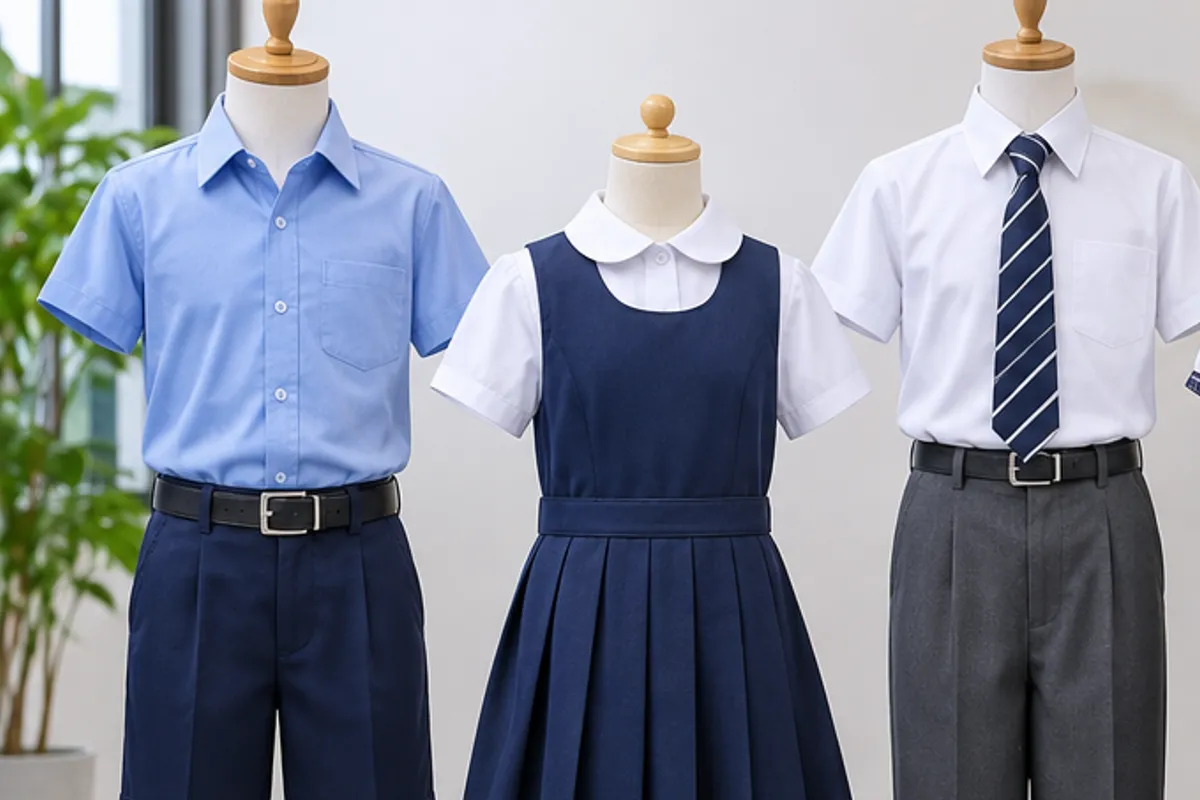
A school shorts size ratio should lean towards the younger and middle age bands, because shorts are worn most by infant and junior students and sell in a short, concentrated season. A practical start gives the most pairs to ages 5–6 to 9–10, fewer to the youngest band, and a small tail into ages 11–12 and 13–14.
Shorts are not simply trousers with less leg. They are bought by a narrower group of students, in a narrower window of the year, and usually in more than one pair at once. That changes the ratio.
Who buys school shorts?
The shape of a shorts ratio follows the students who wear them.
- Infants and young juniors wear shorts most often, and many schools list them as the default summer bottom for these years.
- Older juniors wear them less as they move towards trousers, especially in cooler climates.
- Seniors rarely wear tailored shorts on the day uniform in many countries, though warm-climate schools may list them for every year.
- Girls may wear shorts where the uniform list allows a choice, which adds demand across the same age bands.
Our shorts run from age 3–4 to 13–14, and the elastic-back version is offered up to age 11–12. Your own size range is agreed for each order.
Example ratios for three kinds of school
The three columns below are starting examples. Adjust them against your own sales or roll data before you order.
| Age band | Infant-heavy school | Junior school | All-age school in a warm climate |
|---|---|---|---|
| 3–4 | 3 | 1 | 1 |
| 5–6 | 4 | 2 | 2 |
| 7–8 | 3 | 3 | 2 |
| 9–10 | 1 | 3 | 3 |
| 11–12 | — | 2 | 3 |
| 13–14 | — | 1 | 2 |
| Total parts | 11 | 12 | 13 |
Read each column on its own. In the junior school column, an order of 120 pairs gives ten pairs per part, so 10 in age 3–4, 20 in 5–6, 30 each in 7–8 and 9–10, and so on.
The infant-heavy column stops at 9–10 on purpose. If a school has very few older students in shorts, leaving the upper bands out of the first order is safer than holding stock that may not move until next summer.
How does the short season change the ratio?
Trousers sell across the whole year. Shorts sell mostly in the weeks before and just after the warm term starts. That has two effects on sizing.
First, there is little time to correct a mistake. A size that sells out in the first fortnight may not be worth reordering if the season will be half over before new stock lands. So the ratio needs to be right at the start, with a little extra depth in the sizes you expect to move fastest.
Second, children grow over the cooler months. A student who wore age 7–8 last summer may need 9–10 this year. Buyers who base the shorts ratio on last summer’s sales should shift it up by about one band in the younger sizes to allow for this.
Signals to change your shorts ratio
Keep a short record during the season and act on it the next year.
- Sizes that sold out, and the week they ran out
- Sizes left over when the warm term ended
- Requests for sizes above 13–14 that you could not fill
- How many students switched to elastic-back from a regular waist
- Whether the school changed its summer list, for example allowing shorts for an extra year group
Leftover shorts are usually still sellable the following year, as long as the colour and style stay on the list. That makes overstock in the middle sizes less risky than a sell-out, but stock in the largest sizes can sit for a long time.
Shorts alongside trousers in one order
Shorts and trousers can be cut from the same fabric and colour so they match on a student. Each is its own style for the minimum of 50 pieces, with sizes mixed freely within it. Many buyers set the shorts ratio first, then fill the trouser ratio around it, because shorts have the tighter selling window.
See our shorts and elastic-back styles on the school trousers and shorts page, and read how the starting measurements are set on our size charts page. Send us the ratio you have in mind and we will quote by fabric, quantity and branding.
Questions buyers ask
Should elastic-back shorts follow the same ratio as regular shorts?
Not quite. Elastic-back shorts are mainly bought for the youngest students, so their ratio sits lower, often peaking at ages 3–4 and 5–6. Give them their own ratio and stop it at the oldest band where the school still lists them.
How many pairs of shorts does a family usually buy?
Families often buy two or three pairs so one can be washed while another is worn. Ask your till records how many pairs leave in a single sale. That figure helps you judge depth in the busiest sizes before the warm term.
Is it worth stocking shorts in a senior waist size?
Only where the school lists shorts for senior students or the climate is warm all year. In most other cases, the demand is too small to justify a full size run. Take requests and add them to a later order instead.