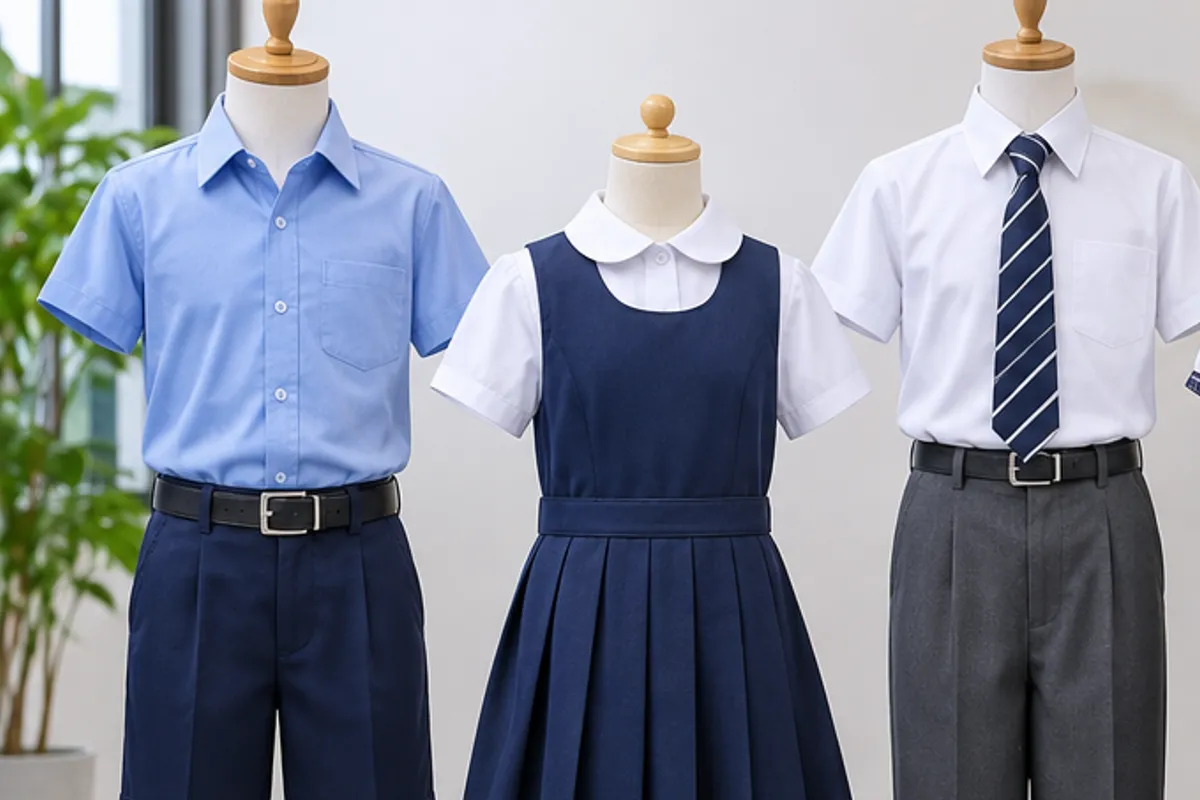
For school shorts in Australia, the year starts in summer: the school year begins in late January or early February, so shorts are the first bottoms families buy, and trousers follow as the weather cools around Term 2. A practical plan for an Australian shop or school orders in two waves, shorts-heavy for the January rush and trouser-heavy for the autumn changeover.
That order of events is the reverse of a northern-hemisphere shop, and it shapes every quantity and date in the plan.
How the Australian year shapes demand
The school year is usually split into four terms. The pattern below is a general guide; each state and school sets its own dates and uniform rules.
| Period | Weather, in general | What families buy |
|---|---|---|
| January, before Term 1 | Summer holidays | Shorts, summer shirts and polos for the new year |
| Term 1 | Hot to warm | Shorts top-ups, especially for new starters |
| Term 2 | Cooling into winter | Trousers, often called long pants, and warmer layers |
| Term 3 | Winter into spring | Trouser top-ups and replacements |
| Term 4 | Warm again | Shorts return; buying slows before the long holiday |
For many primary schools, shorts are worn for much of the year, and some students wear them through winter with a jumper. Secondary schools often move older students into trousers for longer.
Planning the two waves
Wave one: the January rush
This is the larger shorts order. It must be on the shelf before families shop in the weeks before Term 1, which means it needs to leave India well before the end of the year. Work back from your January on-sale date using the shipping method and lead time confirmed in your quotation, and allow for the slower weeks around the end-of-year holidays.
Include in wave one:
- shorts in every junior size, with extra depth in the middle age bands
- a trouser stock for seniors who wear them all year
- elastic-back shorts for prep and junior classes where the list names them
Wave two: the Term 2 changeover
This is the trouser-heavy order. It should arrive before the weather turns, so before the end of Term 1. It also gives a chance to top up shorts sizes that sold out in January, ready for Term 4.
Which sizes matter most for Australian shorts?
Because shorts are worn by more year groups and for more of the year than in cooler countries, the shorts size run often goes higher. Our shorts run from age 3–4 to 13–14, which covers most primary and early secondary students; your own range is agreed for each order.
When shaping the ratio:
- Give the deepest stock to the prep and lower primary sizes at the January rush, when new starters buy several pairs.
- Allow for growth over the long summer holiday: students often need one size up from last year’s shorts.
- Keep a modest stock in ages 11–12 and 13–14 if the schools you serve let secondary students wear shorts.
Use these as a starting point and adjust them against your own sales or roll data.
Matching shorts and trousers across the waves
Students wear shorts and trousers from different deliveries in the same year, and often on alternate days in spring or autumn. Order both in the same fabric and colour so they match, and keep a sample pair from wave one to compare when wave two arrives. Each is a separate style with a minimum of 50 pieces, with sizes mixed within it.
A planning checklist for Australian buyers
- Confirm each school’s dates for Term 1 and the winter uniform changeover
- Find last year’s peak shorts week from till records
- Set the January on-sale date and count back to the order date
- Set a second on-sale date before Term 2 for trousers
- Check which year groups wear shorts and whether girls may choose them
- Decide whether both waves ship separately or together
We manufacture in India and take enquiries from buyers in Australia and any other country. Shipping method, terms and documents are confirmed in the quotation. Our page for uniform shops and retailers explains how we work with shops, and the full set of trouser and shorts styles is on our school trousers and shorts page. Send your two on-sale dates with your enquiry, and we will plan the quotation around them.
Questions buyers ask
What do Australian buyers call long school trousers?
Many say trousers, and many families say long pants or simply pants. Both mean the same garment. We use whatever wording you use in your enquiry, so your tickets and size guides stay in the language your customers know.
Can wave one and wave two be one order?
They can be one quotation with two deliveries, or one shipment with the trousers stored until Term 2. One shipment is simpler to manage; two deliveries save storage space through the summer.
Should shorts be ordered for Term 4 separately?
Usually not. Shorts left from Term 1 plus a top-up in wave two normally carry through Term 4. Check stock after Term 3 and add a small top-up only if a size is close to running out.