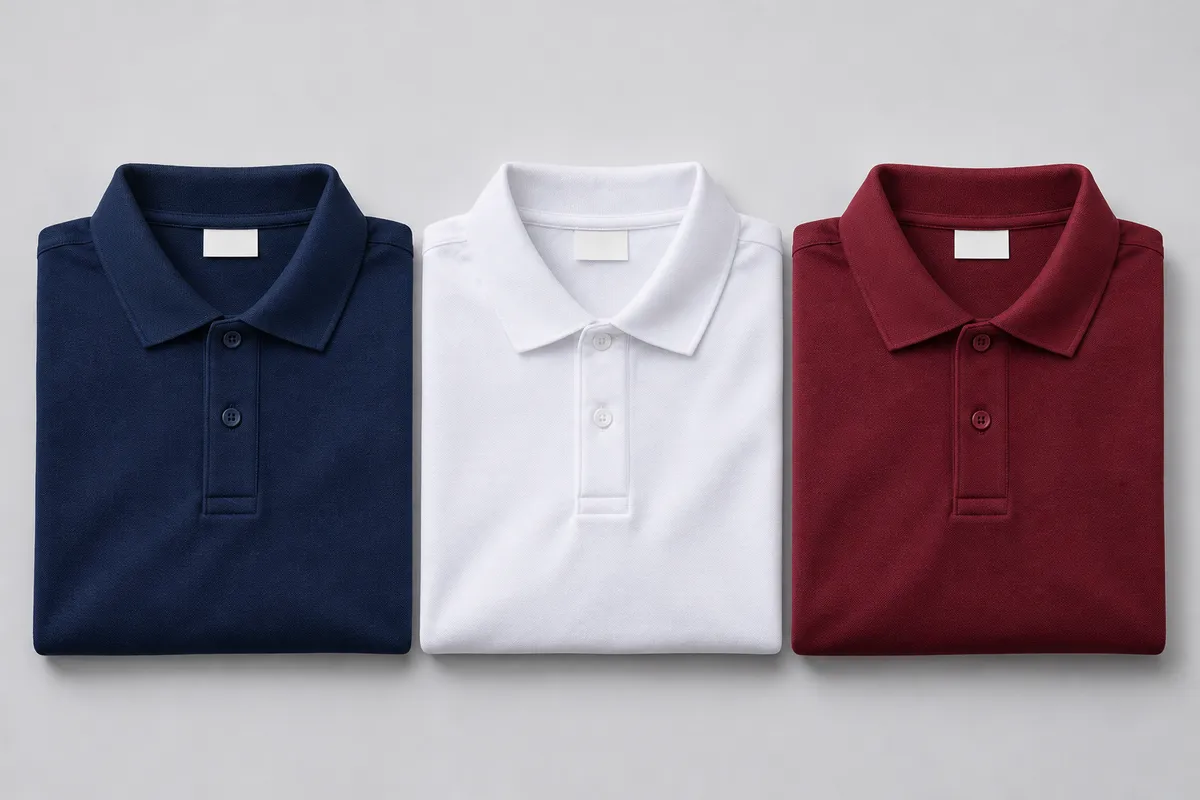
Polo shirt printing puts the school logo onto the piqué as a flat layer of ink or transfer, rather than stitching it. A print suits logos with fine detail, small text or many colours, and it feels lighter on the chest. Because piqué has a textured surface, the print method and artwork are chosen so the logo stays crisp and does not crack along the texture.
Logo embroidery or printing is available on our polos. This post explains when printing makes sense and how to get a clean result on a knitted polo.
When is printing a better fit than embroidery?
Embroidery is the traditional school polo finish, but printing has clear strengths in some cases:
| Situation | Why printing can suit it |
|---|---|
| Logo with fine lines or small lettering | Print holds detail that stitches would lose |
| Many colours or shading in the crest | Print reproduces more colours |
| Young children | A print is lighter and softer on the chest |
| Polo also worn for PE | Lighter feel suits active wear |
| Large logo or text on the back | Large areas are practical in print |
| Year group or event wording | Easy to change wording between runs |
Embroidery tends to win when the school wants a raised, textured badge with a traditional look. Many schools use both, with an embroidered crest on everyday polos and a printed mark on sports polos.
How does a print behave on piqué?
Piqué’s small raised cells affect how a print sits:
- Texture shows through. Thin prints can show the piqué pattern underneath, giving a slightly broken look.
- Fine lines can break. Very thin lines may skip across the gaps in the texture.
- Stretch matters. The print must flex with the knit so it does not crack when the polo is pulled on.
- Fibre matters. Polyester and poly-cotton take print differently, so the method is matched to the fabric.
These are handled by choosing a suitable print method for the fabric and adjusting artwork where needed. The result is checked on the sample before bulk production.
Preparing artwork for a printed polo logo
Clean artwork makes a large difference to a print. Before sending it:
- Send a vector file if you have one, or the highest-resolution image available
- List the logo colours, ideally with colour references
- Say whether the logo sits on a white, light or dark polo body
- Mark any very fine lines or tiny text you want to keep
- State the logo size, or let us propose one for each size band
- Note any second print position, such as the back neck
On dark polos, light print colours often need a base layer to look bright, which is part of the print method confirmed on the sample.
How long does a printed logo last?
Durability depends on the print method, the fabric and, above all, how the polo is washed. Prints last longer when the polo is washed inside out, not dried on high heat, and not ironed over the logo. These are worth putting on the care label and sharing with families.
We do not publish durability ratings; you judge the print on the sample and, if you wish, wash it a few times before approving bulk production.
Our page on logos, embroidery and labels covers artwork and label options. Suppliers running printed polos for several schools can find more in our notes for schoolwear suppliers and distributors. Our school polo shirts page lists the styles and fabrics a printed logo can go on.
Send your artwork and polo colour, and we will set out the logo method, size and position in your quotation.
Questions buyers ask
Will a printed logo crack after washing?
A print can crack if it is too thick for the fabric, if the polo is dried on high heat, or if it is ironed directly. A suitable print method for piqué and good care reduce this. The sample lets you test the print before bulk production.
Can a printed logo match the school’s exact colours?
Print can match colours closely when you supply references. Some shades are harder to reproduce on certain fabrics or body colours, so colour is approved on the sample against your reference rather than on screen.
Is a printed logo cheaper than embroidery?
It depends on the logo size, number of colours and quantity. We quote each polo style by fabric, quantity and branding, so asking for both options in the quotation is the clearest way to compare.