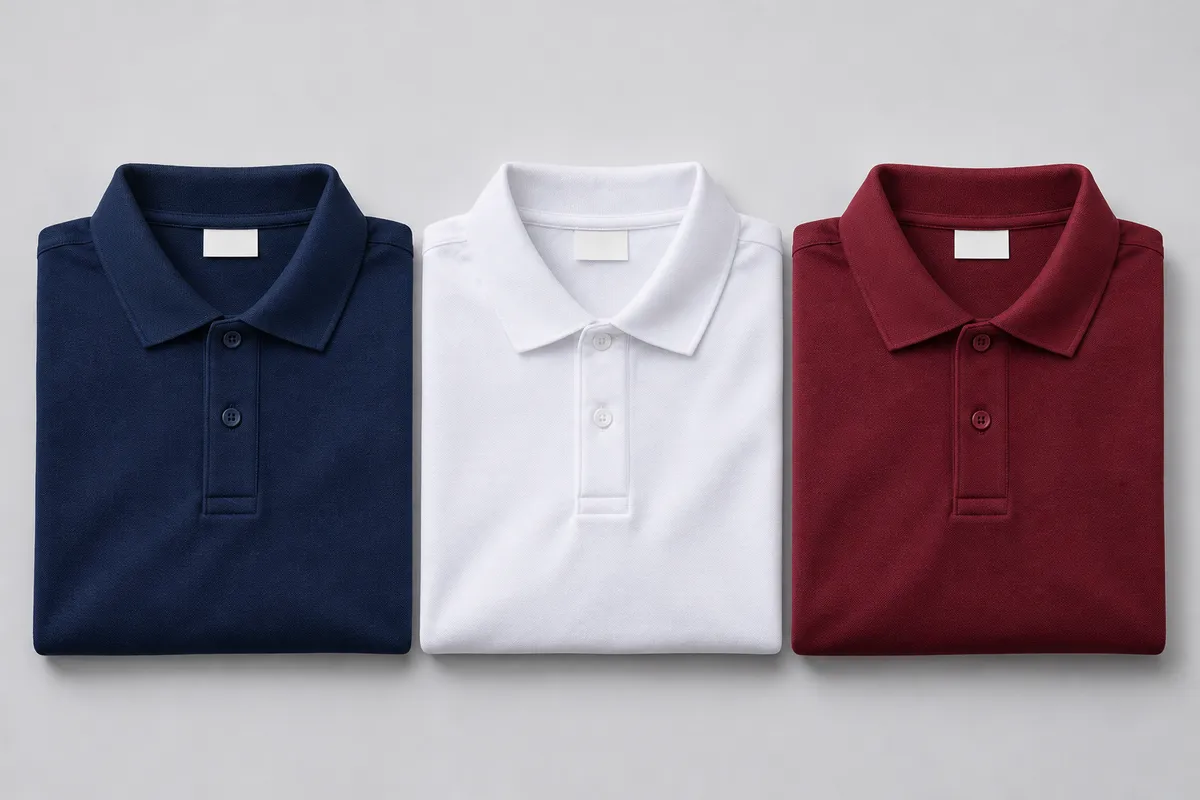
A polo shirt size ratio should follow the roll of the schools you supply: spread evenly across the primary bands, then thinner in the senior chest sizes, with plain colours carrying more pieces than logo polos. Because polos are worn in every year group, they need steadier top-ups through the year than seasonal garments.
This post is for uniform shops, suppliers and schools planning a bulk polo order. It covers sizing, two starting ratios to adjust, and how to plan top-ups.
How polo shirts are sized
We size polos by age band from age 3–4 to 15–16, then by chest measurement for senior students. The size chart is agreed for each order, with chest, length and sleeve for each size. If you sell polos now, send your size chart or a polo in each size and we work from it. Our size charts page explains how a chart is agreed.
Polos are knitted, so they have more give than a woven shirt. Even so, a polo that runs short in the body gets returned. When you agree the chart, check the body length on the sample as closely as the chest.
Two starting ratios to adjust
The tables below are starting examples, not forecasts. Adjust each against your own sales records or the school’s roll by year group. They are set out as pieces per 100 so they scale to any order size.
Example A: a primary school polo, one colour, with logo
| Age band | Pieces per 100 |
|---|---|
| 3–4 | 6 |
| 4–5 | 11 |
| 5–6 | 13 |
| 6–7 | 13 |
| 7–8 | 13 |
| 8–9 | 13 |
| 9–10 | 12 |
| 10–11 | 11 |
| 11–12 | 8 |
Example B: a secondary school polo, one colour, with logo
| Size | Pieces per 100 |
|---|---|
| Age 11–12 | 14 |
| Age 12–13 | 18 |
| Age 13–14 | 18 |
| Age 14–15 | 16 |
| Age 15–16 | 12 |
| Senior chest size, small | 10 |
| Senior chest size, medium | 7 |
| Senior chest size, large | 5 |
Primary polos are usually spread evenly, because each year group has a similar number of children and most buy new polos each year. Secondary polos often lean to the younger years, where students are still growing, and thin out as they reach adult sizes.
Plain polos and logo polos are planned differently
A logo polo belongs to one school. Its ratio should follow that school’s roll, and any leftover stock can only be sold to that school’s families.
A plain polo under your own label can sell to every school whose list includes a white or navy polo. Its ratio can follow your whole shop’s sales rather than one school’s roll, and leftover stock carries over easily. Many shops hold a deeper size range in plain polos for that reason.
If you order both, set them as separate styles with separate ratios. The minimum is 100 pieces per style, with sizes mixed within it.
Planning top-up orders
Polos are worn all year, in every year group, and families often buy several. Demand comes in waves: the start of the school year, the start of the warmer term, and steady replacements in between. A top-up plan keeps you from running out of the core sizes.
| When | What to do | What to look at |
|---|---|---|
| Before the main order | Set the ratio from last year’s sales or the school roll | Which sizes ran out last year |
| First weeks of term | Record sales by size each week | Sizes selling faster than the ratio |
| After the first rush | Place a top-up for the gaps | Core sizes, plus any that sold out |
| Before the warmer term | Check stock of short-sleeve polos | Second wave of demand |
| End of the school year | Review the year’s sales by size | Adjust next year’s ratio |
A few rules help top-ups run smoothly:
- Ask for the lead time when you plan the main order. It is confirmed in the quotation, and it tells you how early a top-up must be placed.
- Top up to the minimum per style. A top-up of 100 pieces of one style can be spread across the sizes you need.
- Combine colours carefully. A white and a navy polo are separate colours of one style; the colour split is confirmed at quotation.
- Reorder to the approved sample, so colour, logo and fit match the first delivery.
- Keep your records. After one full year, your own sales by size will be a stronger guide than either table above.
Request a quotation
Send us your polo style, your colours, the logo if any, your size range and a first ratio, plus how often you expect to top up. Our school polo shirts page lists every polo style, fabric and size. We quote per style, by fabric, quantity and branding.
Questions buyers ask
How do I turn a pieces-per-100 ratio into an order?
Multiply each figure by your total order divided by 100: for 300 polos, triple every number. Round to whole pieces, check the sizes still add up to your total, and confirm each style reaches the minimum.
Should long-sleeve polos follow the short-sleeve ratio?
Use the short-sleeve ratio as a starting point, at a smaller quantity, because long sleeves sell mainly in the colder terms. Check sleeve length on the sample for each size, since a short sleeve is easy to miss when the chest fits.
How much of the budget should be held back for top-ups?
Hold back enough to cover the core sizes in the weeks after the first rush, rather than a fixed share. The lead time in your quotation sets how early that top-up must be placed, so plan the two orders together.