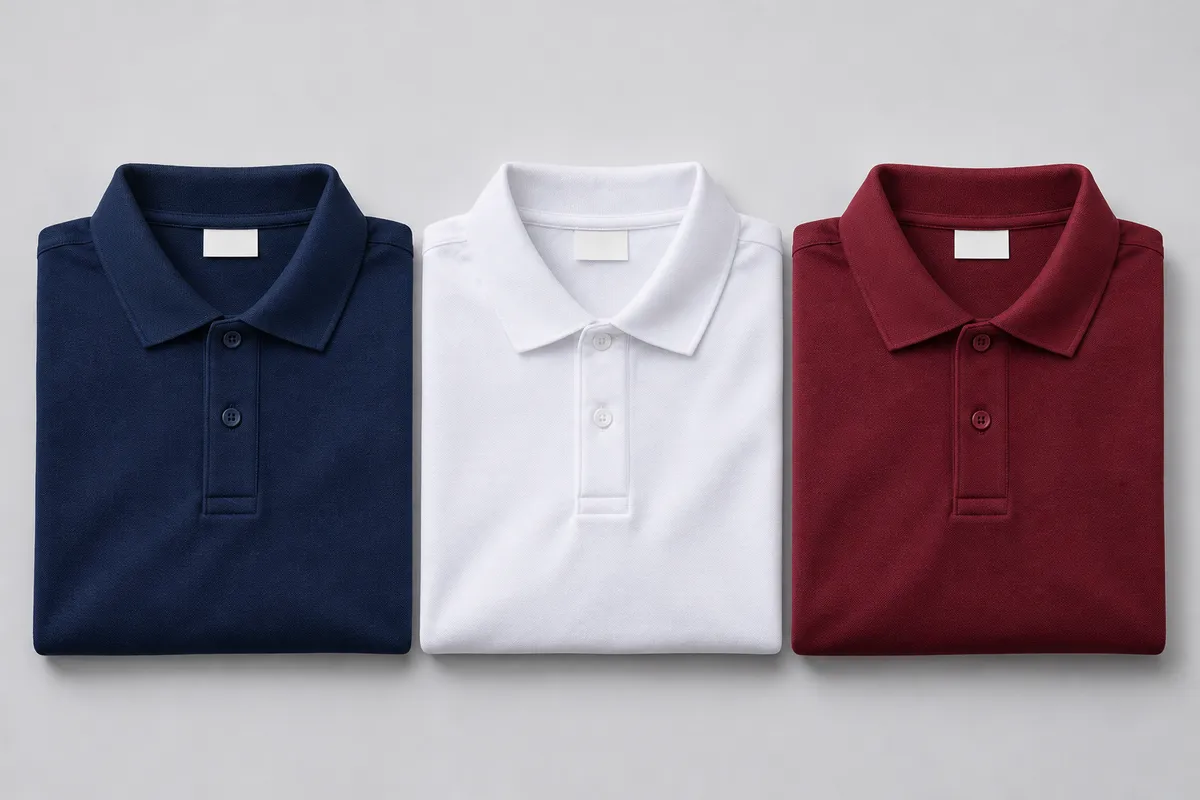
Polo shirt sizes by age are labels such as “age 7–8” that stand for a set of body measurements, chiefly chest and height, that a typical child of that age has. They are a guide, not a rule: a tall seven-year-old may need an age 8–9 polo, and a slight ten-year-old may still fit 9–10. For a buyer, the useful question is not the child’s age but which chest and height each band is cut for.
Our polos are listed by age band from 3–4 up to 15–16, followed by chest sizes for older students. The measurements behind each band are agreed on the size chart for every order.
What does “age 7–8” mean on a polo?
An age band is a two-year label covering one year of growth. A child who has just turned seven and a child about to turn eight are meant to share it. Behind the label sit three figures the family never sees:
- the body chest the polo fits,
- the height it is cut for, which sets body and sleeve length,
- the garment measurements on the production chart, with ease added.
Two makers can both label a polo “7–8” and cut it to different figures. That is why buyers switching makers should send a polo per size rather than a list of age labels.
How age bands line up with year groups
Shops and schools often think in year groups, and families think in ages. The table below is a rough planning example for a school year that starts in September, as in England. It shows the age band most children in each year group will wear at the start of the year, with the band many will move into by the end.
| Year group (England) | Age at September | Usual band at the start | Band many move into |
|---|---|---|---|
| Reception | 4 | 4–5 | 5–6 |
| Year 2 | 6 | 6–7 | 7–8 |
| Year 4 | 8 | 8–9 | 9–10 |
| Year 6 | 10 | 10–11 | 11–12 |
| Year 8 | 12 | 12–13 | 13–14 |
| Year 10 | 14 | 14–15 | 15–16 |
Schools in other countries can draw the same table from their own calendar. The point is the shift: by the summer, a share of each class has grown into the next band, which is why the larger band in each pair needs extra stock for the second half of the year.
Why families buy a band up
Parents often choose a polo one band above the child’s age so it lasts the year. Knitted piqué has some give, so a slightly large polo looks acceptable in a way a slightly large shirt does not. For a shop, that habit pulls demand up the range. A school whose youngest children are mostly five may still sell more 5–6 and 6–7 polos than 4–5.
Watch this in your sales. If the band above each year group sells out first every September, set next year’s ratio to match rather than following ages on the roll.
Labelling the bands
The label on the polo is the only size information most families see. A few choices make the bands easier to use:
- Print the age band and, if you can, the height or chest it fits.
- Use the same format on the neck label, the pack sticker and the shelf.
- Keep the band names identical across every polo style you stock.
- Put the full measurement table on your own size guide, linked from the shelf or website.
We sew in size labels with the wording you choose and pack by size with a size sticker on each pack. Our size charts page covers how the measurements behind each band are recorded.
Request a quotation
Tell us your age bands, the chest or height each should fit, and the polo styles you need, or send a polo in each band. We quote per style, by fabric, quantity and branding. Styles, colours and logo options are on our school polo shirts page.
Questions buyers ask
Can we use single-year sizes, such as age 7, instead of two-year bands?
You can, but it doubles the number of sizes and splits your stock thinly. Two-year bands are common for school polos because knitted fabric covers a year of growth comfortably. Choose single years only if your families expect them.
Do age bands run the same for girls and boys?
On a standard polo, one set of bands covers everyone. If you add a shaped-fit polo, it gets its own chart, and its bands can be cut differently. A shaped polo counts as a separate style for the minimum.
Where should our age bands stop?
Stop where your students’ builds start to vary widely, often around 13–14 or 15–16, and move to chest sizes from there. Looking at which age bands you sell least of in the top years usually shows the right point.