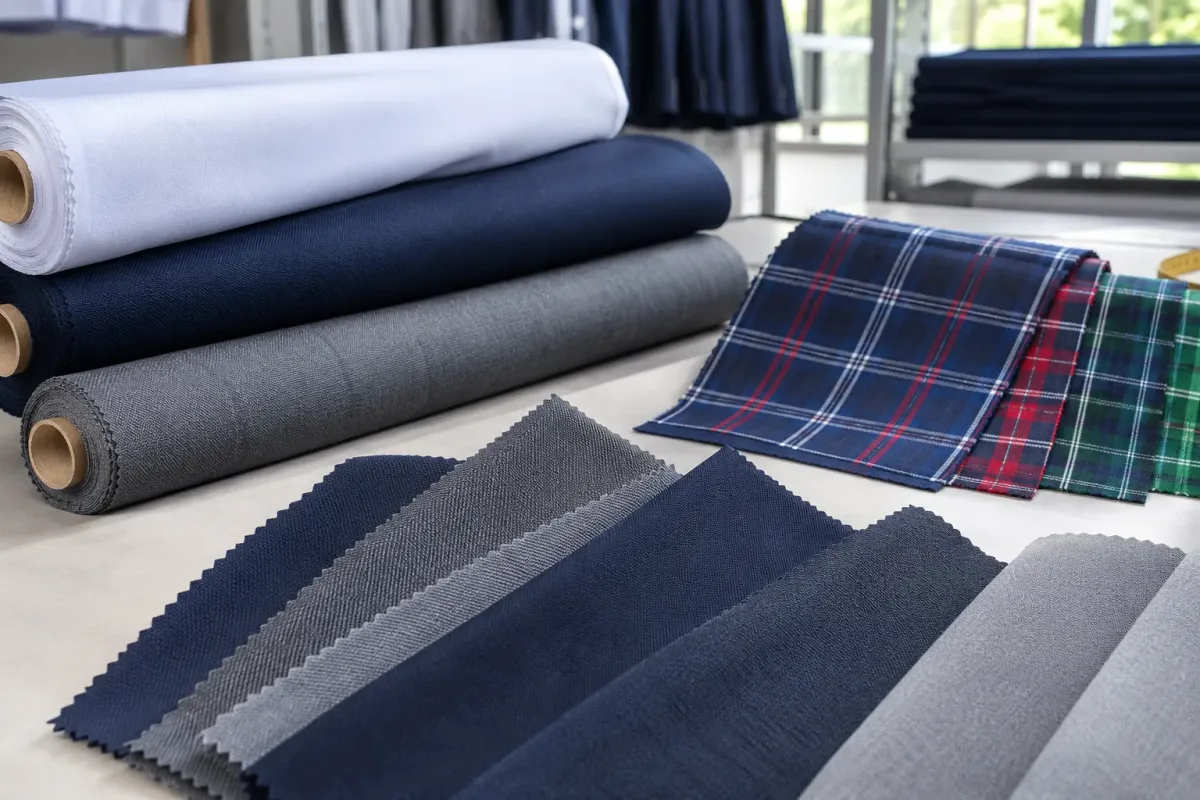
Check skirt pleating to stripe means folding each pleat so the same stripe of the check lands on the outside of every fold, making the skirt look mostly one colour when the student stands still and showing the full check when they move. Pleating to the pattern does the opposite: the pleats are sized to the check repeat so the full check stays visible across the skirt. Choosing between them is the most visible decision on a check skirt after the check itself.
Both methods are traditional. Schools with a long-standing check skirt usually already use one, and a new supplier needs to know which.
What is the difference?
When fabric is folded into a pleat, part of it disappears inside the fold. Which part disappears decides what the skirt shows.
| Method | What shows on the face | Look when standing | Look when moving |
|---|---|---|---|
| Pleated to the stripe | One chosen stripe or colour block | Mostly one colour, with fine lines | Full check flashes out from the folds |
| Pleated to the pattern | The full check, repeat by repeat | Clearly check all over | Similar to standing |
Pleating to the stripe gives a striking, almost striped look and is common on kilt-style and senior skirts. Pleating to the pattern looks more like a flat piece of check fabric and is common on junior and part-pleated skirts.
How pleat size follows the check
In both methods, the pleat size is tied to the check repeat, the distance before the pattern starts again.
- To the stripe: the depth of each fold is set so the chosen stripe comes back to the face at every pleat. The visible spacing is usually the width of that stripe plus a little of its neighbours.
- To the pattern: each pleat takes up exactly one full repeat, so the pattern lines up from one pleat to the next without stepping.
This is why a check skirt’s pleat count is often fixed by the check rather than chosen freely. A large check repeat may mean fewer, deeper pleats; a small repeat allows more. It is also why a check skirt uses more fabric than a plain one with the same number of pleats.
Which stripe should go on the face?
If pleating to the stripe, choose the stripe that most clearly represents the school’s look. A dark ground stripe gives a quiet, smart skirt. A bright accent stripe makes the skirt look much brighter than the fabric roll suggests. When copying an existing skirt, we follow the stripe it already shows.
Matching the check at seams and waistband
Whichever method you use, the check should also run cleanly:
- Across side seams, so horizontal lines meet at the same height.
- At the waistband, where a cross-grain or straight-grain cut is chosen and kept consistent.
- At the zip or wrap edge, where the check should not step out of line.
- At the hem, where a level horizontal line reads as a neat, straight hem.
We match yarn-dyed check from a piece of your fabric, matching the colours and repeat as closely as we can, and send a swatch before bulk fabric is made. The pleating method is then shown on the sample. Our fabrics and colour matching page explains how swatch approval works.
What to tell us
- Pleat to the stripe, or pleat to the pattern
- If to the stripe: which stripe or colour shows on the face
- Pleat type: knife, box or a mix
- Whether the waistband is cut on the straight or the cross
- Your current skirt, if you have one, so we can follow it
Check skirts are listed with our other styles on the school skirts and skorts page. We manufacture in India and fix the stripe or pattern placement on the approved sample, so reorders follow it. Send us a skirt or a piece of the check for a quotation.
Questions buyers ask
Does pleating to the stripe make the skirt look a different colour?
When the student stands still, yes, it can. The face shows mainly the chosen stripe, so a navy and green check pleated to the navy stripe can look largely navy from a distance. It shifts back to check when the pleats open.
Can the same check be pleated differently for junior and senior skirts?
Yes. Some schools pleat senior skirts to the stripe for a smart look and junior skirts to the pattern so the check is clear. Both use the same fabric, so the uniform still reads as one.
Why does a check skirt need a full skirt to copy rather than a swatch?
A swatch shows the colours and repeat, but not how the pleats were folded. A full skirt shows which stripe sits on the face, the pleat depth and how the check meets at the seams.