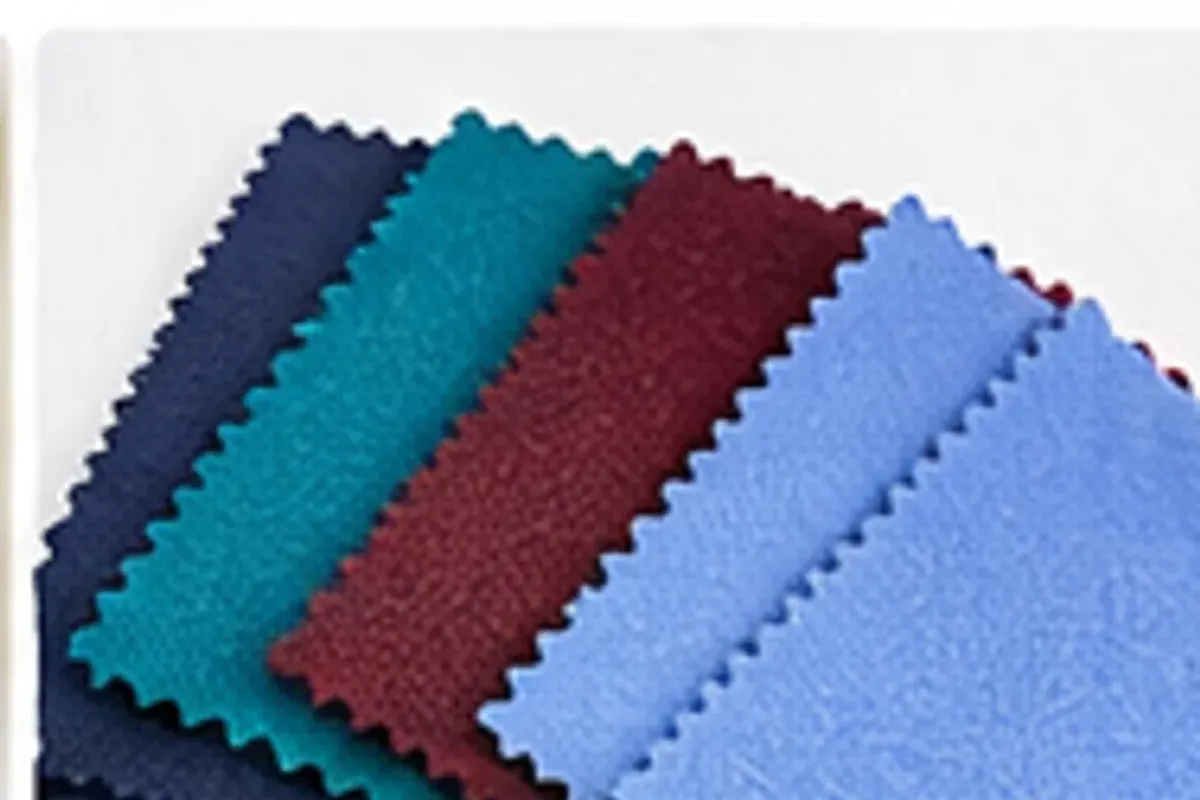
Choosing poly-viscose vs polyester for a school skirt is mainly a choice between softness and crispness. Poly-viscose feels softer and drapes more like natural cloth, while polyester twill holds a sharper pleat and recovers well from washing. Both are sound choices for school wear; the right one depends on the skirt style, the climate and what your customers value most.
These are the two plain fabrics we use for pleated skirts, A-line skirts and skorts. Check skirts are made in yarn-dyed check, which is a separate decision.
What each fabric is
Poly-viscose is a blend of polyester and viscose fibres woven together. Polyester brings strength and shape-holding. Viscose, a regenerated cellulose fibre, brings softness, drape and a less synthetic feel. The blend ratio can vary, and a higher viscose share feels softer.
Polyester twill is a woven fabric made entirely or mainly from polyester, in a twill weave. A twill weave shows fine diagonal lines on the surface and tends to be firm and hard-wearing. Polyester responds well to heat-setting, which is why it holds pleats firmly.
How do they compare in a school skirt?
| Quality | Poly-viscose | Polyester twill |
|---|---|---|
| Hand feel | Softer, more like natural cloth | Firmer, smoother |
| Drape | Flows and swings | Holds its outline |
| Pleat sharpness | Good, softer edge | Crisp edge, holds firmly |
| After washing | May need a light press | Often wearable straight from the hanger |
| Warmth in hot weather | Generally feels cooler and more comfortable | Can feel warmer against the skin |
| Surface look | Matt, slightly richer | Smooth, with a fine diagonal line |
| Typical choice | Schools wanting a quality feel | Shops and families wanting low care |
These are general characteristics of the two fabric types. The exact feel depends on the fabric weight and finish, which you judge on the swatch and sample.
Which suits which skirt style?
Pleated skirts
Polyester twill is the low-maintenance choice for knife and box pleat skirts, because the pleats stay sharp through repeated washing. Poly-viscose works well too, giving a softer pleat that some schools prefer for its look, but families may need to press it more often.
A-line skirts
With no pleats to hold, the difference is mostly in drape and feel. Poly-viscose gives an A-line skirt a gentle swing. Polyester twill keeps a cleaner, more structured outline.
Skorts
Skorts are active garments, worn for play and movement. Polyester twill is hard-wearing at the seams and the inner shorts. Poly-viscose is more comfortable in warm classrooms. Either works, and the choice often follows the skirt on the same uniform list.
Climate and customers
In hot or humid climates, the softer, cooler feel of poly-viscose can be an advantage, especially for younger children. In cooler, wetter climates, polyester twill’s quick recovery and easy care often matter more. Shops serving families who want minimal ironing tend to lean towards polyester twill. Schools focused on a premium look and feel tend to lean towards poly-viscose.
Some suppliers stock both, offering the polyester twill skirt as the everyday option and the poly-viscose skirt as a softer alternative. If you do this, keep the colour as close as possible across the two, since different fibres can take dye slightly differently. Our fabrics and colour matching page explains how shades are matched and approved.
Making the decision
- Which matters more to your customers: softness or low care?
- How many pleats, and how sharp should they stay?
- What is the climate where the skirts will be worn?
- Must the skirt match trousers or pinafores in a particular fabric?
- Would a swatch of each help you or the school decide?
Both fabrics are available for every plain style on our school skirts and skorts page, with the fabric confirmed at quotation. We manufacture in India and can send swatches of both before you commit. Tell us your style and quantity, and ask for each fabric to be quoted so you can compare.
Questions buyers ask
Will poly-viscose and polyester twill skirts look the same colour?
They can be matched closely, but polyester and viscose take dye differently, so a navy in each may look slightly different in certain light. Approving a swatch of each fabric side by side is the safest way to check.
Is polyester twill suitable for a skirt worn all year?
Yes. It is a common year-round choice for school skirts. In very warm months, some schools switch to a summer dress instead, so the skirt fabric need not be chosen for the hottest weeks alone.
Can trousers and skirts on the same list use different fabrics?
They can, though many schools prefer the same fabric for both so the colours match exactly. If they differ, approve both shades together to make sure they look like one uniform.