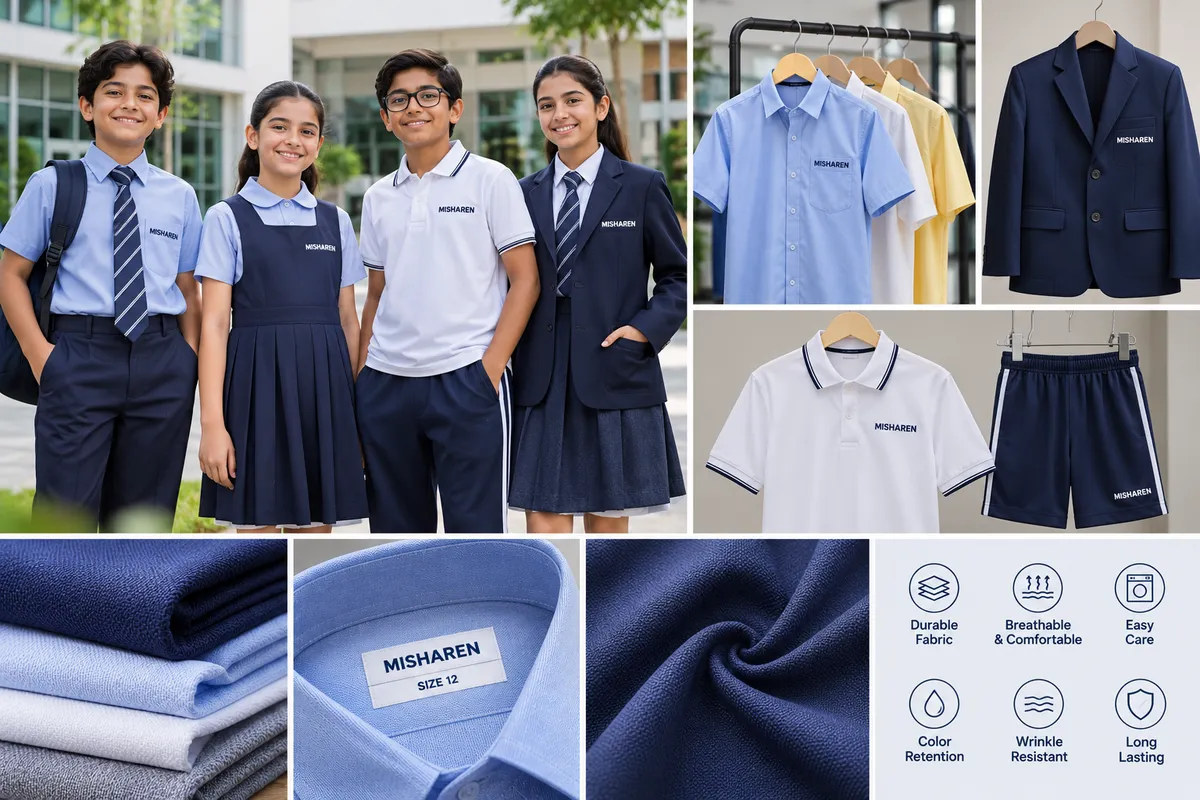
A placket on school uniform is the reinforced strip of fabric around an opening where the garment fastens: the full button stand down a shirt front, the short two- or three-button opening on a polo shirt, the opening above a shirt cuff, and the front band of a cardigan. Plackets give buttons and buttonholes a firm double layer to sit in, so the opening does not stretch or tear. Different garments use different plackets and fastenings, and the choice affects how easily a child dresses and how long the garment lasts.
Plackets garment by garment
Shirt front placket. A strip running the full length of the front, folded or applied, with buttonholes on one side and buttons on the other. It may be a visible strip with two lines of stitching (a “top” placket) or folded under with no stitching showing (a “French” front). School shirts usually have the visible version.
Sleeve placket. A small opening above a shirt cuff, finished with a narrow strip, so the hand passes through when the cuff is undone.
Polo placket. A short opening at the neck, typically with two or three buttons. It is reinforced with a piece of woven tape or fabric behind the knit so the buttons hold. The placket can be in the body colour or a contrast.
Cardigan front band. A knitted band down both fronts of a knitted cardigan, carrying the buttonholes. On a sweatshirt cardigan the band is a sewn-on strip of rib or fleece.
Zip opening. On zip-front pinafores, summer dresses and tracksuit tops, the zip replaces the placket and is set into the seam or the front.
Which fastening goes on which garment?
| Garment | Usual fastening | Alternative | Why it is chosen |
|---|---|---|---|
| Shirt | Buttons, full front | None common | Standard, easy to repair |
| Blouse | Buttons, full front | None common | As for shirts |
| Polo shirt | Two or three buttons on a short placket | None common | Pulls over the head; buttons only at neck |
| Knitted cardigan | Buttons on a knitted band | None common | Traditional look |
| Sweatshirt cardigan | Buttons or press studs, as specified | Press studs are quicker for small children | |
| Bib pinafore | Buttons on straps or side | None common | Strap buttons allow length adjustment |
| Zip-front pinafore | Front zip | Easiest for young children to put on alone | |
| Summer dress | Buttons or zip at the front | Back zip on some styles | Front opening lets children dress themselves |
| Nursery smock | Buttons or press studs, as specified | Press studs are quick for small hands | |
| Tracksuit top, fleece jacket | Full zip | Fast to open and close outdoors | |
| Trousers and skirts | Button or hook with a zip fly | Elastic-back, or pull-on | Formal finish; easy versions for juniors |
Buttons, press studs or zips?
Buttons are familiar, easy to sew back on and look smart, but small children find them slow. Buttonholes must be stitched densely so they do not fray.
Press studs (snaps) close with a press and open with a pull. They suit nursery smocks and young children’s cardigans. They need a firm placket behind them, or they can pull through the fabric.
Zips are the fastest of the three and the easiest for a child to do alone. They need a strong seam and a zip suited to the garment’s weight. The zip colour can match the fabric or contrast with it.
What to check on a sample
The placket is where a garment is most often handled, so check it carefully on the sample:
- The placket lies flat and does not ripple or twist after washing
- Buttonholes are dense and clean, with no loose threads
- Buttons are sewn firmly, with a shank on thicker garments
- Press studs are backed by a firm interfacing or tape
- Zips run smoothly and the tape is sewn evenly
- Placket colour and button colour match your specification
We make every garment in the table, with the fastenings you choose where options are given. You can see how zip-front and button-front styles differ on our school summer dresses page. For thread, button and zip colour matching, see fabrics and colour matching.
If you have a garment whose placket and fastening you like, send it with your enquiry and we will quote the same detail.
Questions buyers ask
How many buttons should a school polo placket have?
Two or three is usual. Two keeps the opening short and neat, suiting younger children; three gives a slightly wider opening that is easier to pull over larger heads. The number is confirmed on the sample to match your current polo if you have one.
Are press studs strong enough for school wear?
Yes, when the placket behind them is reinforced. Press studs are common on nursery smocks and sweatshirt cardigans for young children. On garments that are pulled hard, buttons may last longer, so the choice depends on the age of the wearer.
Can button colours differ from the fabric colour?
Yes. Many schools use buttons that match the fabric for a quiet look, while some choose a contrast to pick out a school colour. Tell us the button colour you want, and we confirm it on the sample before bulk production.