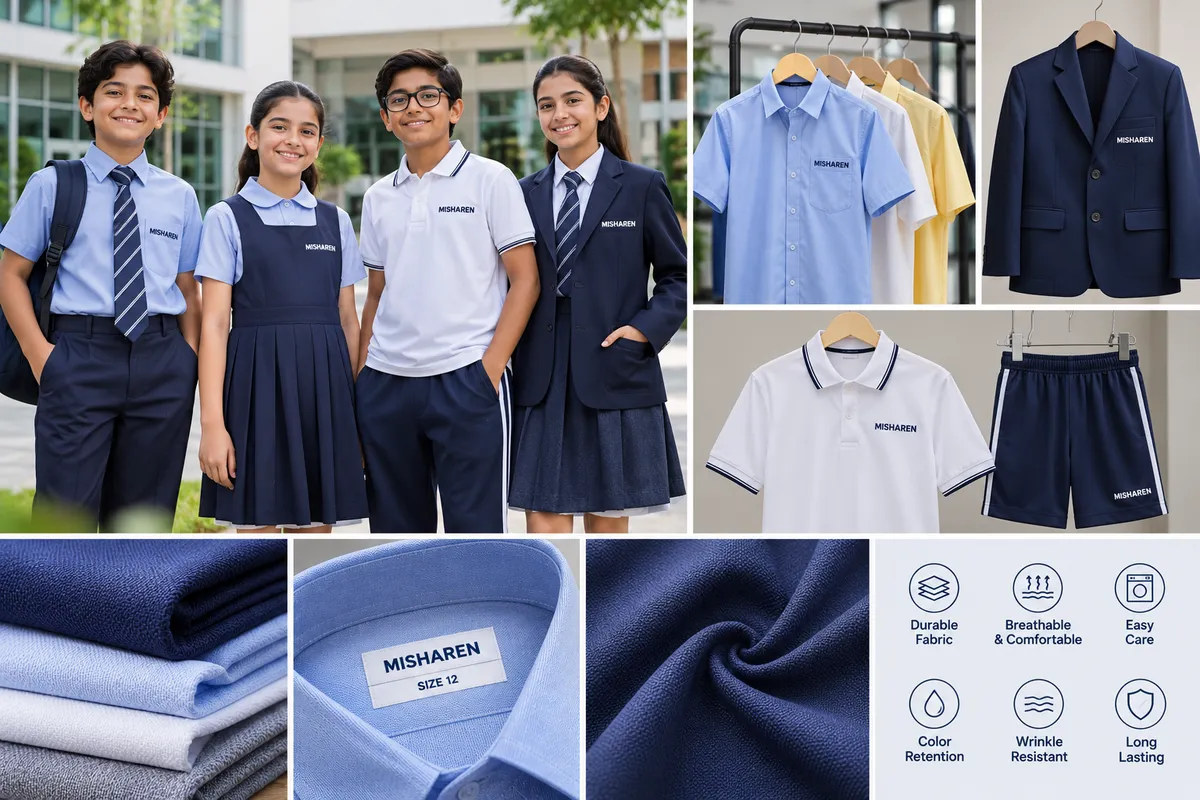
A school uniform budget is easier to plan once you know what a manufacturer’s quotation is built from: the fabric, the quantity per style, the branding, the number of separate styles, packing and the delivery terms. Each of these is a choice the buyer makes, so a budget that seems too tight can often be met by changing a specification rather than cutting quantities.
This guide does not give prices; those depend on each order and are set in a quotation. It explains the levers, so the person holding the budget can ask for the right options.
What shapes the quotation for a uniform order?
| Factor | How it affects the quotation | Where the buyer has a choice |
|---|---|---|
| Fabric | Different fabrics cost different amounts to buy and make up | Poly-cotton or cotton; polyester or poly-viscose; acrylic or cotton-acrylic knit |
| Quantity per style | Larger runs of one style spread setup work over more pieces | Fewer styles in larger quantities |
| Number of styles | Each style needs its own sample, setup and minimum | Share garments across year groups or schools where possible |
| Branding | Embroidery, printing, size and number of positions all differ | One logo position instead of two; logo on fewer items |
| Construction | Lining, braid, pleats, extra pockets add work | Keep detail where it shows; simplify where it does not |
| Labels | Own woven labels differ from standard ones | Woven or printed; one label or several |
| Packing | Individual bags, size stickers, sets by student | Bulk packed by size versus individually packed |
| Delivery | Shipping method and terms vary | Sea or air, consolidated or split deliveries |
None of these is good or bad in itself. A lined blazer with braid may be exactly right for a school; the point is to know which choices carry weight in the total.
Building the budget in steps
- List every garment and its quantity per size. Use last year’s sales or issue figures where you have them.
- Write the specification for each. Fabric, construction, logo and label.
- Ask for a quotation per style. Ours is quoted per style, by fabric, quantity and branding, which shows exactly where the total comes from.
- Mark which details are essential. The blazer badge, perhaps, but not a second logo on the sleeve.
- Ask for options on the rest. For example, the polo quoted with embroidery and with a printed logo.
- Add delivery and costs at your end. Shipping method, terms and documents are confirmed in the quotation; any costs on arrival depend on your country.
Step 5 is where most budgets are met. A manufacturer can quote alternatives side by side if asked.
Where schools often find room in the budget
Fewer logo items. Putting the logo on the blazer, jumper and PE top while leaving trousers, skirts and shirts plain reduces branded styles and gives families more choice of where to buy.
Shared styles across year groups. One polo for the whole school is one style; separate polos for juniors and seniors are two.
One branding method across garments. Using one method where it suits keeps setup simple, though embroidery and printing each suit different fabrics.
Ordering at the right time. Rushed orders may need faster shipping. Planning backwards from term start leaves time for the usual method.
Meeting minimums without excess. Our minimum is 50 pieces per style for woven garments and 100 for knitwear and sportswear, with sizes mixed. Plan quantities to reach the minimum for each style rather than ordering well beyond what will sell.
A budget-holder’s checklist
- Every garment on the list has a quantity and specification
- Essential and optional details are marked for each garment
- Quotations show each style separately
- Alternatives have been requested for the optional details
- Delivery terms are clear, and costs at your end are checked separately
- Payment stages are in the finance calendar
- A small margin is held for top-up orders during the year
We manufacture in India and quote every style separately, so the effect of each choice is visible. Ask us to quote alternatives, such as embroidery and print on the same polo, and you can see the difference before deciding.
Our minimum order and samples page explains how minimums and styles work. The garments where specification choices make the most difference are often school blazers and polo shirts. Send us your list, with the details marked essential or optional, and we will quote with alternatives.
Questions buyers ask
How can a school reduce its uniform budget without lowering quality?
Look at the specification rather than the quantity. Fewer logo items, shared styles across year groups and simpler construction where it does not show all reduce the total while keeping fabric and finish where they matter. Ask for each option to be quoted separately.
Does ordering more pieces always reduce the cost per garment?
Larger quantities of one style usually spread setup work across more pieces. But ordering far beyond what will sell ties up cash and storage and risks leftover stock if the uniform changes. Order what your records show you need, plus a sensible margin.
Should a uniform budget include top-up orders?
Yes. Students grow, join mid-year and lose garments, so most schools and shops need at least one top-up order. Each top-up style must still reach the minimum, so plan which garments it will cover and hold part of the budget back for it.