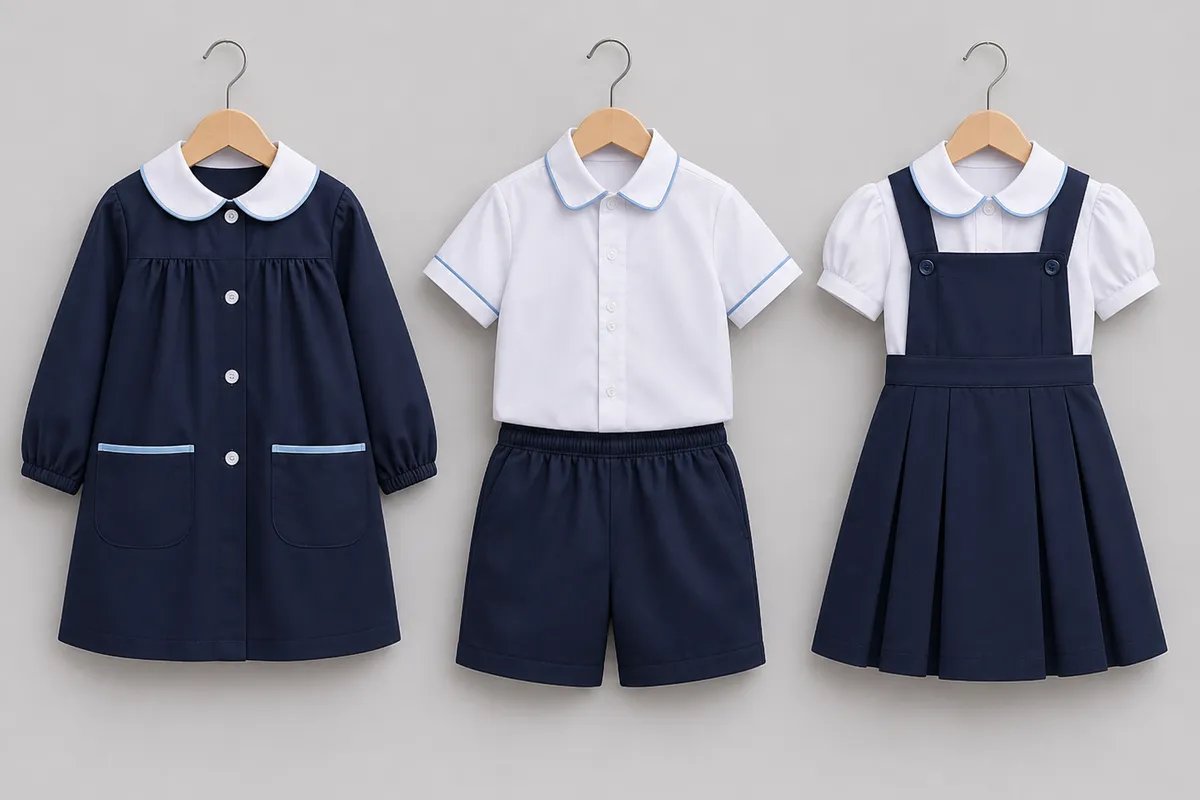
Choosing a nursery summer and winter uniform fabric usually means keeping the same fibre (poly-cotton or cotton) and colour all year while varying the weight of the cloth and the sleeve length. A lighter fabric with short sleeves suits warm months; a slightly heavier fabric with long sleeves suits cooler ones, often worn under a separate warm layer. Many nurseries in warm climates need only one version, while those with distinct seasons find two versions keep children comfortable.
Do nurseries need two versions at all?
It depends on the climate and the building.
- Hot all year. One lightweight version with short sleeves is usually enough.
- Mild with a cool season. One version, plus a warm layer the school sources or orders separately, often works.
- Distinct summer and winter. Two versions of the same garment help: light for summer, heavier with long sleeves for winter.
A smock worn over the child’s own clothes adapts naturally, because families dress the child for the weather underneath. Sets worn on their own need more thought.
Summer and winter choices by garment
| Garment | Summer version | Winter version |
|---|---|---|
| Smock | Lighter fabric, short sleeves | Medium fabric, long sleeves with elastic cuffs |
| Shirt or blouse | Lighter fabric, short sleeves | Same or slightly heavier fabric, long sleeves |
| Shorts | Lighter or medium fabric | Medium fabric; some schools switch to trousers |
| Pinafore | Medium fabric | Heavier fabric, worn with a long-sleeved blouse |
Weight is described by comparison or by reference garment; a figure in a quotation describes the fabric, not a promise about warmth.
Keeping colours matched across seasons
The biggest risk with two versions is that the summer and winter garments look like different colours. Fabric of different weights, and especially of different fibres, takes dye differently. To keep them matched:
- Use the same fibre for both versions where possible.
- Send one colour reference and have both fabrics matched to it.
- Approve both colours side by side at sample stage, not months apart.
- Keep an approved sample of each for reorders.
Our fabrics and colour matching page explains how colour is matched across fabrics.
Fibre choice by season
Some buyers choose cotton for summer and poly-cotton for winter, or the reverse. That is possible, but it makes matching harder, as noted above. More often, buyers keep one fibre and change the weight:
- Cotton is often requested for hot months, for its natural fibre and matt look.
- Poly-cotton is often chosen for its quicker drying, which helps in wet or cold seasons when garments take longer to dry indoors.
Either fibre can be used in both seasons. The choice is confirmed at quotation and on the sample.
Planning a two-season order
- Decide whether one version or two is needed
- Choose the fibre and keep it the same if you can
- Describe the weight for each version, or send reference garments
- Set sleeve lengths and cuff finishes for each
- Match both versions to one colour reference
- Note that each version counts as a separate style for the minimum
The minimum for nursery garments is 50 pieces per style, with sizes mixed, so a two-version smock means two styles. Southern and northern hemisphere schools start their years at different times, so plan each version backwards from the season it is needed in; lead time is confirmed in the quotation. The styles are on our nursery and kindergarten uniforms page.
We manufacture nursery uniforms in India in lighter and heavier fabrics. Tell us the climate and the months each version is worn, and we will quote both.
Questions buyers ask
Can the winter smock be lined?
Our listed smock is an unlined woven garment. If you want extra warmth, a heavier fabric and long sleeves are the usual route, with a warm layer underneath. Ask at enquiry if you need a different construction, and we will confirm at quotation.
Should winter shorts become trousers for nursery children?
Some schools switch to trousers in winter; others keep shorts with tights or leggings that families provide. We list shorts in the kindergarten set. If you want elastic-waist trousers, ask at quotation and we will confirm the style.
Is one fabric weight a reasonable compromise for all year?
Often, yes, especially in mild climates. A medium-weight poly-cotton or cotton works through most of the year, with a separate warm layer in cooler months. This also halves the number of styles to stock.