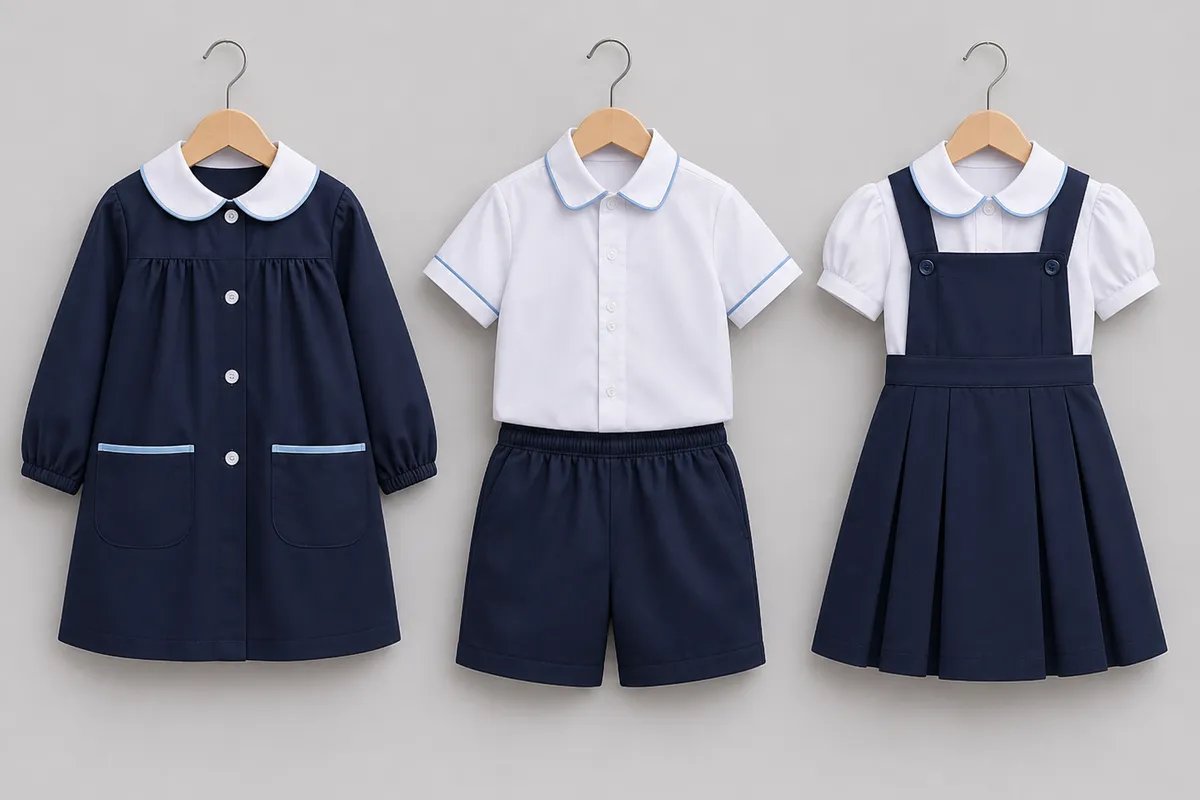
A nursery with rolling admissions needs uniform on the shelf every month, not just at the start of the year. The practical answer is a starter reserve in the two or three smallest sizes, a simple record of who is due to join and when, and an order cycle timed so the reserve is refilled before it runs out. Planning nursery rolling admissions uniform this way means a child who starts in February is kitted out as quickly as one who started in September.
Why rolling admissions change uniform planning
Schools mostly take a year group at once. Many nurseries do not. Children may join:
- after a birthday, once they reach the setting’s starting age;
- at the start of each term;
- whenever a place comes free in a room;
- after a family moves to the area.
Each of these produces a trickle of new starters rather than one intake. The sizes they need are mostly at the small end, because new children are usually the youngest in their room, and each one needs a full set straight away.
Building a starter reserve
A starter reserve is uniform held back specifically for children who join after the main issue. It is separate from stock for growth or replacements.
| Size | Example reserve for a 60-place nursery | Why |
|---|---|---|
| 2–3 | Enough for the next term’s expected toddler starters | Most new starters join the youngest room |
| 3–4 | The largest share of the reserve | Covers both new two-and-a-halfs sized up and new three-year-olds |
| 4–5 | A small number | For older children moving from another setting |
| 5–6 and up | One or two, or none | Few children join late at this age |
These figures are a starting example to set against your own waiting list. A nursery that knows its next term’s starters by name can plan almost exactly; one that fills places as they come up needs a slightly larger buffer.
Starter packs: what goes in one?
Many settings make up a starter pack in advance, so a new family receives everything at their first session. A typical pack contains:
- Two or three main sets in the child’s size
- One or two smocks, if smocks go home
- A copy of the uniform list and the recommended number of sets
- A size guide showing how to check fit as the child grows
- A note of where to buy further sets
If you ask for sets to be packed together in one bag with a size sticker, making up starter packs becomes a matter of picking bags off a shelf. Packing is confirmed in the quotation.
Setting an order cycle for a rolling intake
The hard part of rolling admissions is timing the next order. A workable cycle looks like this:
- List expected starters for the next two terms from your waiting list and birthdays.
- Count the reserve on the shelf each month.
- Set a reorder point, the number at which you place the next order, allowing for lead time. Lead time is confirmed in the quotation, so plan backwards from when the reserve would run out.
- Combine needs. Nursery styles start at 50 pieces per style, and sizes can be mixed. Combining starter sizes with growth replacements, or with a second colour, makes reorders reach the minimum more easily.
- Reorder to the approved sample so each new batch matches what children already wear.
Our how to order page walks through the steps from enquiry to dispatch, which helps when fixing the reorder point. The garments are on our nursery and kindergarten uniforms page.
Send us your expected starters by term and the reserve you want to hold, and we will quote each style by fabric, quantity and branding.
Questions buyers ask
How big should a starter reserve be?
Size it to cover new starters between one delivery and the next, judged from your waiting list and past joining patterns. A nursery reordering twice a year needs a bigger reserve than one reordering every term.
Can we order just a few sets for one new child?
We make bulk orders, starting at 50 pieces per style with sizes mixed. That is why nurseries with rolling admissions hold a reserve: it lets them kit out single new children from the shelf between bulk orders.
What if a size runs out before the next order arrives?
Issue the next size up as a temporary measure. A slightly large set works for a small child, while a set that is too small does not. Note the shortfall and raise that size in your next order.