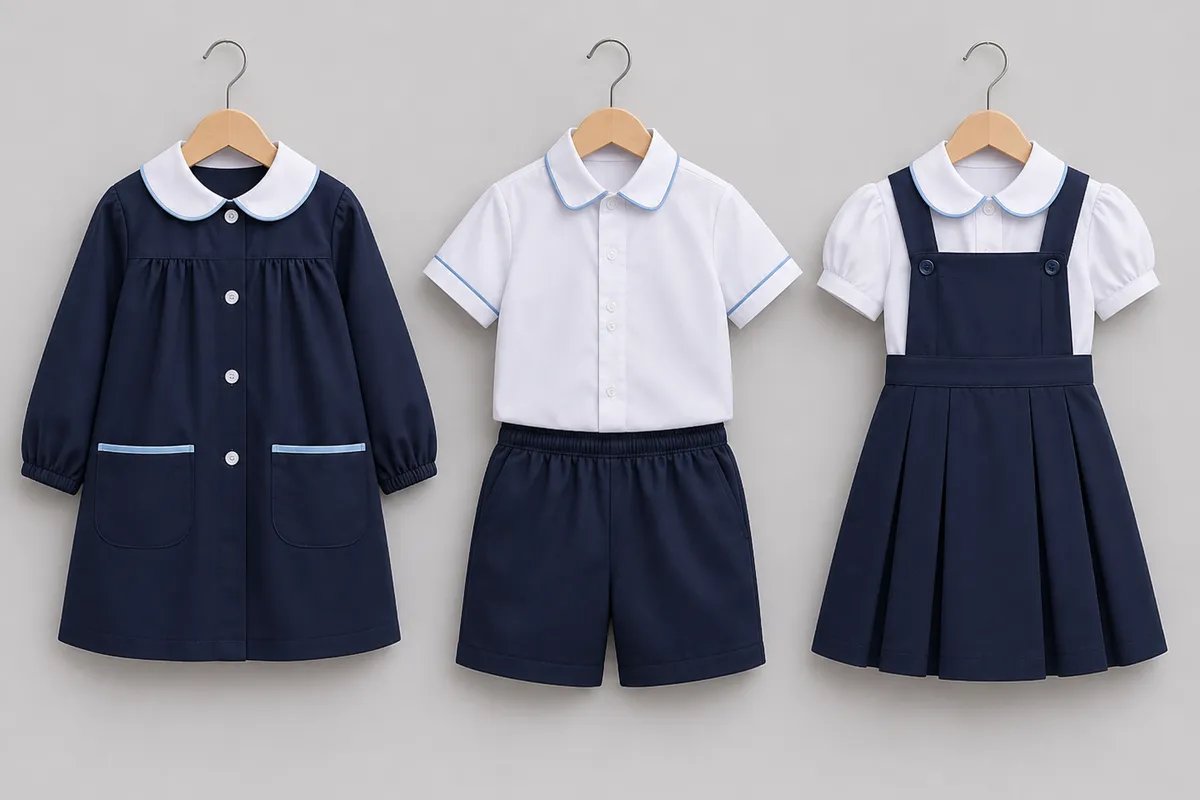
UKG uniform is the uniform worn in upper kindergarten, the last year before Class 1, and schools plan it in one of two ways: keep the same kindergarten design as LKG in a larger size, or introduce a step towards the primary uniform. Either works. What matters for ordering is that the choice is made early, because it decides whether UKG stock is part of the kindergarten order or the primary one, and how much is left over when children move up.
Should UKG wear the kindergarten uniform or the primary uniform?
Schools using the LKG and UKG pattern make different choices, and each has trade-offs.
| Approach | What children wear in UKG | Ordering effect | Points to consider |
|---|---|---|---|
| Same as LKG | KG smock or set, one size up | UKG adds sizes to the KG styles | Simple stock; families may reuse LKG sets if they still fit |
| Bridge uniform | KG set in the primary colours, or with a primary-style collar | A separate UKG style | Prepares children for Class 1; one more style to manage |
| Primary uniform early | Class 1 shirts, shorts, skirts or pinafores in small sizes | UKG sizes join the primary styles | Families buy once for UKG and Class 1; garments must suit five- and six-year-olds |
There is no single right answer. Many schools keep UKG in the kindergarten uniform because small children are still more comfortable in simple sets with elastic waists.
How many UKG sets should a school or shop order?
UKG is normally one year, and children leave at the end of it, so planning differs from LKG.
- Size for one year, not two. Children wear UKG uniform for a single year, so one band above current size is usually enough.
- Expect fewer new joiners. Most UKG children came up from LKG, so the class size is known early.
- Watch the top size. UKG children are the tallest in the kindergarten, and the largest band may need more pieces than in LKG.
Ask families how many sets they will buy, or use last year’s sales. A recommendation of two or three sets per child is common in day schools where uniform is washed every evening.
Planning the move from UKG to Class 1
The end of UKG is when the school’s two uniforms meet. Good planning at this point avoids gaps for families.
- Know the Class 1 intake. Most UKG children move to Class 1, so the primary order for next year can be sized from the current UKG roll.
- Check size overlap. The largest UKG size and the smallest Class 1 size should line up, so no child falls between them.
- Time both orders. If kindergarten and primary uniform are ordered together, UKG and Class 1 sizes are planned on one sheet.
- Clear UKG stock thoughtfully. Leftover large UKG sets can go to tall LKG children next year if the design is shared.
Nursery and kindergarten styles start at 50 pieces per style, with sizes mixed. A school with two or three UKG sections usually reaches this in one style, while a smaller school can combine UKG with LKG in a shared design.
Our page for schools and school groups explains how we work with schools ordering their own uniform. You can see the kindergarten garments on our nursery and kindergarten uniforms page. Send us your UKG numbers, your chosen approach and your Class 1 garment list if you want them quoted together.
Questions buyers ask
Is UKG uniform different from LKG uniform?
In many schools the design is the same and only the size changes. Others use a slightly more formal set in UKG. It is the school’s decision, and we make whichever design you choose to the approved sample.
Can UKG children wear the Class 1 uniform early?
Yes, if the garments suit them. Check that waistbands, collars and fastenings are easy for five-year-olds to manage, and that the smallest primary sizes fit the youngest UKG children before deciding.
What should a school do with spare UKG sizes at year end?
If LKG and UKG share a design, spare large sizes can serve the tallest children in next year’s LKG and UKG classes. Count them before placing the next kindergarten order.