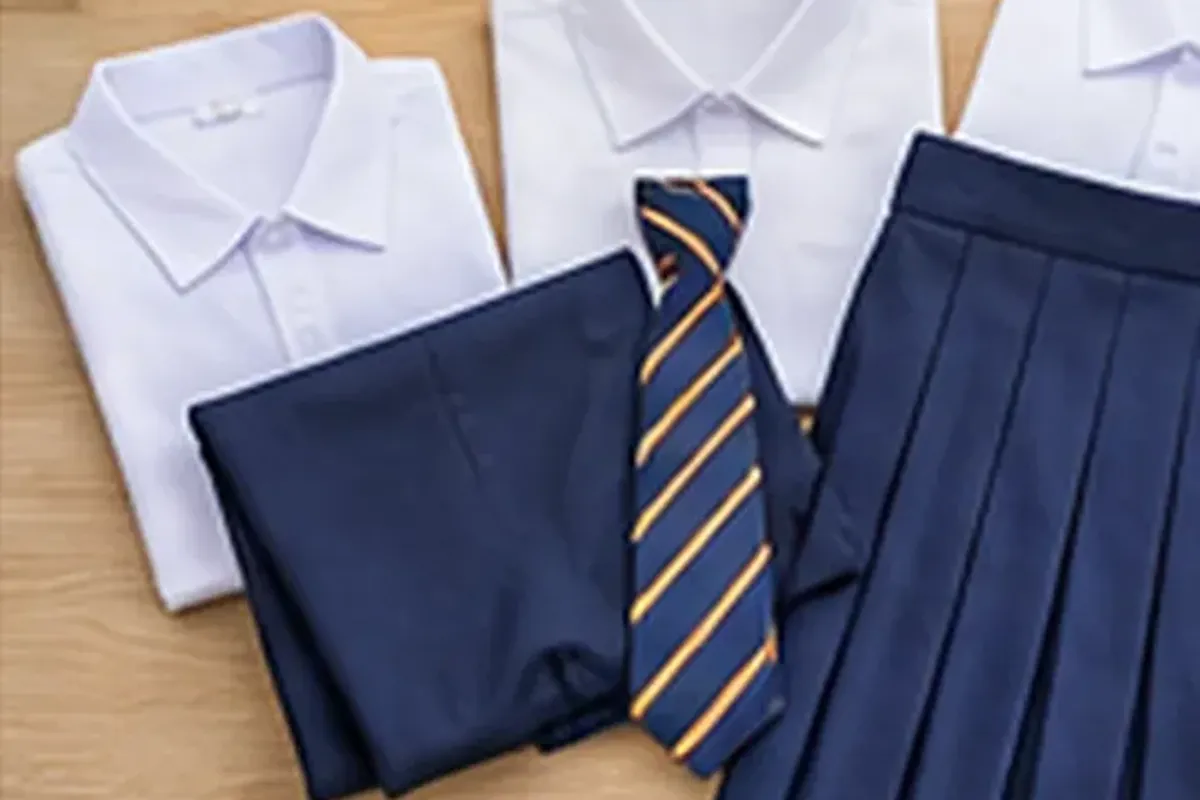
A knife pleat school skirt is pleated with sharp, narrow folds that all lie in the same direction, so the skirt shows a series of overlapping edges round the body. When you order one in bulk, state the pleat direction, the number of pleats, the spacing between fold edges and the depth of each turn-back. Direction is the detail most often missed, and it changes how the skirt looks at once.
Knife pleats give a fine, even texture and plenty of movement. They are widely used on senior skirts and on check skirts, where the narrow folds show the pattern in stripes.
Which way should knife pleats face?
Knife pleats can face left, face right, or face away from the centre front on each side. Each layout gives a different look:
| Layout | How the folds lie | Typical use |
|---|---|---|
| All one direction | Every fold points the same way round the body | Classic all-round knife pleat skirt |
| Facing away from centre front | Left half points left, right half points right | Symmetrical front, often with a flat centre panel |
| Facing towards a centre box | Folds turn towards a single box pleat at the front | Mixed layout with a clear centre line |
“All one direction” is the simplest to make and to press. The symmetrical layouts look tidier from the front but meet at a point that needs careful handling, usually a box or a flat panel.
If the skirt you sell now has a particular direction, write it down as seen by someone looking at the front of the skirt, for example “folds face to the wearer’s left”. Confusion between the wearer’s left and the viewer’s left is common, so a photo with an arrow helps.
Spacing, depth and count
Knife pleats are defined by three linked measurements. Change one and the others usually move too.
- Spacing: the visible distance from one fold edge to the next on the outside of the skirt.
- Turn-back depth: how much fabric is folded under each pleat. A deeper turn-back gives more swing and uses more cloth.
- Count: the number of pleats all round. More pleats at the same waist mean closer spacing.
Narrow spacing with many pleats gives a fine, almost ribbed look. Wider spacing with fewer pleats looks plainer and is quicker to press at home. For school wear, a moderate spacing that families can iron without trouble is usually the practical choice.
Do knife pleats work in every size?
They do, but the smallest sizes have a short waist to divide up. Some buyers keep the same count across the range, giving very fine pleats on junior sizes. Others reduce the count on small sizes so the spacing stays similar. Agree one rule and write it on the size chart.
Knife pleats in plain and check fabrics
In plain poly-viscose or polyester twill, knife pleats are set by pressing and stitching, and the fabric choice affects how sharp the edges stay over time. In yarn-dyed check, there is a further decision: whether each fold lands on a chosen stripe of the check, so the skirt shows one colour on the outside when standing still. That decision affects the pleat spacing, because the spacing then follows the check repeat.
A note on stitched-down length: knife pleats are often sewn flat from the waistband to the hip, then left open. A longer stitched section gives a slimmer line over the hip; a shorter one gives more movement.
What to send with your enquiry
- Pleat direction, described from the front, with a photo if possible
- Pleat count all round, or front and back separately
- Spacing between fold edges at the hip
- Turn-back depth, or “follow our current skirt”
- Stitched-down length from the waistband seam
- Fabric and colour, or the check reference
- How the count changes, if at all, across your size range
Schoolwear suppliers often run one knife pleat pattern for many schools in different checks. Our page for schoolwear suppliers and distributors covers how multi-school ranges are quoted, and our school skirts and skorts page lists the styles we make.
We manufacture in India and lock the pleat direction and spacing on the approved sample. Send us your current skirt or the measurements above and we will prepare a quotation for each style.
Questions buyers ask
Why do knife pleats sometimes twist after washing?
Twisting usually means the pleats were not set evenly, or the skirt was hung by one side while damp. Even pressing during making and hanging the skirt by the waistband to dry both help the folds fall straight again.
Can a knife pleat skirt have a flat front panel?
Yes. Many senior skirts have a flat front panel with knife pleats starting either side and facing away from it. The panel gives a clean front, and the pleats provide movement at the sides and back.
Are knife pleats suitable for younger children?
They are, though families of younger children often find wider pleats or box pleats quicker to iron. If a school uses knife pleats across all ages, consider slightly wider spacing on junior sizes to keep home pressing manageable.