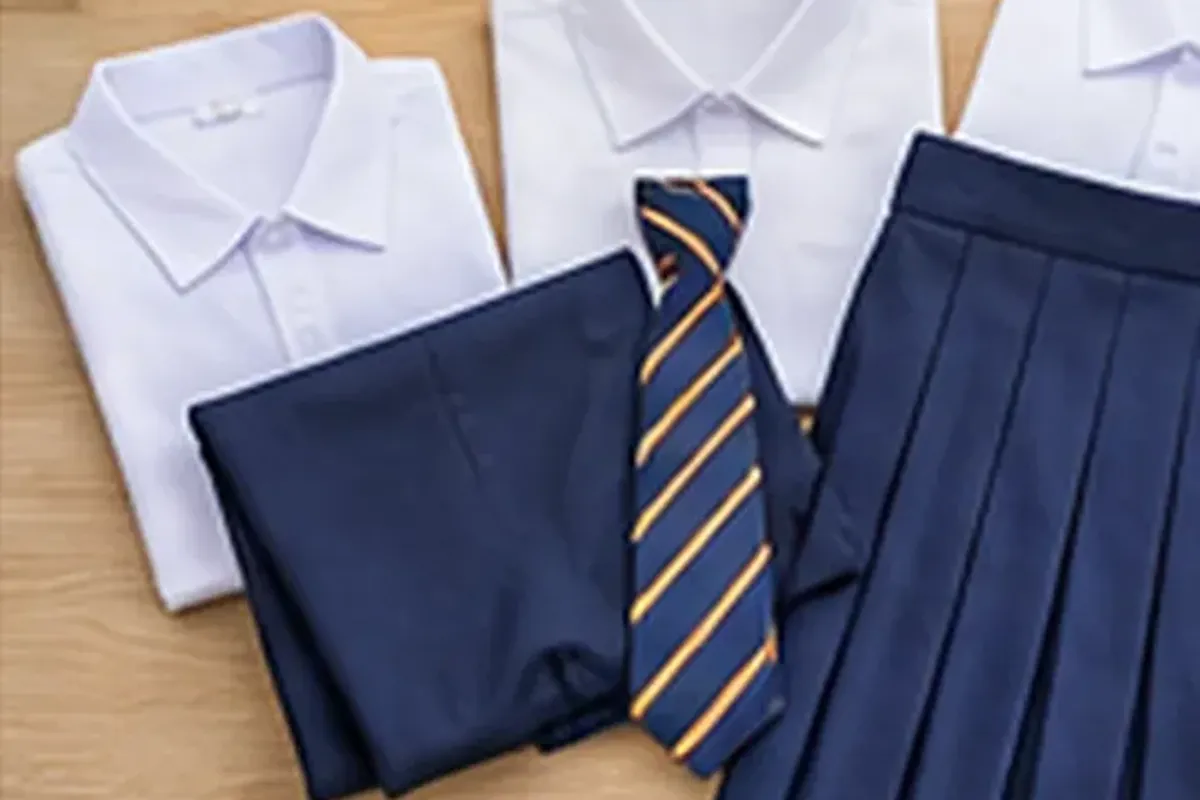
A lined school skirt has a second, lighter layer of fabric sewn inside it, usually hanging from the waistband, so the outer fabric does not touch the legs directly. A lining can help a skirt slide over tights, hang more smoothly and feel more comfortable in cold weather. Many school skirts are unlined, though, because pleated skirts in firm fabrics hang well without one and are simpler to wash and dry.
Whether to line a skirt is the buyer’s choice, specified at quotation. It affects comfort, care and cost, so it is worth deciding on purpose rather than by habit.
What does a lining do?
A lining has several practical effects:
- Smoother movement over tights. The outer fabric can cling to tights; a smooth lining reduces this.
- Improved drape. A lining can help an A-line or straight skirt hang cleanly.
- Comfort. It keeps seam allowances and the inside of the hem away from the skin.
- Warmth. A second layer adds a little warmth in winter.
- Opacity. In lighter colours, a lining reduces show-through.
On a fully pleated skirt, however, a lining can work against the pleats, because it has to follow the full width of the skirt or it restricts movement.
Lined or unlined: a comparison
| Point | Lined | Unlined |
|---|---|---|
| Feel against the legs | Smooth, light | Outer fabric touches the legs |
| Cling to tights | Reduced | Possible, depending on fabric |
| Drape on A-line skirts | Cleaner | Fine in firmer fabrics |
| Effect on pleats | Lining must be cut to allow movement | No restriction |
| Warmth | Slightly warmer | Cooler in warm weather |
| Washing and drying | Two layers to dry; may twist | Quicker to dry and press |
| Cost and time to make | Higher | Lower |
Which skirts benefit most from a lining?
A-line and straight skirts
These skirts rely on a clean outline. A lining helps them hang smoothly and stop clinging, so A-line skirts in softer poly-viscose are the most common candidates.
Light-coloured skirts
A pale grey skirt may show the outline of anything underneath in bright light. A lining reduces this.
Pleated skirts
Usually unlined. A firm fabric such as polyester twill hangs well on its own, and a lining could limit the swing of the pleats. If a lining is wanted, it is often a partial lining at the top or a separate A-line lining shaped to allow the pleats to open.
Skorts
Skorts are not lined, because the inner shorts already sit beneath the panel.
Lining options to specify
If you decide to line a skirt, agree:
- Full or part lining. Full to the hem, or only the upper part.
- Attached how. Sewn into the waistband and left free at the hem, or anchored at the side seams.
- Length. Usually a little shorter than the outer skirt so it does not show.
- Lining fabric and colour. Matched or toned to the skirt colour.
- Hem finish on the lining. Turned and stitched, or neatened to save bulk.
Lining is offered as an option rather than as standard, and it is confirmed on the quotation and sample. Our fabrics and colour matching page covers the outer fabrics we use for skirts.
Deciding for your range
Think about the climate, the season the skirt is worn in, and how much families value easy care. In warm climates and for younger children, unlined skirts are usually more practical. In colder regions, a lined A-line skirt for winter can make sense.
Our school skirts and skorts page shows the styles we make. We manufacture in India, and you can ask for one style to be quoted both lined and unlined so you can compare before deciding.
Questions buyers ask
Does a lining make a skirt harder to iron?
A little. The lining is pressed separately, usually on a low heat, and should not be pressed into the pleats or hem of the outer skirt. Many families simply hang a lined A-line skirt and press only the outer fabric.
Can a lining be added later to an existing skirt style?
Yes. Adding a lining is treated as a change to the specification and is shown on a new sample before bulk. It changes the quotation, because it adds fabric and making time.
Is a lined skirt better for winter?
A lining adds a modest amount of warmth and helps the skirt slide over tights, both useful in cold weather. Some schools use a lined skirt in winter and an unlined skirt or dress in summer.