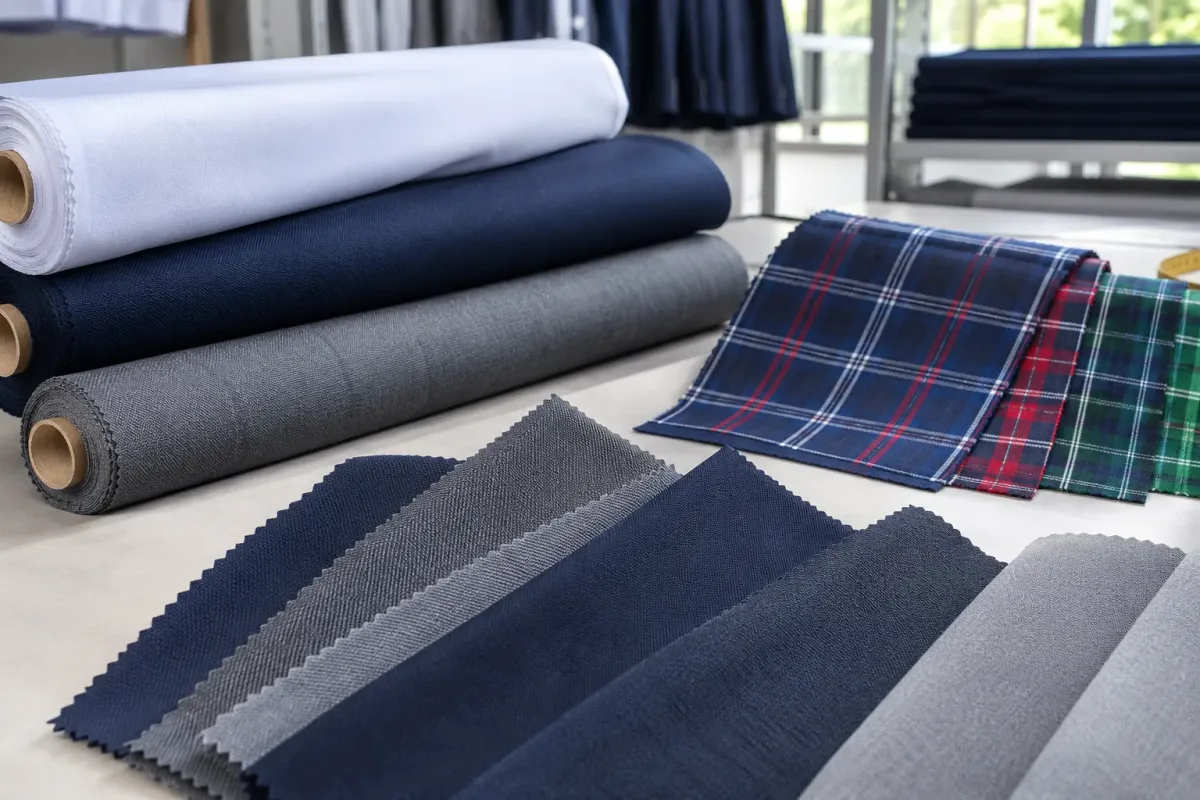
School skirt colour matching means making a plain skirt’s shade sit right next to the other garments on the list, such as the pinafore, trousers and blazer. The most reliable way is to send one reference for the whole set, approve every fabric’s shade side by side, and keep the approved shade as the standard for reorders. Different fabrics take colour slightly differently, so “navy” needs to be agreed against a physical sample, not a word.
A school sees the uniform as one colour. If the skirt looks a touch greener or lighter than the blazer, families and staff notice. Getting it right at the start avoids awkward conversations later.
Why do two navies not always match?
Several things affect how a colour looks once it is on a garment:
- Fibre. Polyester and viscose take dye differently, so a poly-viscose skirt and a polyester blazer dyed to the same reference can look slightly different.
- Weave. A twill weave catches light along its diagonal lines, which can make the same colour look a shade lighter than a plain weave.
- Surface finish. A smooth fabric reflects more light than a matt one.
- Lighting. Colours that match in daylight can drift under classroom lights.
None of this means matching is impossible. It means it should be judged on real fabric in more than one light, which is what shade approval is for.
Which garments should the skirt match?
The level of match needed depends on how the garments are worn together.
| Garment pair | Worn how | How close the match should be |
|---|---|---|
| Skirt and trousers | Side by side across a class | Very close; same fabric where possible |
| Skirt and pinafore | Different year groups, same colour | Very close; often the same fabric |
| Skirt and skort | Same students, different days | Very close; same fabric family |
| Skirt and blazer | Worn together, different fabrics | Close; slight difference is usually accepted |
| Skirt and knitted jumper | Worn together, woven against knit | Toned rather than identical |
Skirts, trousers and pinafores are often made in the same fabric, poly-viscose or polyester twill, which makes them the easiest to match closely. Blazers and knitwear differ in fibre and structure, so the aim there is a colour that clearly belongs to the same family.
How to get a good match
- Send one master reference. Ideally a garment the school considers correct, or a fabric piece. If you can only give a colour-standard number, say which one.
- Send the other garments too. If the skirt must sit beside an existing blazer or pinafore, send those as well, so we can judge the skirt against them.
- Approve shades side by side. We send the shade, or a sample garment, for approval before cutting. Compare it next to the other garments in daylight and indoors.
- Keep the approved swatch. It becomes the reference for every reorder, and we check later batches against it before dispatch.
Our fabrics and colour matching page sets out how we match an existing uniform and approve shades before production.
What if the current garments do not match each other?
It happens, especially when different items came from different makers over the years. Decide which garment is the “true” colour and match everything new to that one. Over time, as old stock sells through, the set comes back into line.
Planning a full colour set
- Choose one master reference for the school colour
- List every garment that must match it, and in which fabric
- Send references for any garments made elsewhere
- Approve all shades together, not one at a time
- Store the approved swatches with the order records
Plain skirts in navy, grey, black, bottle green or a matched shade are on our school skirts and skorts page. We are a uniform manufacturer in India, and we match each fabric to your reference before bulk production. Send your references and garment list for a quotation.
Questions buyers ask
Can you match a skirt to a blazer from another maker?
We can match the skirt’s colour to the blazer as closely as the two fabrics allow. Send the blazer, or a clear piece of its fabric, and judge the skirt shade beside it before approving.
Is grey harder to match than navy?
Greys can be tricky because small shifts towards blue, green or brown show easily against other garments. Approving a grey shade in daylight and under indoor light, beside the other grey items, helps avoid surprises.
Should the skort be made in the same fabric as the skirt?
Making both in the same fabric is the simplest way to keep the colour identical. If they are in different fabrics, approve both shades side by side so they read as one uniform.