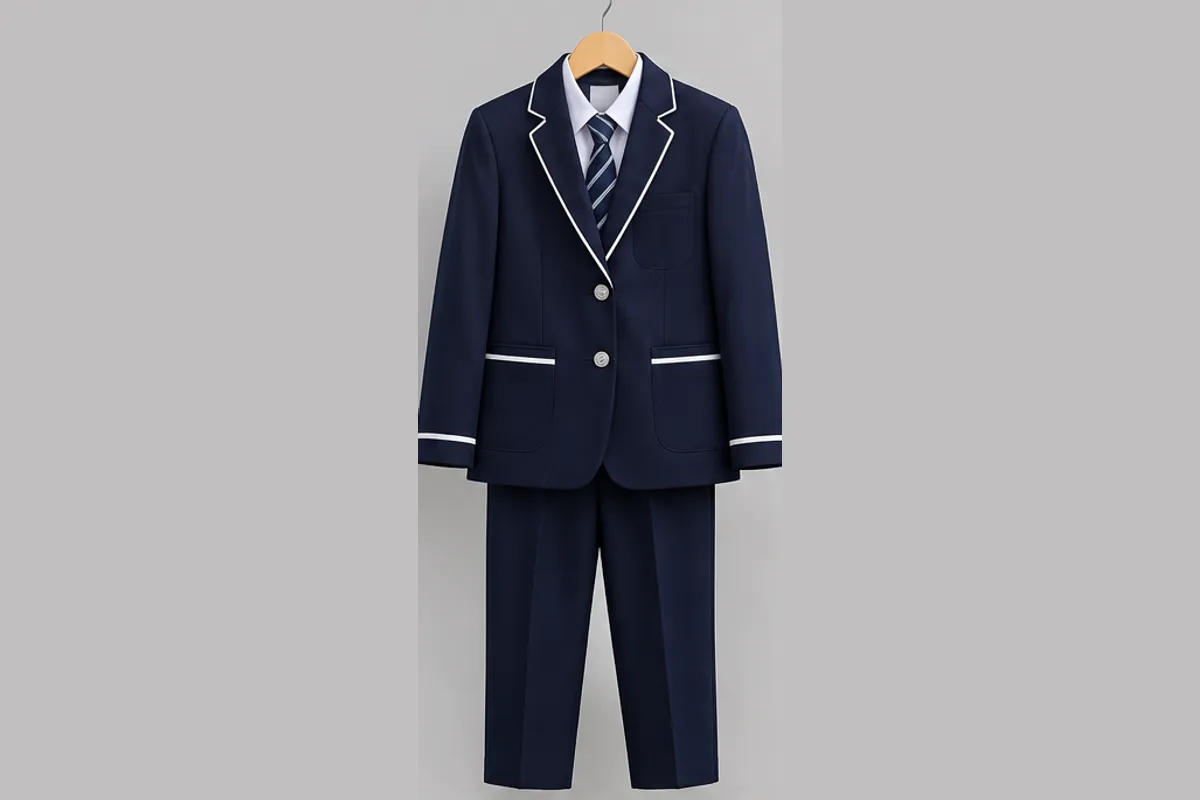
To measure for a school blazer, take four body measurements over a school shirt: chest, across the back shoulders, arm length and height. Then match the chest to your chart first, check the shoulder and arm against it, and choose the size where all three sit within range. Chest alone is not enough for a blazer, because shoulders and sleeves cannot be let out later.
This guide is for shop staff, school uniform coordinators and charity volunteers who measure students before a bulk order or at a counter. It explains each step, what tends to go wrong, and how to record results so they turn into a useful size list.
What should the student wear when being measured?
Measure over a school shirt or a thin top, never over a jumper or coat. If the school’s uniform puts a jumper under the blazer in winter, note that on the record rather than measuring over it. The size chart already allows ease for a layer underneath, so measuring over bulk adds that allowance twice and pushes students into a size too big.
Ask the student to stand straight with arms relaxed, feet together, looking ahead. Shoes off for height. Empty pockets.
The four measurements, step by step
Step 1: chest
Pass the tape under the arms and round the fullest part of the chest. Keep it level at the back; a tape that dips at the back gives a smaller reading. Let the student breathe normally. Read the tape where it meets, snug but not tight.
Step 2: across the back
Measure from the outer edge of one shoulder bone to the other, across the upper back. This is the measurement most often skipped, and it is the one that decides whether the blazer looks right. A broad-shouldered student may need a size up even when the chest says otherwise.
Step 3: arm length
With the arm hanging naturally and slightly bent, measure from the shoulder point over the elbow to the wrist bone. Measure one arm only, the same side each time, so records are consistent.
Step 4: height
Stand the student against a wall with heels touching it. Height helps with back length and is the quickest way to spot students who will need a longer fitting later.
Turning measurements into a size
Body measurements and garment measurements are different numbers. Your blazer chart shows garment figures, which are larger than the body by the ease the pattern allows. The family size guide, if you have one, translates body measurements into sizes. Use that to choose.
| If the measurements say | Choose | Note on the record |
|---|---|---|
| Chest and shoulder in one size, arm in the same | That size | Nothing extra |
| Chest in one size, shoulder in the next | The larger size | Check sleeve on try-on |
| Chest and shoulder fit, arm longer than the size | Same size | Flag for a longer sleeve or long fitting |
| Chest between two sizes, student still growing | Larger size | Confirm shoulder does not overhang |
| Chest fits, height well above the age band | Same chest size | Flag as possible long fitting |
When a student falls between sizes, the shoulder is the deciding point. A blazer that is roomy in the chest but sits correctly on the shoulder will look acceptable for longer than one that is tight across the back.
Recording results for a bulk order
For a school or charity collecting sizes for a whole group, measure everyone in one session with the same tape and the same person reading it where possible. Write measurements on a simple form with student name or number, class, chest, back, arm, height and the size chosen. Then count the chosen sizes to build your order. Our size charts page explains how those sizes map to the chart agreed for each order.
- Same tape used for the whole session
- Measured over a shirt only
- Shoulder measurement recorded for every student
- Students between sizes marked for a try-on
- Long-fitting candidates flagged
- Totals counted by size and by boys’ or girls’ style
If you can, keep a set of sample blazers in the main sizes for try-on. A quick try-on settles most borderline cases faster than a second set of measurements.
Our school blazers are made to your size chart in your colours. Send us the size totals from your measuring session and we will prepare a quotation for the order.
Questions buyers ask
Is it better to measure in centimetres or inches?
Use whichever your size chart uses, so nobody has to convert at the counter. If staff are more comfortable with inches but the chart is in centimetres, use a dual-sided tape and record only the centimetre side to avoid mixed records.
How long does it take to measure a class for blazers?
A practised pair, one measuring and one writing, can usually move through a class in a single lesson. Allow extra time for try-ons of borderline sizes, and keep the students who need a second check to the end of the session.
Should younger children be measured or just sized by age?
For infants and juniors, age band plus a quick try-on is usually enough, because parents know the age and the range of builds is narrower. Measuring becomes more useful from the early secondary years, when growth varies widely within one year group.