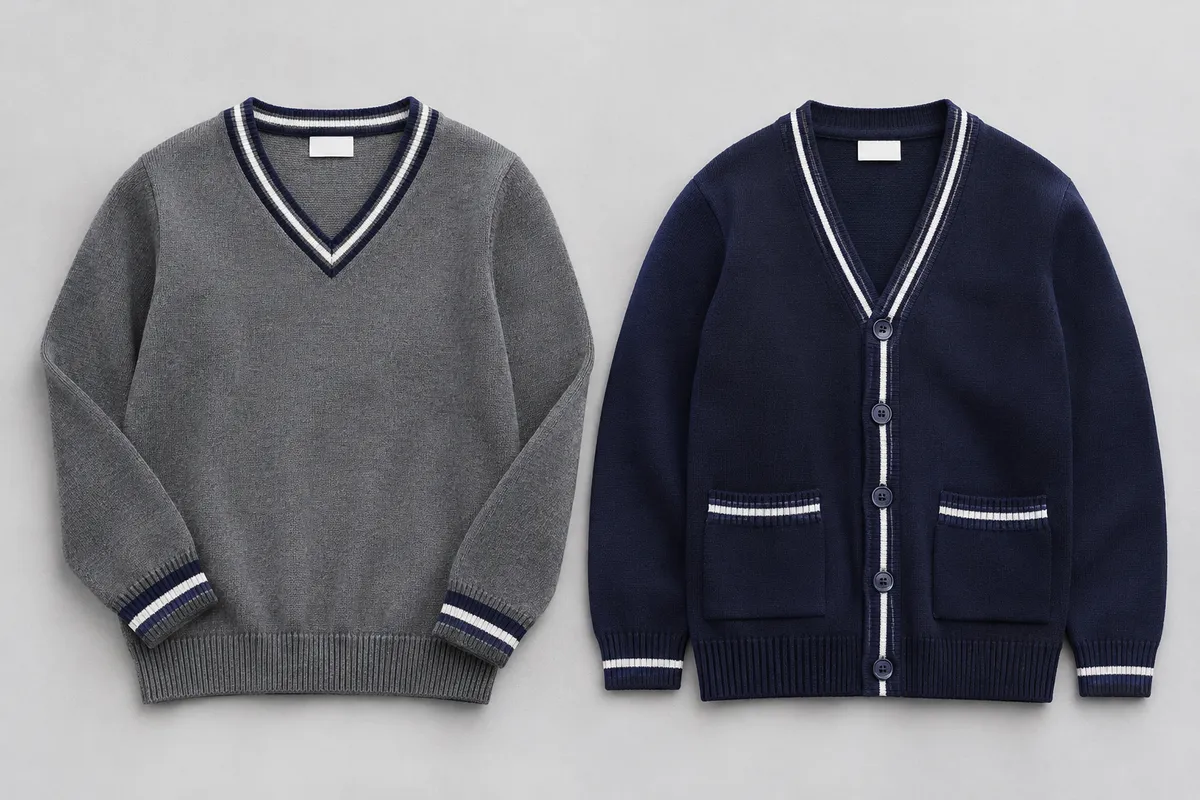
How school jumpers are made follows a clear sequence: the yarn is dyed to the school colour, the body, sleeves and rib trims are knitted, the pieces are joined, the badge and labels are added, and the finished jumper is pressed, checked and folded. Each stage fixes something a buyer cares about, which is why the sample is approved before bulk knitting starts.
This overview walks through the stages in order, so buyers know what is being decided and when.
The stages at a glance
| Stage | What happens | What it fixes for the buyer |
|---|---|---|
| 1. Yarn and colour | Yarn dyed and matched to your reference | Body and stripe colours |
| 2. Knitting | Panels and rib knitted on flat machines | Gauge, knit, stripe widths, rib type |
| 3. Shaping or cutting | Panels shaped on the machine or cut to pattern | Fit and measurements |
| 4. Joining | Shoulders, sleeves, sides and bands joined | Seam strength and neatness |
| 5. Neck and bands | Neck band, or cardigan front band, attached | Neckline shape and V point |
| 6. Badge and labels | Logo embroidered or printed; labels sewn in | Branding and care information |
| 7. Fastenings | Cardigan buttons or press studs, as specified | Opening and closing |
| 8. Finishing | Steamed or pressed to settle the knit | Final shape and size |
| 9. Checking and folding | Compared with the approved sample; folded with size sticker | Consistency with what you approved |
Yarn comes first
Knitwear colour is set at the yarn stage. Unlike a woven shirt cut from dyed cloth, a jumper is knitted from yarn that is already the right colour. That means the body colour and each stripe colour must be approved before knitting. It also means a plain jumper cannot be turned into a striped one later: the stripes are part of the knitting. We make school knitwear in acrylic or cotton-acrylic, confirmed at quotation.
Knitting the pieces
Flat knitting machines produce the front, back and sleeves, usually with the rib knitted at the start of each piece so the hem and cuffs are already attached. Stripes in the rib are made by switching yarn colour for a set number of rows. Neck bands and cardigan front bands are knitted as separate strips. The gauge and knit are the same across a range, so jumpers and cardigans match.
Joining, trimming and branding
The pieces are joined at the shoulders, armholes and sides. The neck band is attached and its point formed on a V-neck. On a cardigan, the front band goes on and buttonholes or stud positions are set. Then the badge is added: logo embroidery or printing is available, and its method, size and position are fixed on the sample. Your woven or printed label, or a plain size label, is sewn in with the care label.
Finishing and checking
Knitwear is steamed or pressed so the stitches settle and the jumper lies at its intended measurements. Our quality check compares finished jumpers with the approved sample: colour, stripes, measurements, badge, labels and seams. Each jumper is folded with a size sticker, and cartons are packed as agreed in the quotation.
What buyers approve, and when
- Colour references, before yarn is dyed for bulk
- The sample, before bulk knitting begins
- Badge position and labels, on the same sample
- Packing instructions, in the quotation
We manufacture in India, and every repeat order is made to the same approved sample. Our fabrics and colour matching page explains how colour references are handled at the first stage.
If you would like to start the process for your school or shop, send your reference jumper or specification, and we will quote your knitted jumpers and cardigans per style, by fabric, quantity and branding.
Questions buyers ask
Why can’t stripes be added after a jumper is knitted?
The stripes are made by changing yarn colour during knitting, so they are part of the fabric. Adding them later would mean sewing on a tape, which behaves differently on stretchy rib. A striped jumper is planned from the yarn stage.
Is every school jumper steamed before packing?
Finishing knitwear by steaming or pressing is a normal step that settles the stitches and brings the garment to its measurements. It is part of making the jumper match the approved sample.
At which stage is the size chart applied?
The size chart shapes the knitting or cutting of each panel and is checked again after finishing. It is agreed with the order and confirmed on the sample before bulk production starts.