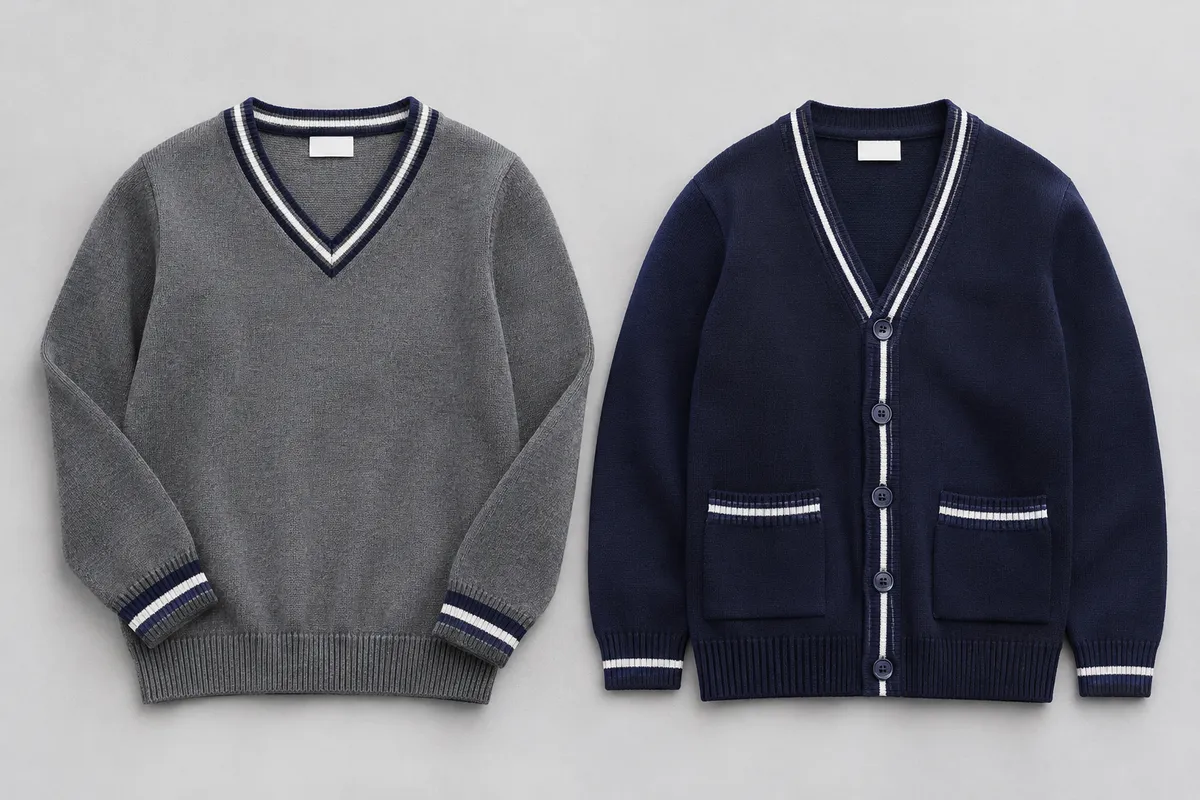
To measure for a school jumper, take three body measurements, chest, height and arm length, with the student standing straight in a shirt, then pick the size whose garment chest is a few centimetres larger than the body chest. The garment should be easy over a shirt without the shoulders dropping or the cuffs covering the hands.
This guide is for schools and shops running a fitting day or collecting sizes for a bulk order. It covers the measurements, the ease that knitwear needs, and how to turn a class list into a quantity by size.
Which body measurements do you need?
Three numbers are enough for knitwear. Take them over a school shirt, not over a coat or another jumper.
- Chest. Pass the tape around the fullest part of the chest, under the arms and level across the back. Keep one finger under the tape so it is snug but not tight.
- Height. Student standing against a wall, shoes off, heels together. Height guides body length and is a quick check on the age band.
- Arm length. From the bony point at the top of the shoulder, over a slightly bent elbow, to the wrist bone. This tells you whether a student with long arms needs the next size up for the sleeves alone.
Write the figures in centimetres. If your customers think in inches, convert later, but keep the original numbers.
How much ease should a knitted jumper have?
Ease is the difference between the body measurement and the garment measurement. A jumper with no ease is tight and shows every fold of the shirt beneath. One with too much hangs off the shoulders and slips down the arms.
Knitted fabric stretches, so a jumper needs less ease than a woven blazer. It needs more than a polo shirt, because it is worn over a shirt and sometimes a tie. The table below is a rough guide for comparing a student’s chest with a garment chart. Adjust it to the fit your school prefers.
| Fit the school wants | Garment chest compared with body chest | What it looks like |
|---|---|---|
| Close | A small margin larger | Neat under a blazer; little room to grow |
| Regular | A moderate margin larger | Easy over a shirt; the usual school fit |
| Roomy | A generous margin larger | Room to grow; sleeves may need turning back |
Ask for the garment chart from your supplier, then compare. We agree the chart for each order on our size charts page, so the garment figures are known before the fitting day.
Running a fitting day for knitwear
Measuring tapes give a starting point. Trying on gives the answer. If you can, hold a set of sample jumpers, one in each size, and let students try them over their shirts.
Some practical points from fitting days:
- Check the shoulder seam. It should sit at or just past the edge of the shoulder.
- Ask the student to raise both arms. The hem should not lift above the waistband.
- Look at the cuffs. They should reach the wrist bone with the arms down.
- For cardigans, button them up before judging the fit.
Record the size chosen, not only the measurements. The chosen size is what you order.
Turning measurements into an order
Once every student has a size, count them. A simple tally is enough:
- List each class or year group with its student count
- Record the size chosen for each student
- Total each size across the school, per style
- Add a margin for new joiners and replacements during the year
- Check each style reaches the minimum of 100 pieces, with sizes mixed
If a style falls short of 100, the margin stock can make up the difference, or a smaller style can be added later as a top-up when numbers are clearer.
With a size tally in hand, send it to us with your colours and logo, and we will quote your knitted jumpers and cardigans per style, by fabric, quantity and branding.
Questions buyers ask
Should students be measured in their summer or winter uniform?
Measure over a long-sleeved school shirt, because that is what the jumper is worn over. A summer polo or a thin T-shirt gives a smaller chest figure and leads to jumpers that feel tight in winter.
What if a student’s chest and height point to different sizes?
Choose by chest first, because a tight jumper is uncomfortable while a long one is only untidy. If the sleeves are then short, try the next size up and check the shoulders do not drop too far.
How often should students be re-measured?
Younger children can change size within a year, so primary schools often re-measure each summer before the new order. Secondary students can be measured on joining and then fitted again only when a jumper feels tight.