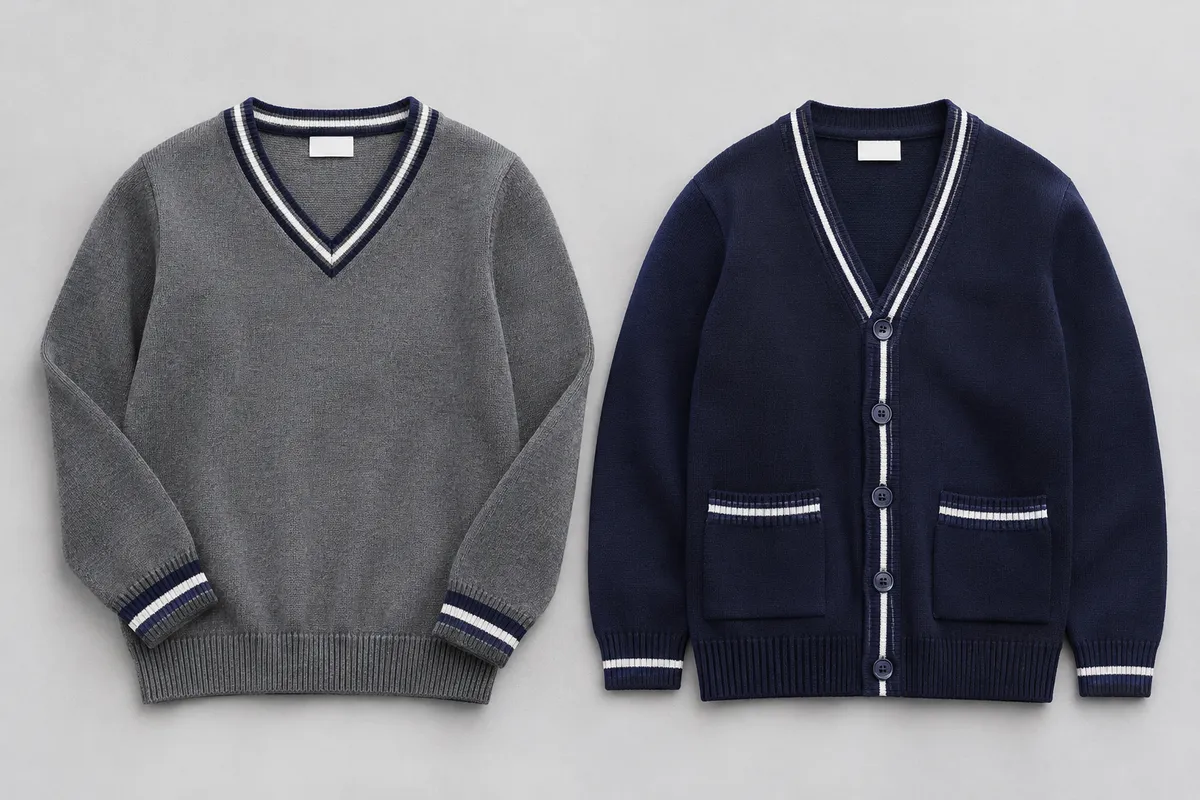
For planning purposes, many shops and schools assume two school jumpers per student over a year where knitwear is worn daily, and one where it is worn only in the coldest weeks. The real figure depends on climate, washing habits, lost-property rates and whether students also own a cardigan or slipover.
This post sets out what drives the number, a worked example of turning it into stock, and the signs that your assumption needs changing.
What pushes the number up or down?
Knitwear behaves differently from shirts and polos. A shirt is washed after every day or two; a jumper is often worn for several days between washes. But a knitted jumper dries more slowly than a polo, and in damp weather a family with only one may have nothing for the next morning.
| Factor | Effect on jumpers per student | Why |
|---|---|---|
| Knitwear worn daily, most of the year | Higher | One in the wash, one being worn |
| Knitwear worn only in winter | Lower | Shorter season, fewer washes |
| Slow drying weather at home | Higher | A second jumper covers drying time |
| Frequent lost property | Higher | Jumpers come off at break and get left behind |
| Cardigan or slipover also owned | Lower | The other garment fills gaps |
| Students growing quickly | Higher across the year | A second jumper bought in a larger size mid-year |
None of these can be measured exactly in advance, so treat any per-student figure as an assumption you test against sales.
Why jumpers go missing more than other garments
Jumpers are the uniform item most often taken off during the day: at break, in a warm classroom, in PE changing rooms. They are then left on benches and playing fields. A jumper without a name in it may never come back.
This has a direct effect on stock. A school with a busy lost-property box sells more replacement jumpers through the year than its roll suggests. Shops serving those schools see steady demand for jumpers in the middle of term, not only at the start. Encouraging families to name every jumper helps them, though it does little to reduce the shop’s need for replacement stock.
Turning a per-student figure into a stock plan
Here is a worked example for a single school. The figures are an illustration only; replace them with your own roll and sales.
- Count the students who wear knitwear. Suppose 600 students, all of whom have a jumper on the list.
- Decide how many buy from you. Some families buy second-hand or keep last year’s jumper. Suppose you expect to supply a portion of the school, say 400 students.
- Apply your per-student assumption. At one new jumper per supplied student per year, that is 400 jumpers; at closer to two, it could be twice that.
- Split the year. Plan an opening order for the start of the school year and a smaller winter top-up.
- Divide by size. Use your size curve to break each order into sizes.
The opening order should meet our knitwear minimum of 100 pieces per style, with sizes mixed. Our page for uniform shops and retailers explains how shop orders are usually arranged.
Signs your assumption needs changing
After one season, look back at the figures.
- Did you run out of core sizes before winter ended?
- Did you sell many jumpers mid-term to students who already had one?
- Did a large number of jumpers remain unsold in spring?
- Has the school changed when knitwear is worn, or added a cardigan?
- Has your share of the school’s families grown or shrunk?
If you ran short, the per-student figure was too low or the top-up came too late. If stock was left over, it may have been too high, or families may be buying second-hand. Adjust one thing at a time, so you can see the effect.
Once you have a per-student figure you trust, send us the resulting quantities by size and colour, and we will quote your school jumpers and cardigans per style, by fabric, quantity and branding.
Questions buyers ask
Do students need as many cardigans as jumpers?
If the cardigan is an alternative rather than an extra, a student usually owns one or the other. Count cardigan wearers separately and apply the same per-student thinking only to them.
Should a school recommend a number of jumpers to families?
Some schools suggest a number on their uniform list to help families plan. A shop can then use that suggestion as a starting point, while knowing many families will buy fewer.
Does a per-student figure differ between primary and secondary schools?
Often it does. Younger children lose jumpers more and grow faster, so primary schools may need more per child across a year. Secondary students keep their jumpers longer but may wear them more days.