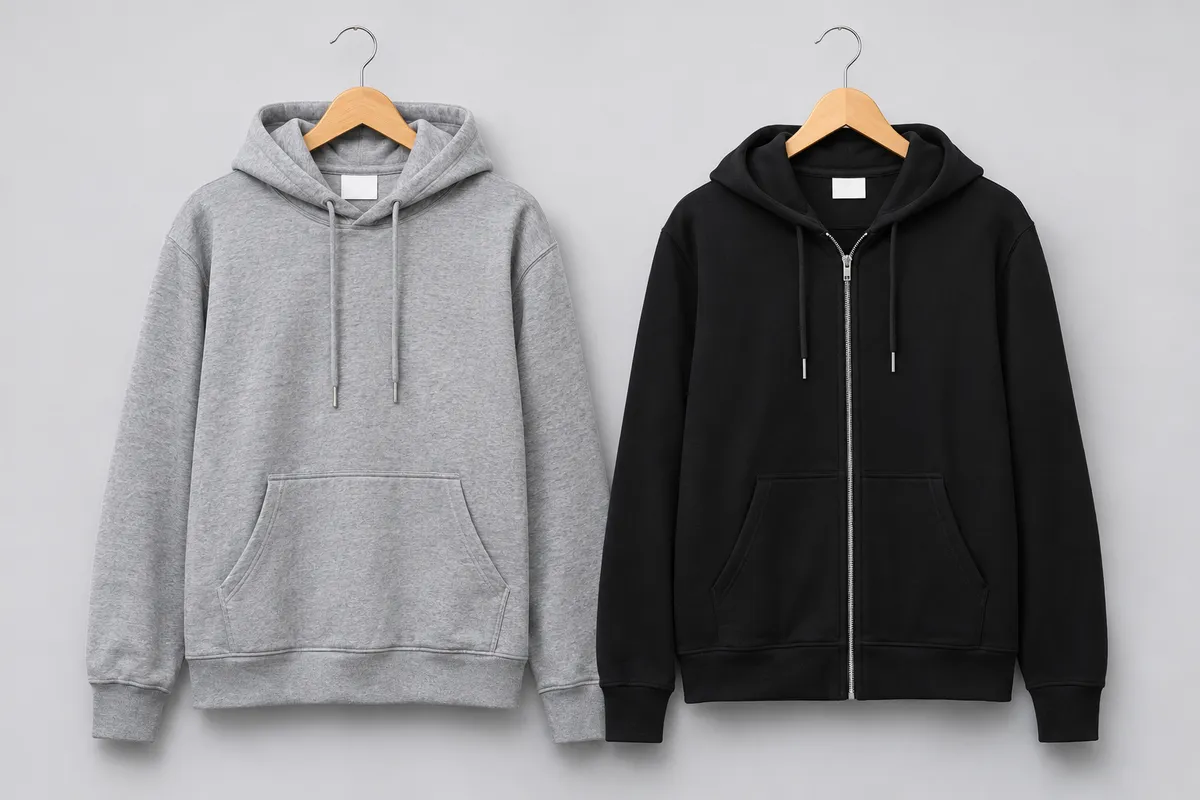
Hoodie drawcords are the cords threaded through the edge of a hood so the wearer can tighten it round the face in wind or rain. On school hoodies there are three usual choices: no drawcord at all, a free drawcord, or a cord fixed in place so it cannot be pulled out or lengthened. Many schools leave cords off hoodies worn by younger children and decide case by case for older year groups. Rules on cords in children’s clothing vary by country, so check what applies where the hoodies will be sold.
This post sets out the options and the practical questions. It is not safety or legal advice; requirements are confirmed at quotation.
What are the drawcord options?
No drawcord. The hood has a plain, finished edge with no channel and no cord. Nothing to catch, nothing to lose, and nothing for students to pull. The hood cannot be tightened, which rarely matters for a garment worn mostly with the hood down.
Free drawcord. A cord runs through a channel in the hood edge and comes out through two holes, called eyelets, at the front of the neck. Students can pull it tight or leave it loose. It is the look most people associate with a hoodie.
Fixed or stitched-down cord. A cord is present for the look, but it is stitched in place at the centre back of the hood so it cannot be pulled through, and the ends are kept short. It gives a hoodie appearance with less to go wrong.
Flat cord or round cord. If a cord is used, it can be flat like a ribbon or round like a lace. Flat cords tend to lie neatly against the chest; round cords look sportier.
How do schools usually decide?
| Wearers | Common choice | Reason |
|---|---|---|
| Nursery and early primary | No drawcord | Small children, play equipment, coat pegs |
| End of primary leavers | No drawcord, or fixed cord | Active play still common |
| Secondary leavers | Any of the three, by school policy | Older students; hood often worn as a style |
| Staff or adult sizes | Free cord is common | Adult wearers |
Many buyers find the simplest route is to leave cords off every hoodie in a mixed order, particularly when one year group spans younger and older students. One specification covers all sizes, and there is no need to treat the youngest wearers differently.
What to check if you do use cords
If the school chooses a drawcord, look at these points on the sample:
- The eyelets are neatly finished and reinforced so they do not tear out of the fleece.
- The cord ends are tipped or knotted so they do not fray.
- Cord colour matches or deliberately contrasts with the hoodie.
- For a fixed cord, the stitching at the back holds when the cord is pulled firmly from one side.
- Cord ends sit at an even, short length on both sides.
If you choose no cord, check instead that the hood edge is neatly turned and that no empty eyelets have been left in place.
Why the choice affects your whole order
Drawcords are a small detail, but they change the specification. A hoodie with eyelets and a cord is a different construction from one without, so the choice is fixed on the sample and then repeated on every piece. If a school changes its mind after approval, a new sample may be needed.
Schools and school groups can read how we confirm details like this before production on our page for schools and school groups.
Tell us your drawcord choice when you send your design and numbers. We will quote your leavers’ hoodies with the hood made exactly as agreed. We manufacture in India and build the sample to that specification.
Questions buyers ask
Can drawcords be removed from hoodies after delivery?
A free cord can usually be pulled out, but this leaves empty eyelets and a loose channel that looks unfinished. If the school does not want cords, it is neater to specify a hood without eyelets from the start.
Do hoodies without drawcords look plain?
Not much, because the hood and front print draw the eye. Some schools add interest with a contrast hood lining instead. The difference is clearest when the hoodie is laid flat rather than worn.
Can the cord be printed or carry the year?
Printing directly on a narrow cord is hard to read and wears quickly. Most schools put the year on the chest, sleeve or back, where it is clearer and lasts longer.