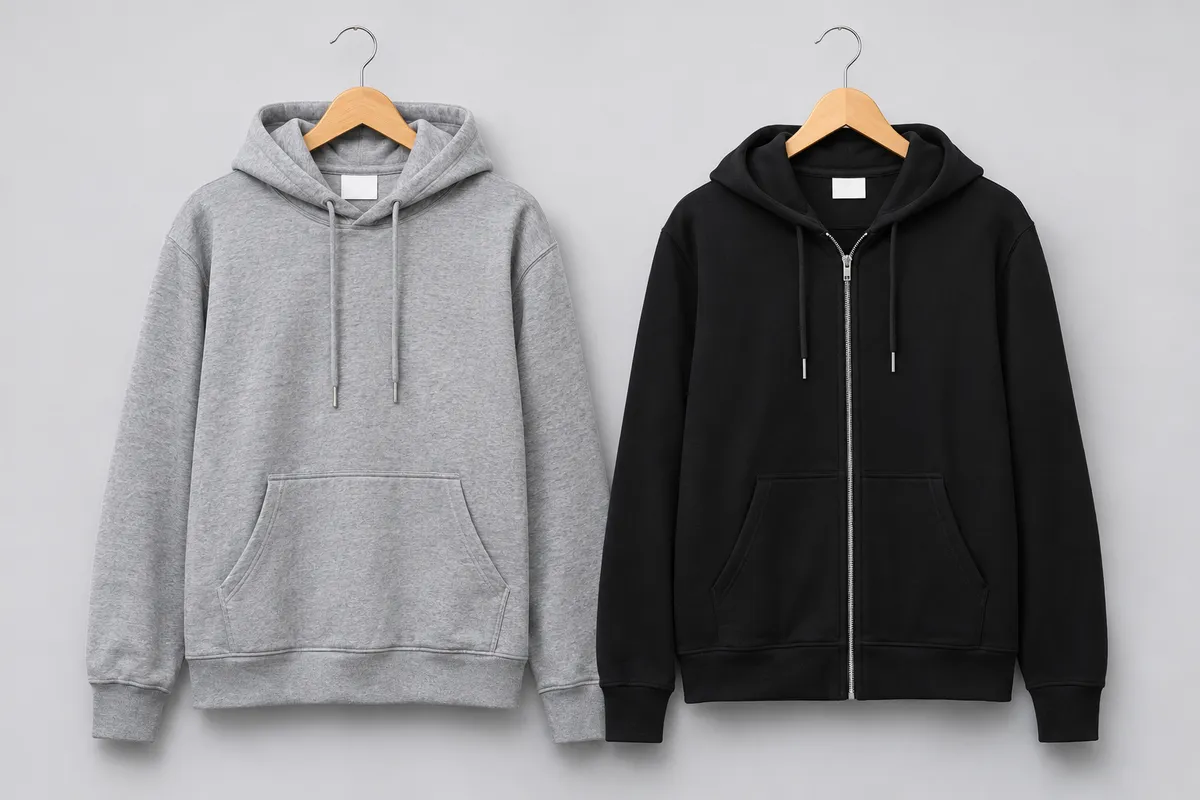
Embroidery on sweatshirt fleece works well for school badges, but fleece is soft, thick and stretchy, so the badge needs a stabilising backing, sensible stitch density and lettering that is not too small. Done well, it gives a raised, hard-wearing badge that lasts the life of the sweatshirt. Done badly, it puckers the fleece or sinks into it. We can supply the badge stitched or printed; its method, size and spot are settled on the sample.
The school badge is usually the only decoration on a uniform sweatshirt, so it carries a lot of weight. Understanding how fleece takes stitching helps you judge the sample.
Why is fleece different from shirt fabric?
A woven shirt is thin and stable; it barely stretches. Fleece is a knitted fabric with a soft, raised inner face. When a needle punches through it thousands of times, three things can happen:
- The fabric stretches under the stitching, then springs back, pulling the badge into ripples.
- Stitches sink into the soft surface, so fine detail disappears.
- The back of the badge becomes stiff or scratchy against the skin.
Each has a practical remedy, and all three are visible on a sample.
What controls the quality of a fleece badge?
| Factor | What it is | Effect on fleece | What to look for on the sample |
|---|---|---|---|
| Backing | A stabilising layer behind the badge during stitching | Stops the fleece stretching and puckering | Badge lies flat, no ripples round the edge |
| Stitch density | How closely stitches are packed | Too dense stiffens and pulls; too sparse lets fleece show through | Even coverage without a board-like feel |
| Underlay | A first layer of stitching that supports the top stitches | Lifts the design so it does not sink | Clean, raised edges |
| Lettering size | Height of the smallest text | Very small letters fill in on soft fabric | Every letter readable |
| Inside finish | How the back of the badge is covered | Rough backing irritates the skin | Soft surface on the inside |
You do not need to specify each factor technically. You need to judge the result and say what you want changed.
Simplifying a badge for fleece
Many school crests were drawn for printed letterheads, not for stitching on a soft fabric. Before the sample stage, look at your artwork with fleece in mind:
- Small text. A motto in tiny letters will not survive on fleece. Remove it, enlarge it, or replace the crest with a simpler version for knitwear.
- Thin lines. Very fine outlines may break up. Thicken them or drop them.
- Number of colours. Every extra thread colour adds detail but also stitching. Several close shades can merge into one at badge size.
- Shading. Gradients do not stitch well. Use flat areas of colour.
- Overall size. The left-chest badge on a child’s sweatshirt is small. Detail that works at a larger size may need to go.
If you also have a woven badge on a blazer, the fleece version does not have to be identical, only recognisably the same.
Checking the embroidered sample
When the sample arrives, check the badge before anything else:
- Flat on the fleece, with no rippling around the edge.
- Every element of the design readable from arm’s length.
- Thread colours as specified, matching the school’s colours.
- Soft on the inside, with no stiff or scratchy patch.
- Position as agreed for each style.
- After one wash, still flat, with no loose threads.
Our fabrics and colour matching page explains how the fleece colour is matched, and the logos, embroidery and labels page covers artwork in more detail.
We manufacture in India and the badge on every bulk piece is compared with the approved sample at our quality check. Send your artwork and thread colours, and we will quote your embroidered school sweatshirts and prepare a sample.
Questions buyers ask
Is embroidery or printing more durable on fleece?
Embroidery generally outlasts printing on fleece, because the thread becomes part of the fabric and does not crack or peel. A good print still lasts well if washed as advised. Durability depends on the design and the care it receives.
Can embroidery go on a lightweight fleece?
Yes, though a lighter fleece is more likely to pucker, so the backing and stitch density matter more. Judge the sample closely, and if the badge pulls, ask for a lighter design or a printed badge instead.
Why does the badge feel stiff after the first wash?
Some backing materials firm up slightly after washing, especially under dense stitching. If the badge is uncomfortable, ask for a softer covering on the inside or a less dense design, and check a washed sample.