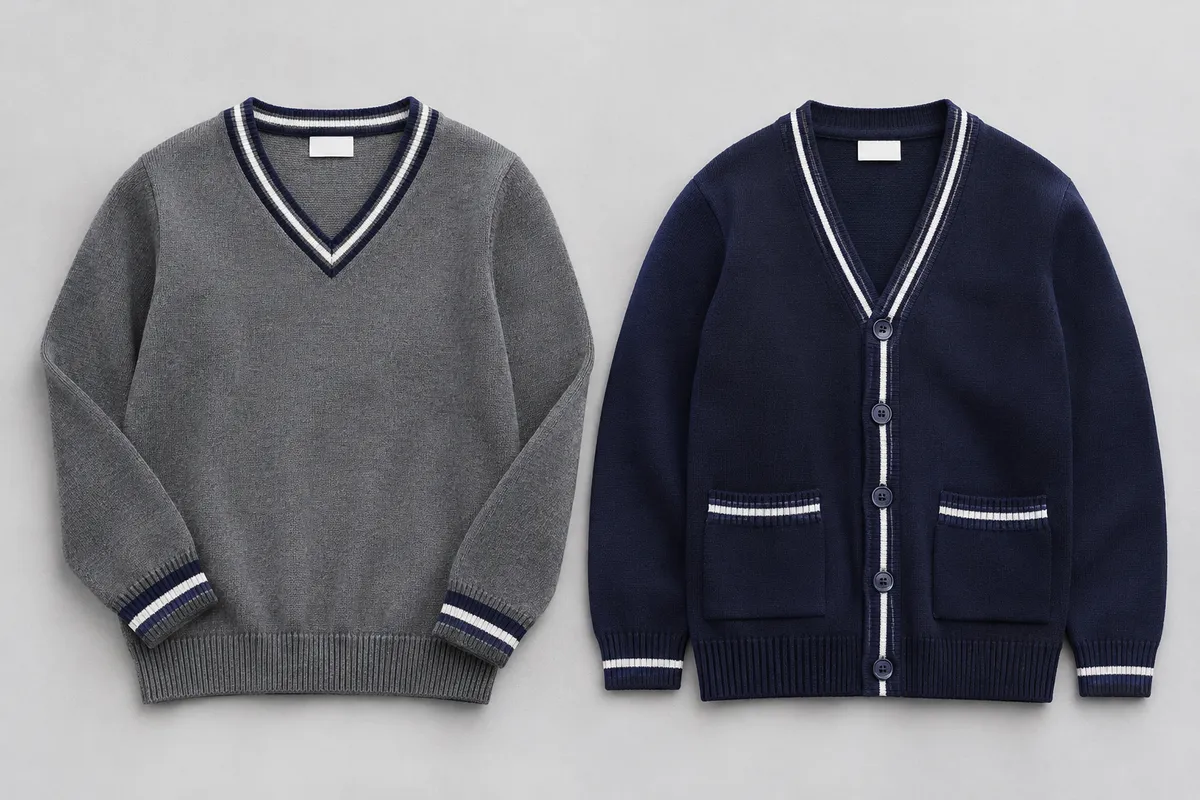
End of winter knitwear stock is the jumpers, cardigans and slipovers left unsold when cold-weather demand fades, and handling it well comes down to three jobs: count it by size, store it so it is still saleable next season, and use the count to set your next first order. Leftover knitwear is not wasted stock if it is in good condition and the uniform has not changed.
This post walks through each job and what to look for at each step.
Step one: count by style and size
Do the count as soon as sales slow, while you still remember how the season went. Count each style separately, and for shops holding several schools, count each school separately.
A simple count sheet looks like this:
| School | Style | Size | Packs on shelf | Packs in stockroom | Damaged or soiled | Notes |
|---|---|---|---|---|---|---|
| School A | V-neck jumper | 9–10 | ||||
| School A | V-neck jumper | 11–12 | ||||
| School A | Cardigan | 9–10 | ||||
| School B | Slipover | 13–14 |
Add a notes column for anything you learned during the season: a size that ran out in the first month, a size that never sold, a request you could not meet.
Step two: store knitwear so it survives until next season
Knitted garments need more care in storage than woven ones. They can stretch, pick up moisture or attract moths if stored badly.
- Keep jumpers folded in their packs; do not leave them on hangers for months
- Store cartons off the floor and away from damp walls
- Keep stock out of direct sunlight, which can fade some colours over time
- Seal cartons and label each one with school, style and sizes
- Separate any returned, tried-on or soiled pieces from new stock
- Check stored cartons once or twice before the next season
If shop-floor stock has been handled a great deal, refold it, replace any damaged pack and put fresh size stickers on before storing.
What should you do with each kind of leftover?
Not every leftover is the same. Sort them before deciding.
Plain knitwear in standard colours. Holds its value. Carry it into next season and reduce the next order by the same amount.
Striped or badged knitwear for one school. Holds its value only if the school keeps the same uniform. Check with the school before counting it as next season’s stock.
Sizes that never sold. If the same size is left over two years running, it is overstocked in your plan. Reduce it in the next order.
Garments from a uniform that is changing. Talk to the school about a sell-through period. A crossover year, when both old and new are allowed, helps families and shops alike.
Damaged or soiled pieces. Do not return them to stock. Some shops pass them to a school’s second-hand scheme if the damage is minor.
Step three: use the leftovers to set the next first order
Your count is now the starting point for next season. Subtract usable stock from your planned quantities size by size, then check what is left against the 100-piece minimum per style. Leftovers in some sizes might mean the next order is weighted more heavily to the sizes that sold out.
If the next order is your first with us, the how to order page sets out the steps from enquiry to dispatch. Repeat orders follow the same steps, knitted to the approved sample, so new stock matches what you have stored.
Bring your end-of-winter count to us when you are ready, and we will quote next season’s jumpers and cardigans per style, by fabric, quantity and branding.
Questions buyers ask
Will stored jumpers look different from a new delivery?
Repeat orders are made to the same sample, so they should match closely. Small shade differences between yarn lots are possible, so put older stock out first and keep each delivery together on the rail.
Should leftover winter knitwear be discounted?
That is a decision for the shop. Plain knitwear usually sells at full price next season, so a discount is not always needed. Discounts make more sense for a uniform that is being replaced.
How do I stop moths in stored school knitwear?
Store only clean, unworn garments, keep cartons sealed and dry, and check them during the off-season. Acrylic and cotton-acrylic knitwear is less attractive to moths than wool, but clean, sealed storage still helps.