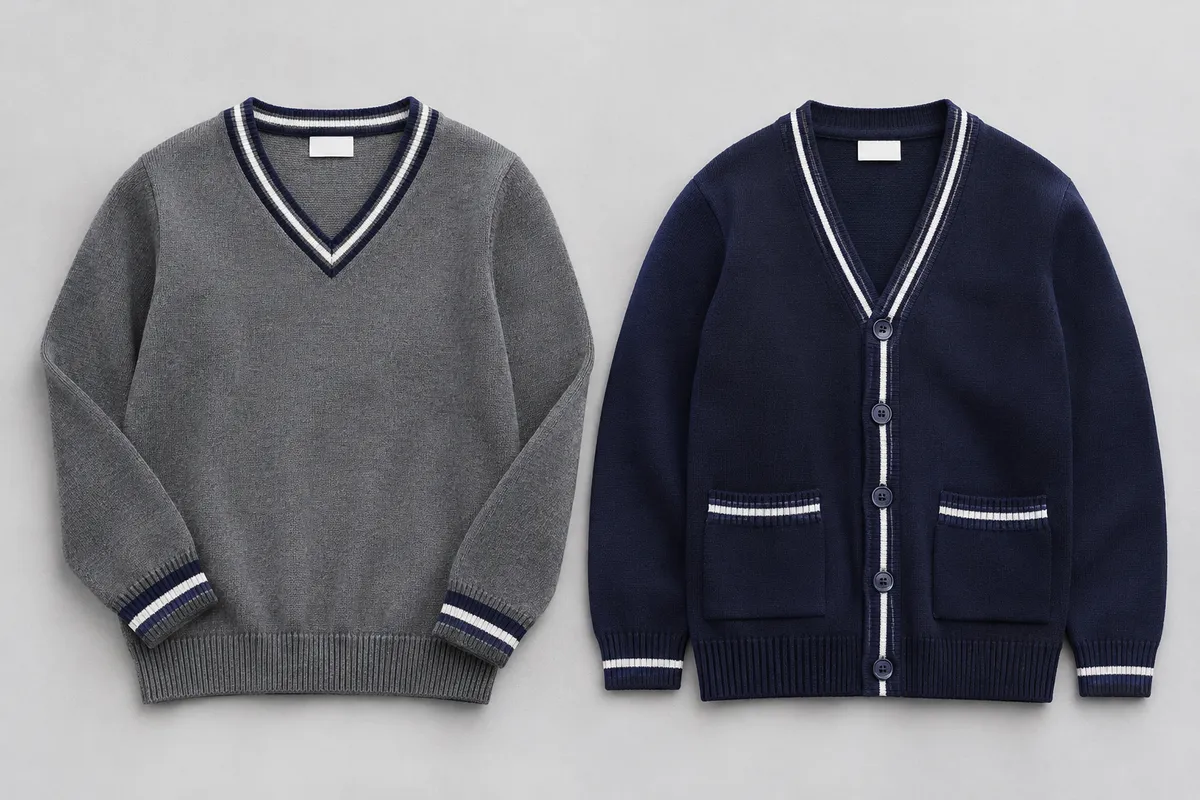
Fully fashioned knitwear is knitted to shape: the machine adds or drops stitches so each panel comes off already shaped for the armhole, shoulder and neck. Cut and sewn knitwear starts as a length or blank of knitted fabric that is then cut to a pattern and overlocked together. Both methods are used for school jumpers, and each leaves clues you can see on a sample.
Buyers meet these terms when comparing suppliers’ specifications. Knowing what they mean helps you ask the right questions and judge what is in front of you.
How each method works
Fully fashioned
The machine knits each panel (front, back, sleeves) to its final shape. Where the armhole curves, stitches are moved in from the edge, leaving a visible line of small marks called fashioning marks. Panels are then joined, often by linking, which joins the knit loop by loop. Because the edges are knitted edges, not cut, little yarn is wasted and the seams can be slim.
Cut and sewn
Knitted fabric, sometimes in shaped blanks with a rib already knitted at the bottom, is cut with a pattern like woven cloth. The cut edges are overlocked to stop them unravelling, and the panels are sewn together. This method is flexible and suits straightforward shapes.
Many garments combine both: for example, panels knitted to length with a finished rib hem, then cut at the armholes and neck.
Comparing the two
| Feature | Fully fashioned | Cut and sewn |
|---|---|---|
| How panels are shaped | On the machine, stitch by stitch | Cut from knitted fabric or blanks |
| Visible clue | Fashioning marks near armholes and neck | Overlocked edges inside the seams |
| Seams | Often linked; slim and flexible | Overlocked; slightly bulkier |
| Yarn use | Little waste | Offcuts from cutting |
| Pattern changes | Need machine programming | Change the cutting pattern |
| Common on | Traditional knitwear | Many everyday knit garments |
Neither method is automatically better for school uniform. What matters is that the seams are neat, the shape is right, and the garment holds up to washing. The method used for your jumper is confirmed at quotation and is visible on the sample.
How to tell which one you have
Turn the jumper inside out and look at the armhole and side seams.
- Fashioning marks. Look along the armhole on the outside. A neat line of small slanted stitches a short way in from the seam suggests the panel was shaped on the machine.
- Seam edges. If the inside of the seam shows an overlocked edge of cut knit, the panel was cut.
- Neck. On a fully fashioned V-neck the neck shaping is often knitted; on a cut and sewn neck the V is cut and the band covers the cut edge.
- Seam thickness. Pinch the shoulder seam. Linked seams feel flatter; overlocked seams feel a little thicker.
What to check whichever method is used
- Seams lie flat on the outside with no puckering
- Inside, no loose loops or cut edges are visible beyond the seam finish
- Armholes are the same on both sides
- The neck band covers the neck edge completely
- After one wash as labelled, seams have not twisted
Fabric and colour are confirmed alongside construction. Our fabrics and colour matching page explains how the knit colour is matched to your reference. We manufacture in India and make every repeat order the same way as the approved sample, so construction does not change between deliveries.
If your current jumper is made one way and you want the same, send it and we will copy it as closely as our production allows, then quote your knitted jumpers and cardigans per style, by fabric, quantity and branding.
Questions buyers ask
Do fashioning marks mean a jumper is better made?
They show that the panel was shaped on the machine, which many buyers associate with traditional knitwear. They do not on their own prove quality. Check seams, shape and washing behaviour on the sample as well.
Can a cut and sewn jumper unravel at the seams?
Cut knit edges are overlocked to stop unravelling. If the overlock is too narrow or loose, a seam can open under strain. Pull gently along each seam of the sample and look inside for any loose loops.
Will two jumpers made by different methods look different on the shelf?
Often slightly, especially at the shoulders and armholes. If you are replacing a supplier and want continuity, send the old jumper so construction details can be compared before the sample is made.