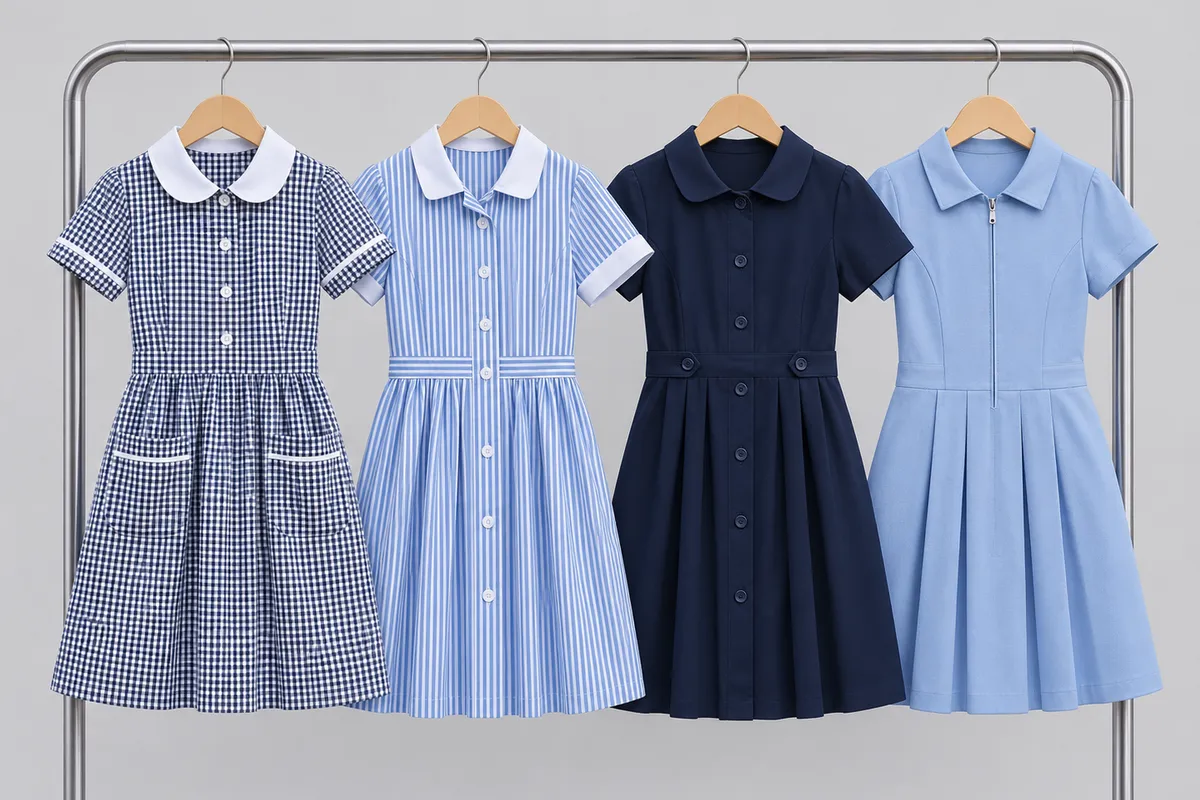
End of season summer dress stock is whatever remains when the warm term closes and families stop buying. Handled well, it becomes the opening stock for next summer: count it by size, store it clean and sealed, and deduct it from the next order so you buy only the gaps.
This post sets out a simple routine for uniform shops, school counters and suppliers at the end of the summer selling season.
Why summer dresses need an end-of-season routine
Most uniform items sell all year, so leftover stock simply stays on the shelf. Summer dresses stop selling for months. They sit in storage through the cooler terms, and anything that goes wrong in that time, from damp to fading to lost paperwork, only shows when the next season begins.
A routine at the close of the season prevents surprises and gives the most reliable figure for next year’s order.
Step one: count by size and style
Count every dress, by style, colour and size. Include dresses in the shop, in the stockroom, on any school counter and in transit to branches.
| Record | Why it matters |
|---|---|
| Quantity by size | Shows which sizes were over-ordered |
| Style and colour | Each style is planned separately |
| Logo or plain | Logo dresses can only be sold to one school |
| Condition | Shop-soiled or tried-on dresses may need separate handling |
| Date the size first ran out, if it did | Shows which sizes were short |
The figures sit beside the season’s sales. Together, they show the real demand by size: what sold plus what was missed.
Step two: store dresses for the cooler months
Summer dresses are made from woven poly-cotton and stored folded. A few precautions keep them saleable:
- Keep them in their polybags, sealed, with size labels facing out.
- Store them dry and off the floor, away from damp walls and direct sunlight, which can fade coloured gingham along folds.
- Box by size, with the size and quantity written on each box.
- Keep the logo dresses separate, labelled with the school.
- Keep one sealed sample of the style with the stock, so next season’s delivery can be compared with it.
Step three: decide what to carry over
Not every leftover dress is worth keeping for a year. Ask of each line:
- Will the dress still be on the uniform list next summer? If the school is changing its dress, plan to clear the old one.
- Is it plain or logo? Plain dresses can serve other schools using the same gingham; logo dresses cannot.
- Is the size likely to sell? An edge size with several leftovers may cover next year with no new order.
- Is the condition still good? Damaged dresses should not go back on the shelf as new.
Lines you decide not to carry can be offered to the school’s second-hand scheme or a local charity, if your own policy allows.
Step four: use the count in next year’s order
The leftover count is a starting point for next summer. Subtract it from your planned quantity in each size, then add any sizes that ran out early. The result is an order that fills gaps rather than adding to surplus.
A sealed reference dress from this year makes the reorder easy: repeat orders are made to the approved sample, so new dresses match the carried-over stock in colour, check and fit. Our minimum order and samples page explains the minimum per style and how samples work.
We manufacture school summer dresses in India for shops, suppliers and schools. See the styles on our school summer dresses page. Send your leftover count with your enquiry for next season, and we will help you build the order around it.
Questions buyers ask
Should leftover summer dresses be sold at a discount?
That is a commercial decision for your shop. Discounting plain dresses at the end of summer can reduce storage, but it may cut into next season’s full-price sales. Many shops store plain stock and discount only lines leaving the uniform list.
How long can summer dresses be stored before they deteriorate?
Stored sealed, dry and out of sunlight, a poly-cotton dress keeps well from one summer to the next. Check a few dresses from each box before the season opens, especially for fading along folds or damp marks.
Do leftover dresses affect the minimum for next year’s order?
The minimum is per style on each order, so leftovers do not change it. If your leftovers cover most sizes, next year’s order may only need to reach the minimum with the sizes that ran short.