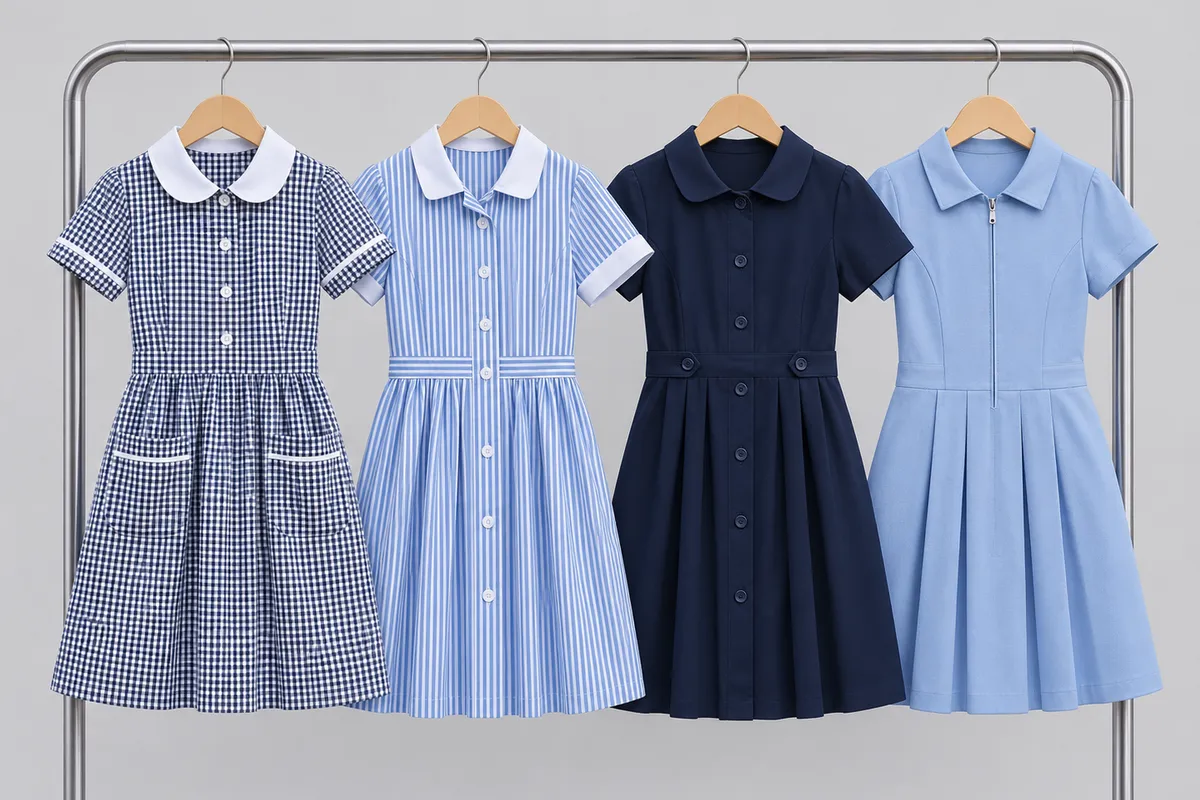
Gingham check size is the width of one square in the pattern, and on school summer dresses it usually falls somewhere between a few millimetres and around a centimetre. A small check reads as a soft, almost solid colour from a distance, while a large check looks bold and playful. The check size should be fixed by measurement or by a fabric reference, not by a description such as “medium”.
Buyers often specify the colour carefully and leave the check to chance. Yet when a new delivery hangs beside older dresses, a different check size is noticed as quickly as a different shade.
How do you measure a gingham check?
Gingham is woven with coloured and white yarns in equal bands, in both directions. One full repeat is one coloured band plus one white band. There are two common ways to quote it:
- Single square: the width of one coloured square, edge to edge.
- Full repeat: one coloured square plus the white square next to it.
Because people use both methods, always say which one you mean. The surest way is to lay a ruler across ten repeats, measure the total and divide by ten. This averages out small variations and gives a figure anyone can check.
| Check description | Rough single-square width | How it looks on a dress |
|---|---|---|
| Fine or mini | 2–3 mm | Reads as a pale solid from a few metres |
| Small | 3–5 mm | Neat and traditional; common for school dresses |
| Medium | 5–8 mm | Clearly a check, still tidy on small sizes |
| Large | 8–12 mm | Bold; suits older students’ sizes |
| Very large | over 12 mm | Rare for school dresses; looks like a picnic cloth |
These widths are a guide to the vocabulary, not a fixed scale. Two mills can mean different things by “small”, which is why a measurement matters.
How does check size affect the dress?
Appearance at a distance. Staff, parents and visitors see the dress from across a hall or playground. A small check in mid-blue looks almost like a plain light blue. A large check is recognisable as gingham from anywhere.
Scale on small sizes. A dress for a four-year-old has a short bodice and narrow panels. A large check can end up with only two or three squares across the front, which looks odd. Smaller repeats sit better across a wide size range.
Pattern matching. A larger check makes any mismatch at the seams more visible. A small check is more forgiving where pieces meet.
Marks and wear. A smaller check breaks up stains and creases better than large white squares.
Fabric use. Matching a large check at side seams and plackets needs more careful placement of pattern pieces, which can use more fabric.
Matching the check on an existing dress
If you are moving production, or adding a new size range to an existing dress, the check must be matched as well as the colour. Send us a dress or a piece of the fabric. We match the colour and the size of the check as closely as we can and send a swatch for approval before bulk fabric is made. The fabrics and colour matching page explains how that approval works.
When you receive the swatch, check it in this order:
- Lay it on the old fabric and line up one edge of the pattern
- Count ten repeats on each and compare the end points
- Look at the three tones (solid, mixed and white) in daylight
- Step back two metres and compare the overall look
- Note any difference in writing before approving
A slight difference over ten repeats is normal in woven fabric. A clear drift means the check is a different size, and that should be raised before sampling.
Choosing a check size for a new dress
If the school has no existing dress, choose the check size with the smallest and largest sizes in mind. A small or medium check usually looks right across the whole age range. Hold a swatch against a small dress pattern piece if you can, to see how many repeats fall across the front.
Each check size in each colour is a separate fabric, and each dress in that fabric is its own style, with a minimum of 50 pieces and sizes mixed within the style. See the styles on our school summer dresses page. Send us your check measurement or a fabric reference with your enquiry, and we will quote per style, by fabric, quantity and branding.
Questions buyers ask
Does the check size change the quotation?
Cost depends on the fabric, the quantity and the branding, and it is quoted per style. A larger check can need more careful placement at the seams, which may affect fabric use, so tell us the check size early in your enquiry.
Can one check size work for both infants and seniors?
Usually yes. A small or medium check sits well on short infant bodices and still looks neat on a senior chest size. Very large checks tend to look awkward on the smallest sizes, so most schools avoid them.
Why do two swatches of the same check look different?
Lighting, the ground colour and the yarn thickness all change how a check appears. A swatch can measure the same yet look lighter if the white is brighter. Compare swatches side by side in daylight, not under shop lighting.