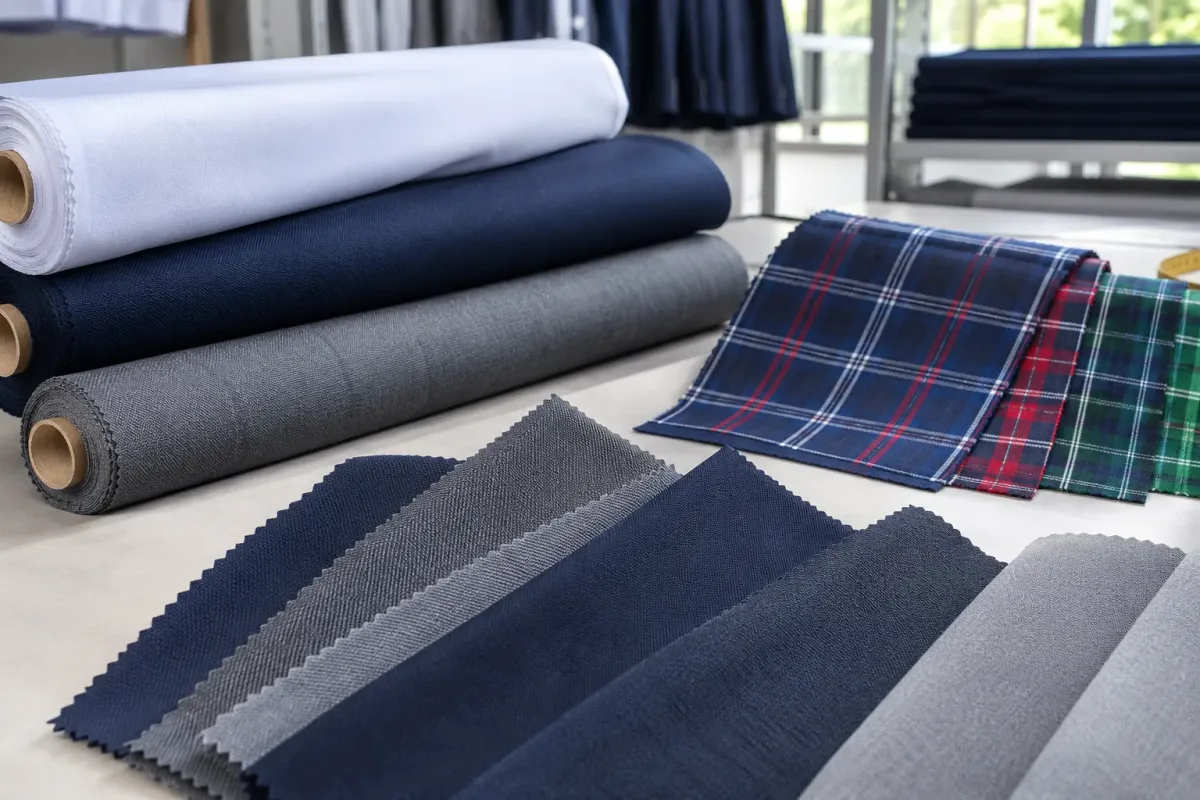
Gingham is the usual choice when a school wants the classic summer dress look, and stripe is chosen when a school wants something that stands apart from neighbouring schools. Both are poly-cotton in our range, so the decision is about appearance, colour matching and how the pattern is cut, rather than how the fabric wears.
This post explains what a trade buyer should know about gingham school dress fabric and striped fabric before ordering in bulk.
Why we use poly-cotton for both
Our gingham and striped dresses are made in poly-cotton. The blend combines a cotton feel with the easier care of polyester, which suits a garment that is washed often during the warm months. The fabric is confirmed at quotation, and a swatch comes to you for approval before bulk fabric is made.
Because gingham and stripe share the same base, the choice between them does not change the care or the handle much. It changes how the dress looks, how hard it is to match an existing dress, and how carefully the pattern has to be placed when the garment is cut.
Gingham and stripe compared
| Point | Gingham | Stripe |
|---|---|---|
| Look | Even check of coloured and white squares | Vertical lines of one or more colours on white or a pale ground |
| Colour range | Blue, red, green, yellow, or matched to your reference | The same colours, sometimes with two colours in the stripe |
| Repeat to agree | Size of the check square | Width of each stripe and the spacing between them |
| Matching an existing dress | Colour and check size | Colour, stripe width, spacing and any second colour |
| Pattern matching at seams | Needed across front, back and side seams | Mainly at the side seams and centre front |
| Pocket and placket placement | Cut to line up with the check | Cut to line up with the stripe |
| Common use | Widely used; easy for shops to stock across schools | Often chosen to make one school’s dress distinct |
Neither is the right answer for every buyer. A shop stocking one dress for several schools usually leans to gingham in a common colour. A school creating its own look may prefer a stripe in its own colour.
Check size and colour matching
The size of the check changes the look of the dress more than many buyers expect. A small check reads as a solid colour from a distance. A large check is bold and easy to recognise. If you are replacing an existing dress, the check size matters as much as the colour, because a new delivery that sits next to older dresses on the shelf will show any difference.
When matching, send us a dress or a piece of the fabric. We match the colour and the size of the check or stripe as closely as we can, then send a swatch for approval. Look at the swatch in daylight, next to the dress you are matching. Our fabrics and colour matching page explains how swatches and shade approval work.
Cutting and pattern matching
Patterned fabric needs more care at the cutting stage than plain fabric. These are the points to agree on the sample:
- Seam matching. The checks or stripes should line up across the side seams and at the centre front, so the pattern flows around the body.
- Placket and button line. On a button-front dress, the placket should sit on the pattern cleanly, not cut a check in half at random.
- Pockets. A patch pocket can be cut to match the body, so it almost disappears, or cut on the bias so the check runs diagonally as a feature. Tell us which.
- Collar and cuffs. These are often cut in white or a plain colour to frame the pattern. If you want them in the dress fabric, say so.
- Waist seam. On a dress with a sewn waist, the pattern above and below should line up at the side seams.
Pattern matching uses more fabric than cutting a plain garment, because pieces have to be placed on the pattern rather than packed tightly. This shows in the quotation, and it is one reason a gingham dress is quoted on its own specification.
Questions to answer before ordering
- Gingham or stripe?
- Which colour, and do you have a reference garment or fabric piece?
- What check size or stripe width?
- Should the collar and cuffs be white, plain colour or the dress fabric?
- Should pockets match the body or be cut on the bias?
- Button-front or zip-front opening?
- Plain, or with an embroidered logo on the chest or pocket?
Each pattern and each opening counts as its own style, with a minimum of 50 pieces per style and sizes mixed within it. You can see the dress styles and size range on our school summer dresses page.
Send us your choice of pattern, colour and check size, with a reference piece if you are matching an existing dress, and we will prepare a quotation. We quote per style, by fabric, quantity and branding.
Questions buyers ask
How do I describe a check size in an enquiry?
Measure across one coloured square and one white square together, in millimetres, and repeat for a stripe’s width and the gap beside it. A measurement plus a photo helps, but a fabric piece remains the surest reference for matching.
Should the dress colour match the cardigan worn over it?
It helps. On cooler summer days the dress is often worn under a cardigan or sweatshirt, so pick a gingham or stripe that sits well with that garment. Send it along with your fabric reference so both are judged together.
Can a dress be made in a colour outside the usual four?
Yes. Blue, red, green and yellow are the usual choices, but any shade can be matched from a fabric piece or garment you send. A swatch in that shade comes to you for approval before the dress fabric is made.