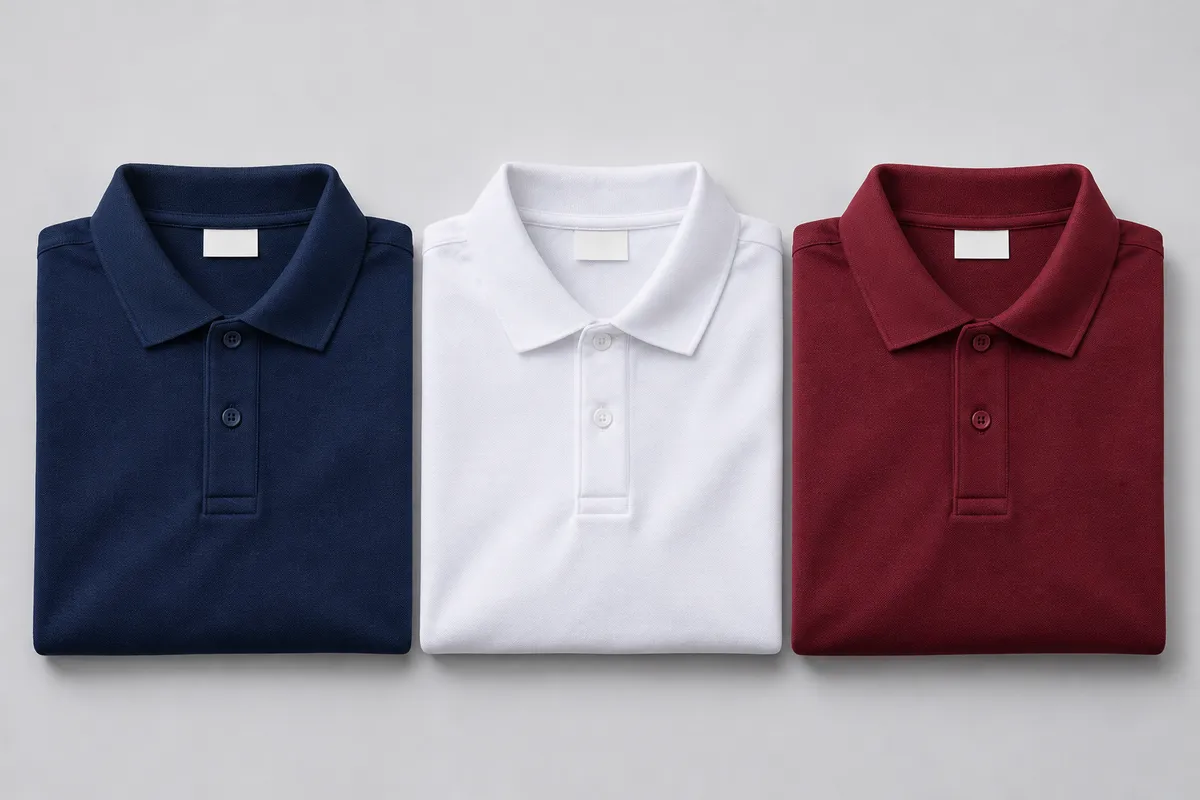
Embroidered polo shirts are the most common choice for school polos, because a stitched badge looks smart and lasts through many washes. The challenge is that piqué is a knit, so it stretches under the needle. Good results depend on a suitable backing behind the logo, artwork simplified for small sizes, and a stitch density that suits the fabric.
Logo embroidery or printing is available on our polos, and the method, size and position are confirmed on the sample. This post covers what makes embroidery on a polo different from embroidery on a woven shirt.
Why is embroidering a polo harder than a shirt?
A woven shirt is stable: its threads cross at right angles and barely move. A piqué polo is made of loops that stretch in every direction. When thousands of stitches go into a small area, a knit can:
- Pucker around the edge of the logo
- Stretch out of shape, so the badge looks distorted
- Show the backing through the fabric texture
- Lose fine details in the raised piqué cells
None of these are inevitable. They are managed by how the logo is prepared and stitched.
What helps embroidery sit flat on piqué?
| Factor | What it does | What to ask |
|---|---|---|
| Backing | Supports the knit under the stitches | A backing suited to knit fabric |
| Stitch density | Controls how solid the logo is | Not so dense that the polo stiffens |
| Underlay stitching | Holds the fabric before the top stitches | Agreed when artwork is prepared |
| Artwork simplification | Removes detail too fine to stitch | Simpler shapes for small sizes |
| Logo size | Spreads stitches over a sensible area | In proportion to each polo size |
| Thread colour | Contrast against the body | Checked on the sample body colour |
Some buyers ask for a soft backing on the inside so the logo does not scratch. Tell us if this matters, especially for polos worn by younger children.
Preparing a school logo for embroidery on a polo
School crests often include fine lines, small lettering and many colours. On a polo, these need some thought:
- Small text may need enlarging or removing on the smallest sizes
- Thin lines may need thickening so they do not sink into the piqué texture
- Many colours may be reduced, as each thread colour adds work
- Gradients cannot be stitched and are usually simplified to flat colours
- White areas on a white polo need an outline or they disappear
Send the clearest artwork you have. The logo is then prepared for stitching and shown on the sample, where you can judge it at actual size.
How should embroidered polos be checked?
When the sample arrives, look at the embroidery from the front and from inside:
- Is the badge flat, with no ripples around it?
- Are the colours right against the body colour?
- Is fine detail readable at normal viewing distance?
- Does the inside feel soft enough against the skin?
- Is the position right on the smallest and largest sizes?
Approving the embroidery on the sample means bulk production follows that standard. Our page on logos, embroidery and labels explains how to send artwork and what to expect.
Schools ordering embroidered polos directly will find our notes for schools and school groups helpful. All three polo styles on our school polo shirts page can carry an embroidered logo.
Send your artwork with your polo specification, and we will set out the logo method and size in your quotation.
Questions buyers ask
Does embroidery make the polo stiff on the chest?
A dense logo can feel stiffer than the surrounding fabric. Keeping the stitch density appropriate for piqué, and the logo a sensible size, keeps the chest flexible. You can judge the feel on the sample before approving bulk production.
Can a polo have embroidery and a printed logo together?
Yes. Some schools embroider the crest on the chest and print a smaller mark elsewhere, such as the back neck. Each position and method is confirmed on the sample, and both are reflected in the quotation.
Will embroidery thread fade faster than the polo?
Embroidery thread usually holds its colour well, though both the thread and the polo can fade with hot washing and strong sun. Washing inside out at a moderate temperature protects both the badge and the body colour.