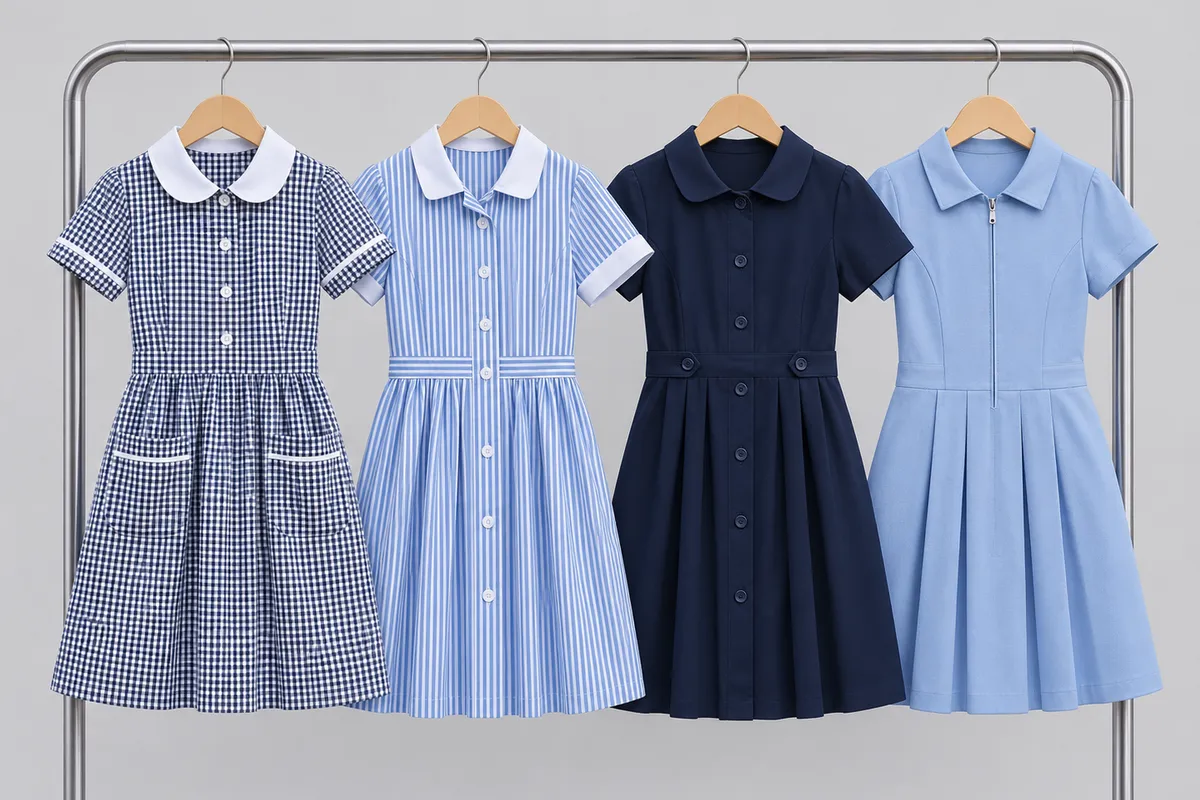
A button front school dress fastens down the centre front through a placket, a doubled band of fabric that carries the buttonholes on one side and the buttons on the other. How well it wears depends on the placket’s width and interfacing, the button size and count, the spacing between buttons and how firmly each button is sewn. These details are agreed on the sample and then repeated in every bulk order.
What placket options are there?
A placket is the strip that holds the fastening. On summer dresses, three types are common.
| Placket type | How it is made | Look and use |
|---|---|---|
| Sewn-on placket | A separate band stitched to the front edge | Neat, defined line; classic shirt-dress look |
| Folded-in placket | The front edge folded back on itself | Plainer; uses less separate fabric |
| Concealed placket | A fly front that hides the buttons | Clean front; slower to fasten for young children |
On gingham, a sewn-on placket can be cut on the bias so the check runs diagonally, which makes a feature of the front. Cut on the straight, it should line up with the check of the body. Either way, it should be specified. The placket is usually lightly interfaced so the buttonholes keep their shape through many washes.
How many buttons, and how far apart?
Gaping between buttons is the most common complaint about button-front dresses. It happens when buttons are spaced too widely, especially across the chest. The answer is to grade the spacing with the size.
As a working pattern:
- Place one button at the neck or just below the collar.
- Place one at the fullest part of the chest, where gaping shows first.
- Space the remaining buttons evenly down to the end of the placket.
- Keep the gap close enough that the fabric cannot open between them when the child reaches forward.
Smaller sizes have shorter plackets, so they carry fewer buttons. Larger and senior sizes carry more. The count for each size is part of the agreed specification, and you can check it on any size you sample.
Buttons themselves
Size. Very small buttons are hard for young children to handle. A slightly larger button is easier to fasten and less likely to slip out of its hole. The same button size across all sizes is simpler to stock for repairs.
Colour. White is the most common choice and stands out cleanly on a coloured check. A button matched to the check colour gives a quieter look.
Attachment. Each button should be sewn with enough thread wraps and tension that it does not loosen in the first term. Pull-testing a few buttons on the sample is a quick, useful check.
Spare button. Some buyers ask for a spare button sewn inside the side seam or on the care label, so families can replace a lost one. Ask about it with your enquiry.
Which way should the buttonholes run?
Buttonholes on a dress placket are usually vertical, running along the placket. Vertical holes keep the button centred on the placket line, which looks tidy. A horizontal hole at the top or at the point of most strain can hold better, because the button pulls against the end of the hole rather than along it. Some dresses mix the two. Whatever is chosen, it should match across the run.
Traditionally, girls’ garments button right over left, but some schools prefer the same button side as boys’ shirts. Confirm the side on the sample so it does not change between orders.
Checking the button front on the sample
- The placket lies flat and straight, without ripples
- Checks or stripes line up across the placket when closed
- No gaping at the chest when the wearer moves her arms forward
- Buttonholes are clean, with no loose threads
- Buttons are firmly sewn and the same height off the fabric
- The button count suits each sampled size
- The placket ends neatly at the waist or hem
Interfacing and fabric approval are explained on our fabrics and colour matching page. A button-front dress is a separate style from the zip-front version, with a minimum of 50 pieces and sizes mixed within it. The button-front and zip-front styles both appear on our school summer dresses page. Send us your placket type, button colour and size range, and we will quote per style, by fabric, quantity and branding.
Questions buyers ask
Should the placket run the full length of the dress?
A placket to the waist is enough for most children to get the dress on and off. A full-length button front gives a shirt-dress look favoured for older students, but it adds buttons and can gape below the waist when the child sits.
Can the buttons be removed for washing?
School dress buttons are sewn on permanently. Families should fasten the buttons before washing, which keeps the placket in shape and reduces strain on the buttonholes during the spin.
Are shank buttons better than flat buttons on a dress?
Flat sew-through buttons are normal on summer dresses because the fabric is light and the placket thin. Shank buttons stand off the fabric and suit thicker garments such as blazers, so they are rarely needed here.