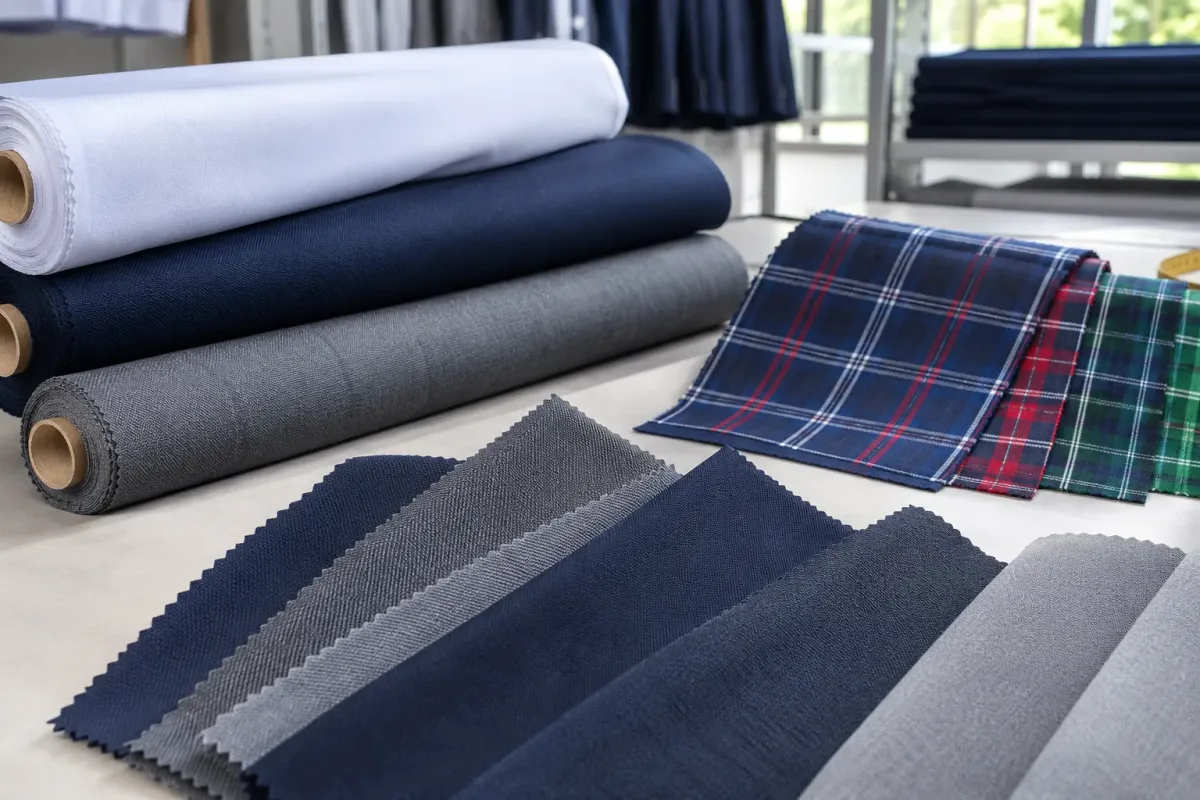
Gingham pattern matching at seams means cutting each piece of a summer dress so that the checks continue unbroken where two pieces join, most visibly at the centre front, the side seams and the waist. Not every seam can match perfectly, because shaped seams such as armholes and darts curve across the check. A buyer should agree which seams must match and which may not, then check those points on the sample.
Which seams must match, and which cannot?
| Seam or join | Can it match? | Priority | Notes |
|---|---|---|---|
| Centre front opening | Yes | High | The most visible line on the dress |
| Side seams, horizontal lines | Yes, below the armhole | High | Horizontal check lines should meet |
| Waist seam at the sides | Yes | Medium | Bodice and skirt checks align at the side |
| Centre back seam, if any | Yes | Medium | Seen when walking away |
| Pocket to skirt | Yes, if cut matched | Medium | Or cut on the bias as a feature |
| Sleeve to bodice | Partly | Low | The sleeve head curves; match at the front notch only |
| Shoulder seams | Partly | Low | The slope prevents a full match |
| Darts and curved panels | No | — | The check bends across the shaping |
Horizontal lines at the side seams are the main test. If the horizontal bars of the check step up or down where front meets back, the eye catches it from across a room.
How does matching change cutting?
On a plain fabric, pattern pieces are packed tightly to use as little fabric as possible. On gingham, each piece must be placed so its check falls in the right place relative to the pieces it joins. That means:
- Pieces are laid so a chosen line of the check runs through the same point on each piece, often the hem or waist line.
- Front and back are lined up so their horizontal bars meet at the side seam.
- Fabric layers are aligned check-on-check before cutting, so every layer in the stack matches.
This careful placement can use more fabric than cutting a plain dress, and it takes longer. Both are reflected when the dress is quoted on its own specification.
Matching on different check sizes
A small check is forgiving: a slight offset is hard to see. A large check shows every misalignment. If a school chooses a large check, the matching standard on the sample becomes more important, and the buyer should check the side seams on several sizes, not just one.
Stripes need matching mainly at the centre front and in the horizontal direction at pockets and yokes. Vertical stripes at the side seams meet at an angle on a shaped dress, which is normal.
Checking matching on the sample
When the sample arrives, check it laid flat and on a form or wearer.
- Centre front: is the opening on the same check line on both sides?
- Side seams: do the horizontal bars meet front to back?
- Waist seam: do bodice and skirt checks line up at the sides?
- Pockets: matched or bias, as agreed, and the same on both?
- Collar and placket: cut as specified?
- Hem: does it run along a straight line of the check?
Note any seam that is not as you want it and raise it before approving. Once the sample is approved, its matching becomes the standard for bulk production. Our fabrics and colour matching page explains how fabric and colour approval fits with the sample stage.
What is a reasonable standard?
Perfect matching at every seam is not possible on a shaped garment. A reasonable standard for school summer dresses is a clean match at the centre front and the side seams below the armhole, with the hem on a straight check line. Shoulders, armholes and darts are expected to break the pattern. Agreeing this standard in writing avoids disappointment when the bulk order arrives.
Each summer dress style starts at 50 pieces, sizes mixed. The gingham and stripe styles are shown on our school summer dresses page. Tell us which seams matter most to you, and we will quote per style, by fabric, quantity and branding.
Questions buyers ask
Why do the checks not match at the shoulder?
The shoulder seam slopes, and the front and back pieces are shaped differently, so the check lines meet at an angle. Matching at the shoulder is usually not attempted, and the eye tends to accept a break there.
Does matching apply to every layer in a bulk cut?
Yes. Before cutting, fabric layers are aligned check-on-check so the pattern sits in the same place on every piece in the stack. This is what lets a bulk order carry the same matching as the approved sample.
Is a bias-cut pocket a way to avoid matching?
A bias pocket does not need to line up with the skirt, as its diagonal check is meant to contrast. It is a deliberate design choice and should still be cut the same way on every dress in the order.