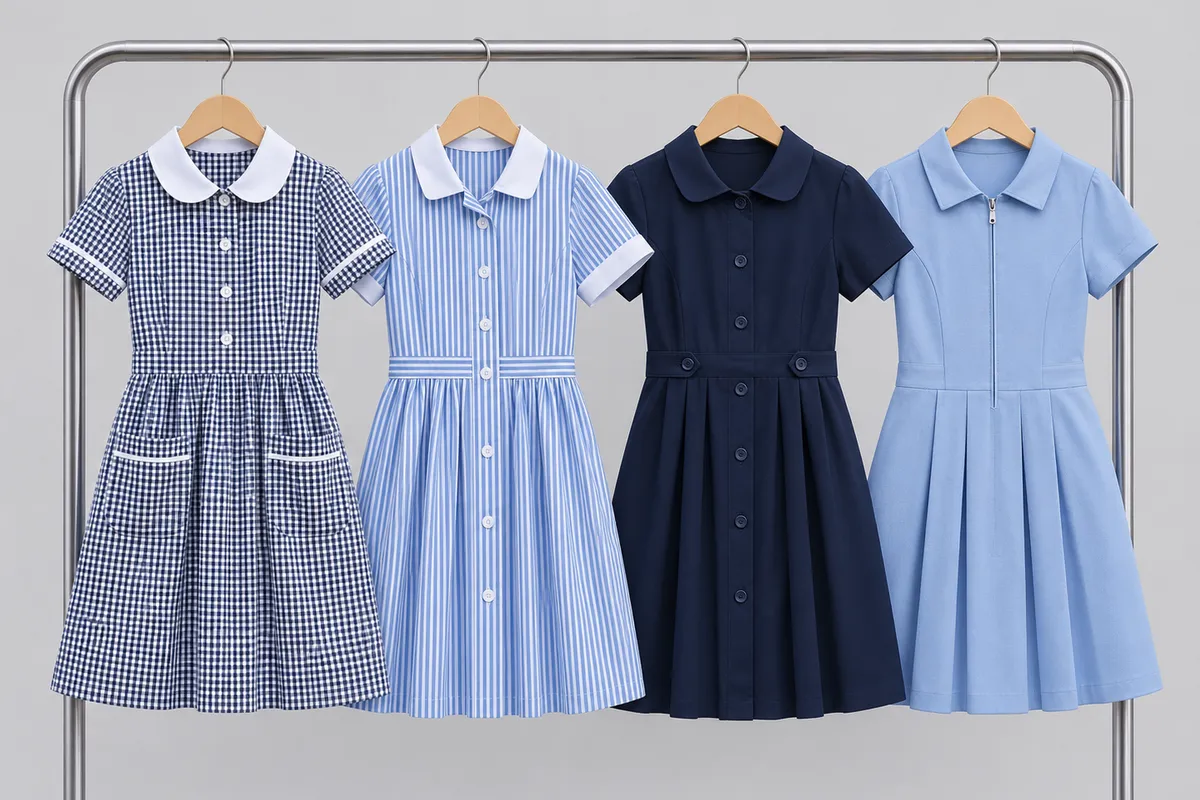
A summer dress sample check is the last chance to change anything before bulk production, so it should cover the fabric, the pattern matching, every detail of the style, the fit on a real wearer, and the logo and label. Once you approve the sample, the bulk order and all later orders are made to it. A methodical check, done in daylight and in more than one size if possible, prevents most problems with a delivered order.
This post gives a step-by-step method that a shop, supplier or school can follow when the sample dress arrives.
How do you check a summer dress sample, step by step?
Step 1: Compare the fabric with the approved swatch
Lay the sample on the swatch you approved earlier.
- Is the check or stripe colour the same?
- Is the white ground as bright?
- Is the check size the same, measured over ten repeats?
- Does the fabric feel the same?
If you are matching an existing dress, put that alongside too. Look in daylight, close up and from a couple of metres away.
Step 2: Check the style details against your specification
Go through your specification line by line. It helps to set out a simple table and tick each item.
| Detail | What you specified | On the sample? | Note |
|---|---|---|---|
| Opening | Button-front or zip-front | ||
| Collar | Shape, width, colour | ||
| Sleeves | Style, length, cuff | ||
| Waist | Seam position, belt, elastic | ||
| Pockets | Type, cut, position | ||
| Length | Shoulder-to-hem measurement | ||
| Hem | Depth and finish | ||
| Lining | None, bodice or full | ||
| Buttons or zip | Colour, size, pull | ||
| Logo | Position, size, thread colours | ||
| Label | Your neck label, care label |
Anything that differs should be noted in writing, even if it looks minor.
Step 3: Inspect the making
Turn the dress inside out. Look at seam finishes, stitching, the base of the opening, pocket corners and the hem. Then check pattern matching on the outside: the centre front, the side seams below the arm and the hem line should sit on the check as agreed. Fasten and unfasten every button or the zip several times.
Step 4: Try it on a wearer
A flat dress can measure correctly and still fit oddly. If you can, put the sample on a child of the right size, or on a form.
- Can she put it on and take it off without help, if that matters for the age?
- Does the collar sit flat and the neckline feel comfortable?
- Is there room to raise and reach the arms?
- Does the waist sit where intended?
- Is the hem at the length your policy sets?
- Does the dress gape at the chest or the opening when she moves?
- Does it look right under the school cardigan?
- Is it opaque when she stands in front of a window?
If the order covers a wide size range, ask for samples in a small and a large size as well as a middle one. Proportions that work in one size do not always carry across the whole range.
Step 5: Wash it once
Wash the sample as a family would, following the care label. Check that the colour has not run into the white, that seams have not puckered, that the logo lies flat and that the dress has kept its size and shape. This catches problems that a new garment hides.
Approving, or asking for changes
If everything matches, approve the sample in writing. If something needs changing, list each change clearly, with a photo where useful. A changed sample may be needed before bulk, depending on what changes. Our page for uniform shops and retailers explains how shops fit sampling into their buying timetable, and minimum order and samples sets out how samples work.
Keep the approved sample. It becomes the standard for the bulk order and for every reorder. The minimum is 50 pieces per style, sizes mixed. Our school summer dresses page lists the styles. When you are ready, send your specification, and we will quote per style, by fabric, quantity and branding.
Questions buyers ask
How long should a sample check take?
A careful check of one dress, including a try-on and one wash, can usually be done within a few days. Allow for this when planning backwards from the term start, as approval is what releases bulk production.
Can I approve the sample with small changes noted?
Yes, if the changes are minor and clear, such as a button colour. Write them in the approval so they are applied in bulk. Larger changes, like a different collar shape, are safer with a revised sample first.
Who should be involved in approving the sample?
The person who wrote the specification, plus whoever knows the school’s expectations, such as the head or uniform lead. For a shop, a staff member who fits children often spots fit issues quickly.