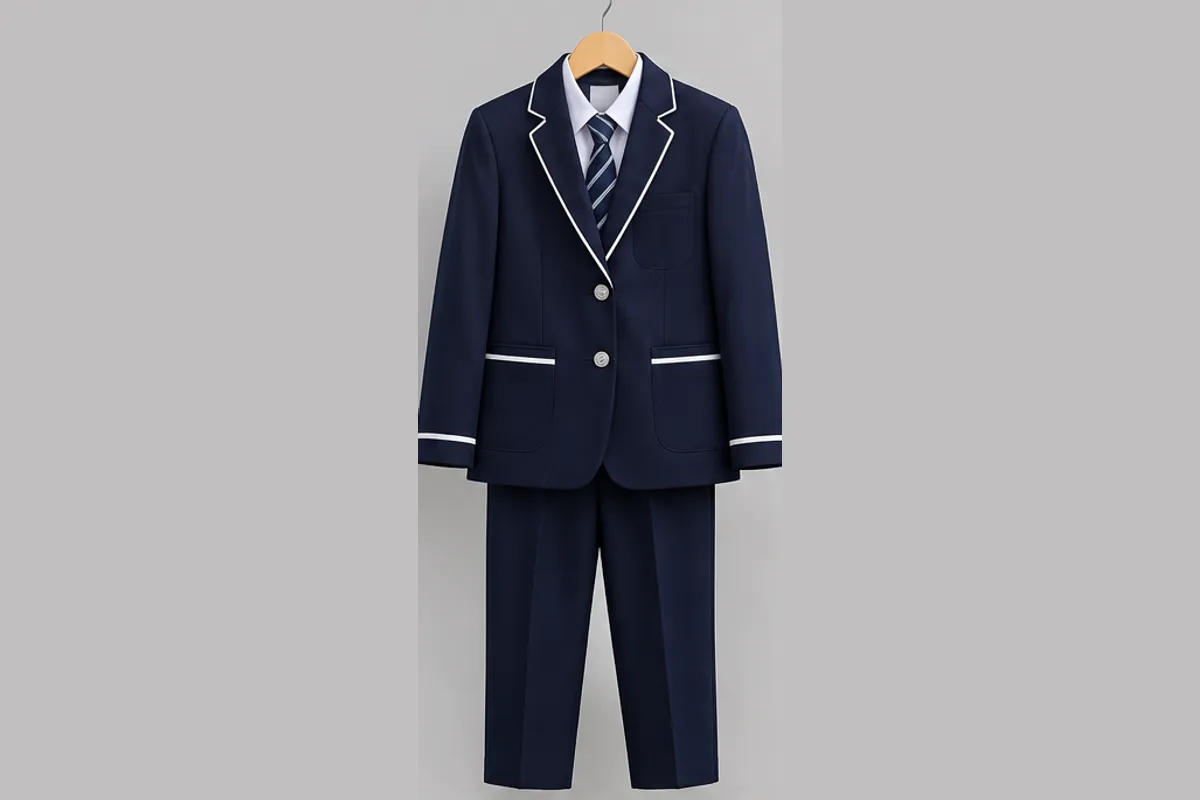
A blazer’s colour can change visibly under different light because the dyes in the cloth reflect daylight, shop lighting and classroom lighting in different ways. Two blazers that match perfectly under one light can look clearly different under another, an effect known as metamerism. The practical answer is to approve a blazer shade by comparing the sample with your reference under at least two light sources, with daylight as the main one.
This matters most when a blazer must sit beside trousers, skirts and knitwear made from different materials. They may match in the shop and clash in the playground.
Metamerism, in plain words
Metamerism is when two colours match under one light but not under another. It happens because different dyes, or the same colour made on different fibres, reflect light differently across the spectrum. Daylight contains a broad, balanced spread of light. Warm indoor lighting has more yellow and red. Some cool lights have more blue. Each one picks out different parts of the dye.
Navy is a classic example: two navies that look identical under warm light can show one as greener or redder in daylight. Greens and maroons can shift too.
Where buyers see the problem
| Situation | What happens | Why |
|---|---|---|
| Blazer approved in an office | Looks different in the playground | Office light differs from daylight |
| Shop rail under warm lights | Customers see a mismatch at home | Home and outdoor light differ |
| Blazer and jumper side by side | Match indoors, differ outdoors | Woven and knitted materials dyed differently |
| Blazer and trousers from different makers | Shade jumps between lights | Different dyes and fibres |
| Repeat order | Looks right in one room only | Dye lot reacts differently to light |
How should you check a blazer shade?
Use a simple routine every time a sample or new batch arrives:
- Look at the sample and the reference together by a window in daylight, away from direct sunlight.
- Look again under the lighting where the blazer will be sold, such as your shop.
- Look a third time under classroom-style lighting, if the school will judge the uniform there.
- Lay the items flat on a neutral grey or white surface, not on a coloured table.
- View from a normal distance, not just up close.
- Note in writing any light under which the colours differ.
If the shade matches in daylight but drifts slightly under shop lights, that is usually acceptable, because daylight is where most people see uniforms together. A mismatch in daylight is a reason to ask for an adjustment.
Matching the blazer with trousers and skirts
The blazer is often the colour anchor for the uniform. Trousers and skirts, in grey, black or a matching colour, are made from different cloths, and they may be dyed at different times. To keep the set looking right:
- approve the blazer shade first, then use it as the reference for bottoms
- view the blazer with a trouser and a skirt together in daylight
- accept a close tone rather than demanding an exact match across fabrics
- keep an unworn piece of the approved blazer as a long-term reference
We match blazer cloth to your reference and send the shade, or a sample blazer, for approval before production. Repeat orders are checked against that approved shade. Our fabrics and colour matching page describes how references and approvals work.
When you are ready to order, send your reference and say under what conditions you will judge the colour. We quote school blazers by fabric, quantity and branding, with the shade confirmed on the sample.
Questions buyers ask
Why does our approved blazer look different in photographs?
Cameras and screens adjust colour automatically, and flash or editing shifts it further. A photograph is not a reliable test of shade. Judge colour on the physical blazer in daylight, and use photographs only for layout and badge position.
Can a blazer shade be matched to a printed colour chart?
A printed chart is a rough guide, but ink on paper does not behave like dye on cloth. A fabric swatch, a garment or a recognised colour-standard reference gives a far more reliable match.
Which light should a school use to sign off the blazer?
Daylight from a window, without direct sun, is the most useful single light. If the uniform committee meets indoors, take the sample to a window before signing it off.